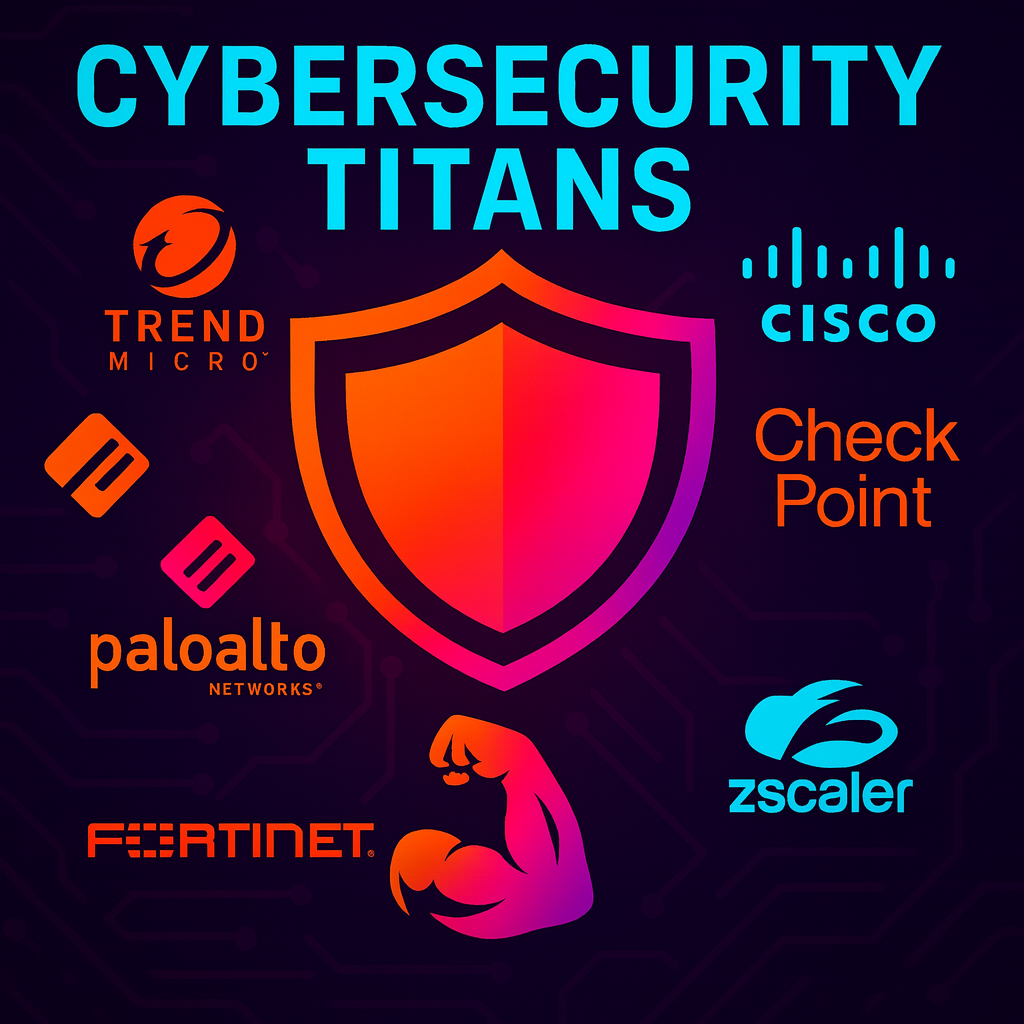
If you want to understand the current state of cybersecurity, you must go back to a time when the field barely existed as an industry of its own. The early 1990s were dominated by simple worms, flat networks and firewalls that were closer to packet-filters than to security platforms. Yet the companies founded in exactly dieser Zeit laid the foundation for a market that today shapes global digital infrastructure. The rise of Palo Alto Networks, Fortinet, Cisco, Check Point, CrowdStrike, Zscaler, SentinelOne and Trend Micro did not happen overnight. It was the result of decades of shifts technical, architectural and cultural.
Check Point is often considered the first true heavyweight. With the introduction of Stateful Inspection, they fundamentally changed how enterprises evaluated traffic. Firewalls suddenly became context-aware gatekeepers. For many organizations, especially banks and government institutions, Check Point was not just a product it was the gold standard. The fact that the brand still holds this position speaks to a level of consistency few companies in tech ever achieve. Around the same time, Cisco was building something different. They weren’t a security vendor in the beginning. They were the backbone of the internet. Routers, switches, interconnectivity—Cisco was the structural layer of everything that moved across the network. As threats evolved, Cisco expanded into security. But unlike others, they integrated it deeply into the network fabric itself. Their advantage was not a single product. Their advantage was the ecosystem. Enterprises trusted Cisco because they trusted the network and Cisco understood the network better than anyone. The early 2000s brought a fundamental shift. Applications became decentralized, internet-facing workloads grew, VPNs exploded and attackers became quieter and more targeted. In this landscape, Palo Alto Networks entered the market and redefined what a firewall could be. Their Next-Generation Firewall was not a slogan—it was a conceptual reset. Policies moved from ports to identities, from protocols to applications. Security teams could suddenly reason about traffic in a human-understandable way. Within a few years, Palo Alto became not just a leader but the defining benchmark for modern perimeter control.
Shortly afterwards, another giant gained momentum: Fortinet. Their strategy was clear, but at the time almost unusual. Instead of focusing on one component, they built an entire platform—from firewalls and switches to wireless, SD-WAN, endpoint and cloud security. Backed by custom ASIC hardware, Fortinet delivered performance at a scale many competitors struggled to match. As consolidation became a must-have, their platform approach suddenly turned into one of the strongest differentiators in the industry. For integrators and global enterprises, Fortinet became a default choice. The next big disruption was caused not by networks, but by the cloud. Remote work, SaaS, identity sprawl and distributed infrastructures made the “castle-and-moat” defense obsolete. Zscaler recognized this before most. They built security as a cloud-native service, long before Zero Trust was a mainstream topic. Their model inverted the logic of classical perimeter defense. Users didn’t connect to networks—they connected to services. To many global organizations, Zscaler became the central point of control in an increasingly borderless world.
Parallel to this, an entirely different revolution unfolded on the endpoint. CrowdStrike realized early that signature-based detection was losing the race against modern attacks. Their cloud-first, telemetry-driven approach marked a turning point. Falcon became more than an endpoint product—it became an analytical engine. SOC teams suddenly had real-time visibility into device behavior, attacker paths and anomalies. It was a new school of endpoint security that pushed the entire market forward. SentinelOne expanded on that momentum with an autonomous, agent-driven model powered by behavioral AI. Where CrowdStrike emphasized detection and intelligence, SentinelOne pushed toward automated containment and machine-driven response. Together, these two vendors reshaped an entire discipline. The endpoint was no longer just the last line of defense—it became a primary intelligence source. To complete the picture, one must mention Trend Micro. A company often underestimated in public perception, but foundational in reality. Trend Micro has been active since the 90s and built its reputation on malware defense, server protection and cloud security. Their relevance in virtualization, email security and hybrid workloads makes them one of the longest-standing global players still driving innovation. At DarkGate, our daily conversations with CTOs, CISOs, Technical Directors and integrators across the world give us a clear picture of how dominant these vendors truly are. Whether you speak with a security lead in Singapore, a financial institution in Switzerland, a manufacturer in the U.S. or a telecom operator in the Middle East—you encounter the same ecosystem. Palo Alto Networks, Fortinet, Cisco, Check Point, CrowdStrike, Zscaler, SentinelOne, Trend Micro. These are not just tools. They are strategic layers. And this is precisely why we built the “IT Vendors” category at DarkGate—and now continue the journey in the Cybersecurity section. Because the influence of these manufacturers is not theoretical. It shapes hiring decisions, defines architectures, drives certifications and impacts entire project portfolios. The candidates that integrators and enterprises seek- architects, engineers, consultants, SOC specialists, platform experts – are nearly always aligned with these ecosystems. Looking at the long arc from the 1990s to today, one pattern stands out. The market evolves in waves. Firewalls. IPS. Endpoint. Cloud. Zero Trust. XDR. AI-driven defense. Each wave produces new leaders, but the companies that manage to ride multiple waves become the Titans. Palo Alto didn’t just build a firewall – they built an entire platform.
Fortinet didn’t just scale performance – they scaled an ecosystem.
Zscaler didn’t just move security to the cloud – they redefined the perimeter.
CrowdStrike and SentinelOne didn’t upgrade the endpoint- they reinvented it. Cisco and Check Point didn’t disappear in the new era – they adapted and endured.
Trend Micro didn’t lose momentum – they expanded into new fields.The next decade will likely continue this pattern. AI-powered detection, identity-centric architectures, distributed cloud meshes, consolidated security platforms. The details may shift. The principles will not.Cybersecurity will remain a market defined by rapid evolution—and by the vendors who have proven that they can evolve with it.