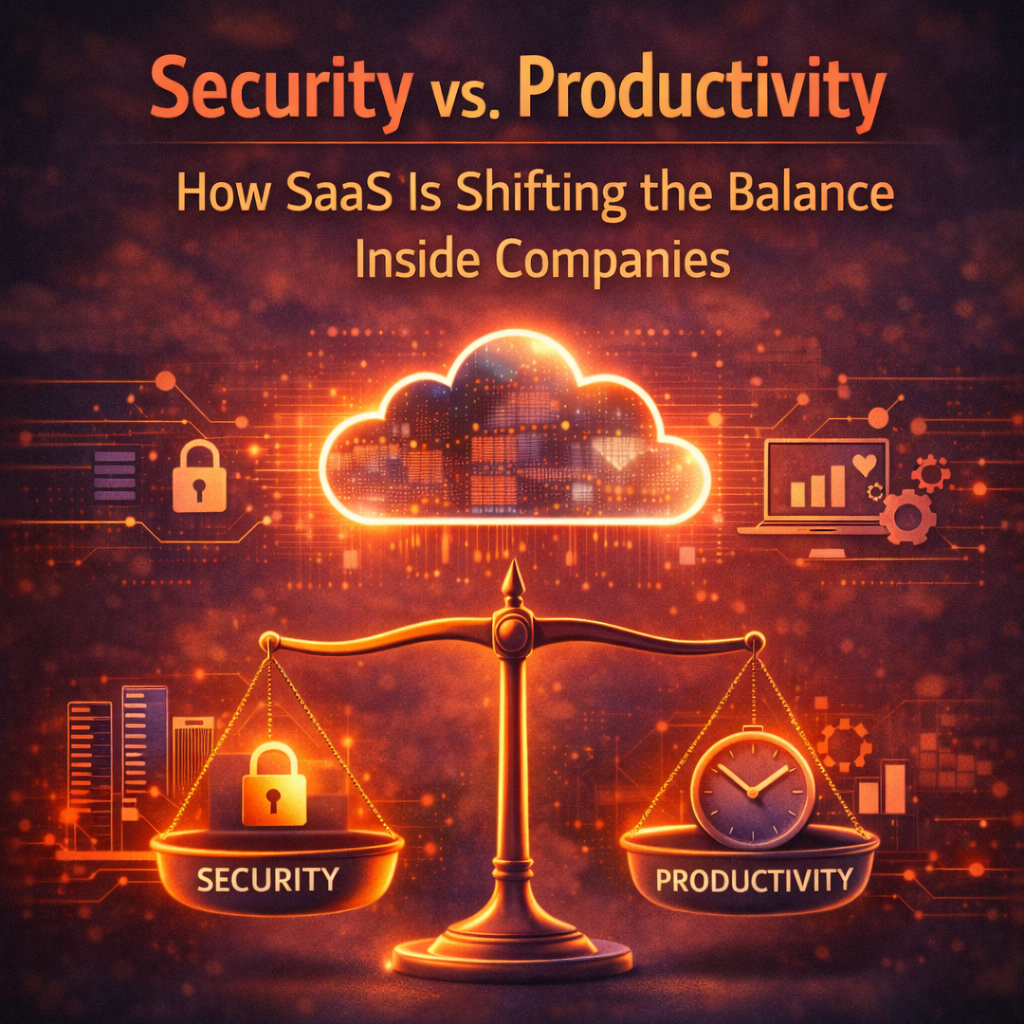
Software as a Service does not only change technologies. It changes the internal dynamics of companies. In many organizations a quiet tension is emerging between business units, IT and security that is rarely named openly but is almost always present. Business teams want speed, flexibility and simple tools. Security wants stability, control and risk reduction. And IT sits right in the middle trying to bring both sides together without slowing the business down or opening new vulnerabilities.
SaaS, Software as a Service, becomes more than a delivery model in this context. It becomes an organizational catalyst. In conversations with companies it becomes clear again and again that the real tension is not technical but cultural. Business teams experience SaaS as liberation. New tools can be activated within minutes, workflows can be adapted quickly, teams become less dependent on central IT processes. For marketing, sales, HR or product teams this feels like progress and in many cases it truly is.From the security perspective the same development looks very different. Every new SaaS application is a new external service, a new data connection, a new potential risk surface. Visibility becomes harder, governance more complex, responsibilities less clear. Security teams therefore experience not acceleration but growing complexity. This is not driven by mistrust toward SaaS vendors but by the challenge of maintaining oversight and responsibility in an increasingly distributed IT landscape.
IT departments are positioned directly between these forces. They are expected to enable innovation, limit risk, control cost and keep operations running smoothly at the same time. In many organizations IT is no longer primarily a technical operator but a mediator between speed and security. IT translates business requirements into controllable solutions and explains to security why certain tools are commercially necessary. This role is demanding but it is becoming central to the success of modern organizations.A Chief Technology Officer at a European IT integrator describes it this way: “Our customers want to move fast. Their markets change constantly and so do their processes. SaaS gives them that flexibility. At the same time they expect us to look closely, assess risks and help them maintain visibility. It is not about blocking tools but about integrating them intelligently.” This mindset now shapes many integration projects. The question is no longer whether SaaS should be used but how it can be used in a way that allows productivity and security to reinforce each other.
In practice tensions mainly arise where governance has not evolved alongside technology. When business teams procure tools without involving IT, shadow IT emerges. When security policies are too rigid, frustration and workarounds appear. When IT only reacts instead of shaping proactively, it loses influence. Companies that manage this well take a different approach. They define clear guardrails instead of rigid rules. They create transparency around which tools are allowed, what requirements they must meet and who is responsible for what. This creates a framework in which teams can operate freely without pushing the organization out of balance.Interestingly many organizations no longer see this tension as a problem but as a signal. It shows that the organization is moving, that processes are being questioned and that digital transformation is happening in daily operations rather than in strategy decks. The tension is not a sign of failure but of change.
At the same time SaaS also reshapes the concept of control itself. Control no longer means owning and operating everything internally. It means understanding dependencies, knowing how data flows and being able to assess risk continuously. Control becomes more strategic and less operational. This requires new skills, new roles and new forms of collaboration.In the end it is not about security versus productivity or control versus speed. It is about balance. Organizations that consciously design this balance use SaaS not only as a technical tool but as a lever for organizational maturity. They build cultures where innovation is possible without being careless and where security is not seen as a blocker but as an enabler.Perhaps this is the most important change SaaS is driving. It forces organizations to rethink responsibility, trust and collaboration. And it shows that real transformation does not happen only in the cloud but in the way people and teams work together.