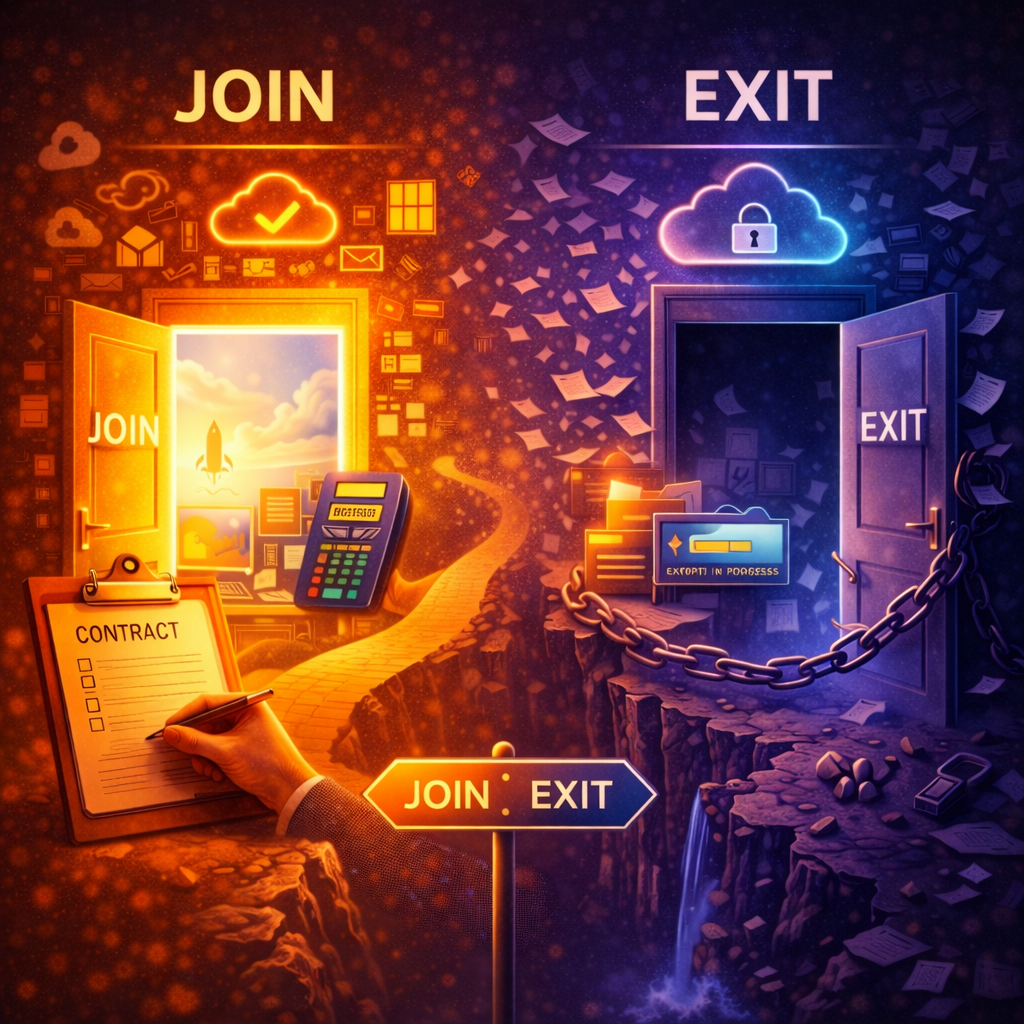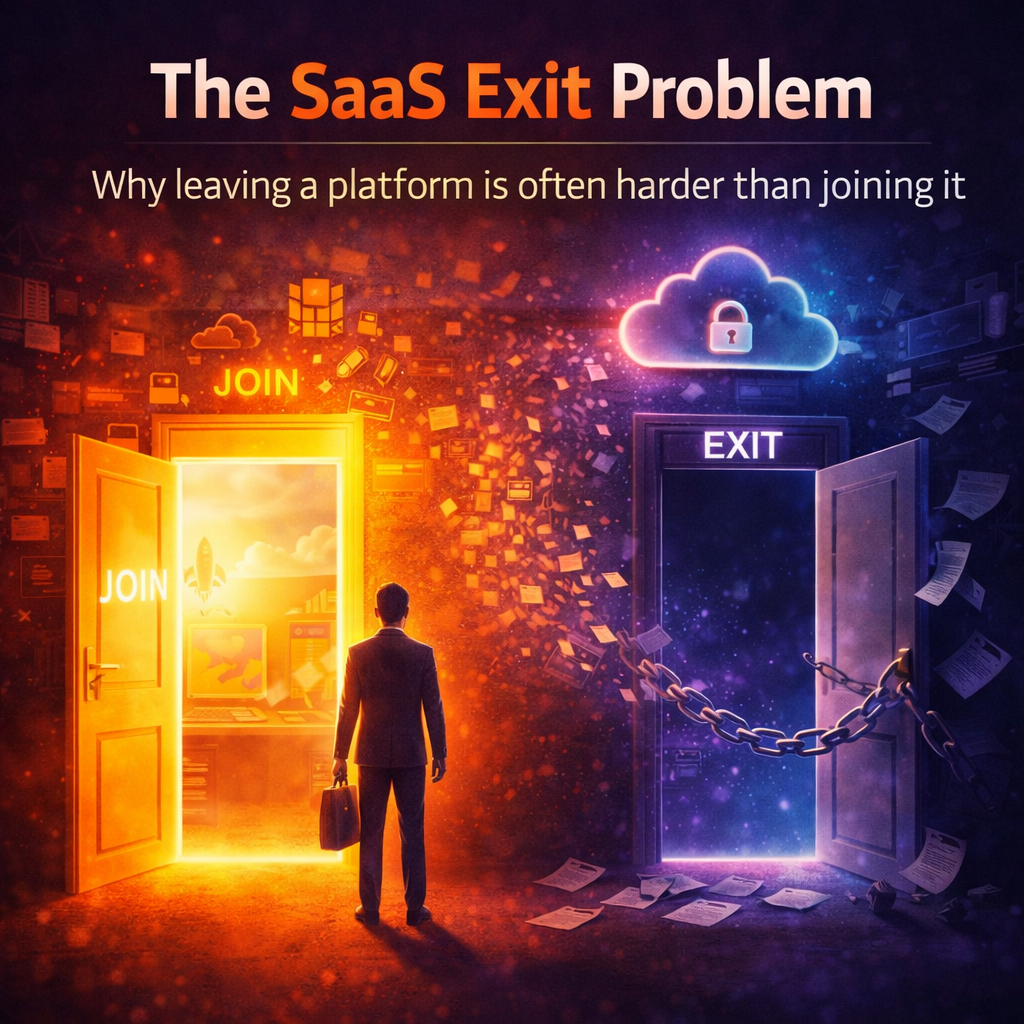
Getting started has never been easier. One click. One contract. One subscription. And suddenly an entire team is working with a new tool. That is one of the great strengths of Software as a Service. No long implementation projects, no hardware, no installations. Instead, instant availability, fast productivity, and the feeling that things are finally moving forward. For many organizations, SaaS feels like liberation. And in many ways, it truly is.Business teams in particular experience SaaS as a powerful enabler. New CRM systems can be launched in hours instead of months. Project management tools are ready immediately. Marketing can start campaigns without waiting for IT approvals. HR can digitize recruiting processes without building their own systems. SaaS dramatically lowers the barrier to digital transformation, and that is exactly why it has been so successful.
But what happens when you want to leave.Not because something went wrong. But because requirements change. Because the company grows. Because markets evolve. Because processes become more complex. Or because another platform fits better than the one you started with. That is where what can quietly be called the SaaS exit problem begins.It is not a problem in the sense of failure. It is a natural consequence of how SaaS works.Because SaaS is not just software. It is structure. Processes. Data models. Habits. Ways of working. And over time, all of that grows together.
Take a CRM or a recruiting system as an example. At the beginning, it is empty. You import contacts, candidates, companies. Then you add fields. Custom categories. Custom statuses. Custom tags. You define what a lead is. What a qualified candidate is. Which skills matter. Which technologies are tracked. Maybe you add fields for certifications, seniority levels, availability, salary ranges, or regions. None of that comes from the system itself.
It comes from the organization.After one or two years, the system is no longer just a tool. It has become a mirror of how the company thinks and works.And that is what makes leaving later more demanding.When you want to migrate, you quickly realize that it is not just about copying data from A to B. It is about transferring meaning. Does the data model of the new system match what you built in the old one. Do the same fields exist. The same categories. The same relationships between objects. Can tags be transferred one to one. Or do they need to be reinterpreted.The same applies to content management systems. A CMS does not just store texts. It stores structures. Categories, taxonomies, links, workflows. Who can publish what. Who reviews content. How versions are handled. How content is distributed. That logic is rarely identical between systems. So migrating is not just about moving content, but about reshaping editorial processes.
Or think about collaboration platforms. They create habits. Where people communicate. What goes through chat. What becomes a ticket. What stays in email. How fast teams respond. How decisions are documented. Those patterns are not stored in databases, but in people’s minds. And that is why they are difficult to migrate.There are also technical aspects. Data formats. Export options.
APIs. Performance limits. Historical data. Logs. Some systems allow full exports, others only partial ones. Some are open by design, others more proprietary. Some provide migration tools, others do not. All of that shapes how easy or hard a transition becomes.The interesting part is that none of this is created with bad intent. Quite the opposite. SaaS vendors optimize their products for use, not for leaving. They invest in user experience, integrations, automation, and ecosystems. They make it attractive to stay because that is exactly what customers value. Continuity. Stability.
Reliability.So the exit problem is not a flaw. It is the price of maturity.The better a system is integrated into an organization, the more valuable it becomes, and the harder it is to replace.In conversations with IT integrators, this pattern appears again and again. One project lead put it this way. Our customers rarely want to leave because something is bad. They want to leave because they have grown. Because they went international.
Because their business models changed. Or because they want to consolidate platforms. The desire to move is often a sign of development, not dissatisfaction.That is why an exit strategy is not about being skeptical. It is about being prepared.Organizations that use SaaS strategically already think about possible exits when they enter. Not because they plan to leave, but because they want to keep the option open.They look at how open data formats are. How well exports work. How flexible data models are. They document customizations. They avoid building too many special solutions that only work inside one platform. They keep their degrees of freedom.At the same time, they deliberately invest in what makes SaaS powerful. Integration. Automation. Ease of use. They understand that dependency is not inherently bad. Dependency is often the cost of efficiency.The difference lies in whether it is chosen consciously or created accidentally.
In the end, the SaaS exit problem is not a risk. It is an invitation to a more mature relationship with technology. It reminds us that every tool we adopt becomes part of our organization. That software is not neutral, but shapes how we work, how we think, and how we decide.And that is also the opportunity. Organizations that treat SaaS not just as software, but as part of their structure, use it not only more efficiently, but more wisely.Leaving does not become trivial. But it becomes understandable. Manageable. Shapeable.And maybe that is the real quality of modern IT. Not that everything can be changed at any time. But that we understand why we use something, and what it means to eventually let it go.