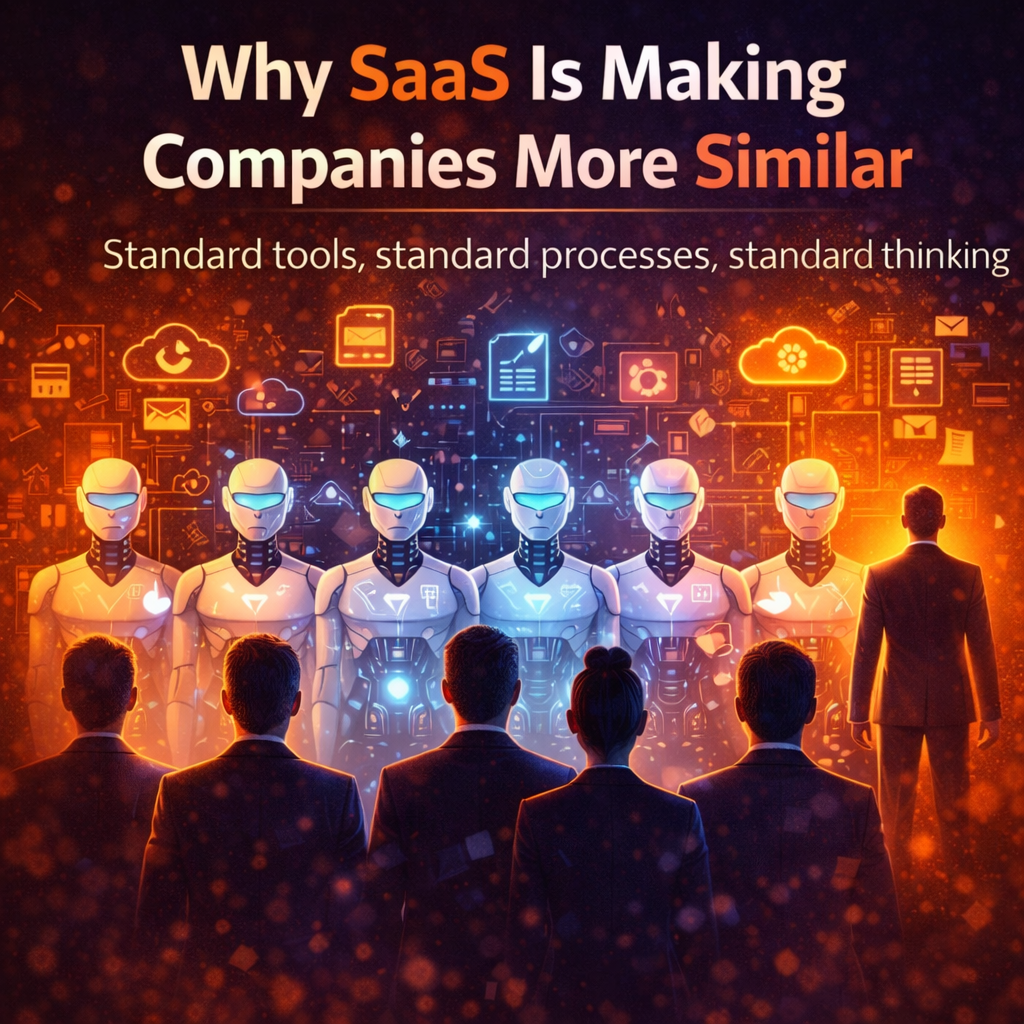
Software as a Service has not only changed technology, it has quietly reshaped company culture as well. Across many organizations, a new form of similarity is emerging. The same tools. The same interfaces. The same workflows. The same mental models. What looks like efficiency on the surface is slowly changing how organizations operate, how decisions are made, and how distinct companies actually feel from one another.This is not a criticism. Quite the opposite. SaaS has made companies faster, more flexible, and more professional. Processes that once took months can now be activated in hours. Teams work with modern interfaces instead of legacy systems built decades ago. Knowledge flows more easily. Collaboration becomes simpler. Yet in many conversations with executives, a new question keeps appearing: if everyone uses the same platforms, do we not also start thinking and working in the same ways?
Interestingly, the IT landscape used to be far more fragmented. In the 1990s and early 2000s, many companies ran highly customized systems. In house software, heavily modified ERP environments, specialized CRM solutions, individually designed databases. Each organization was a small technical universe of its own. That world was inefficient, expensive, and difficult to maintain, but it was also deeply individual. Processes were tailored to specific business models, sometimes even to individual teams or leaders.The rise of large enterprise software providers changed this. SAP, Oracle, Microsoft and others brought structure and stability. Companies began adapting their processes to software instead of adapting software to their processes. That was the first major step toward standardization. SaaS accelerated this trend and at the same time made it accessible. Today even small companies can use the same high quality tools as global enterprises.
The benefits are enormous. Startups look professional much earlier. Mid sized companies suddenly operate with enterprise level capabilities. International scaling becomes realistic. In many of our conversations with Managing Directors and Chief Technology Officers we hear the same message: without SaaS we would not have grown this fast, without SaaS we would not operate this professionally, without SaaS we would not be in these markets.And yet a second development is becoming visible. The more companies rely on the same platforms, the more similar their internal structures become. Recruiting teams use the same applicant tracking systems. Marketing uses the same campaign platforms. Sales uses the same CRM. Product teams collaborate in the same digital workspaces. This creates similar metrics, similar priorities, and similar ideas of what is normal, efficient, or even possible.A CTO of an international software integrator described it like this: in the past we built software to reflect our business. Today we shape our business so that it fits the software. This is not a loss of quality. But it is a shift from individuality toward standardization.
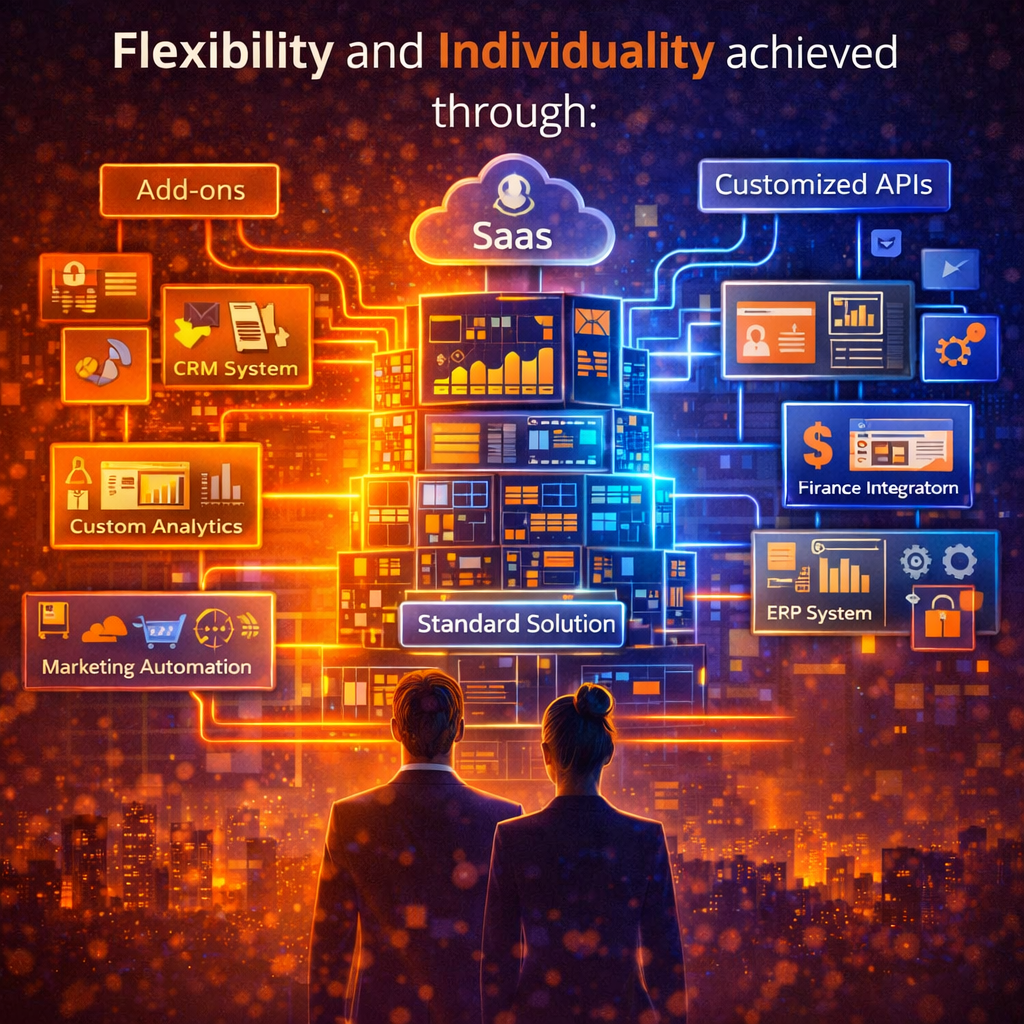
At the same time, a counter movement is emerging. Many SaaS vendors are reacting to this increasing sameness. They recognize that companies do not only want efficiency, but also differentiation. Not only scalability, but also identity. This is why platforms are becoming more modular. APIs, integrations, extensions and add ons allow organizations to create their own combinations of services.Modern CRM ecosystems are a good example. They offer connections to job boards, analytics platforms, marketing automation tools, finance systems and external data sources. Companies no longer build their own software, but they build their own architectures. Individuality no longer happens at the level of code, but at the level of composition.At Darkgate we see this clearly. In our conversations with clients and technology partners we observe two parallel forces. One is the desire for stability, standardization and security. The other is the desire to remain distinctive. Employer branding, candidate experience, customer journeys, and internal culture should not feel identical to competitors even if the technical foundation is similar.
A Managing Director of a European software company once told us: SaaS has made us faster. But differentiation does not come from tools, it comes from decisions. The tools are the framework. What we build inside that framework is still our responsibility.That may be the central point. SaaS does not automatically make companies identical. It makes them comparable. The infrastructure becomes more uniform, but the strategic choices built on top of it remain diverse. That is where the new competitive advantage emerges.
Standardized platforms free companies from technical complexity and shift attention to more fundamental questions. What kind of organization do we want to be. How do we want to treat customers. How do we attract and develop talent. How do we foster innovation. When everyone has access to the same tools, the tools stop being the differentiator. Culture, clarity, and intent take that role.This is a subtle but powerful change. SaaS standardizes infrastructure, but it forces differentiation to move elsewhere. From technology to mindset. From systems to values. From tools to people.
Perhaps SaaS does not make companies more similar. Perhaps it simply makes them more transparent in how they differ. The platforms provide the stage, but the performance is still created by the organization itself.And that is what we consistently observe at Darkgate. The most compelling companies are not the ones with the most exotic tools, but the ones with the clearest sense of who they want to be. SaaS gives them reach. Direction still comes from within.