
For many people, TikTok is still primarily associated with reach, creativity, influencer momentum, and fast moving attention. That is exactly what makes the recent phishing case involving TikTok for Business so interesting. At first glance, it looks like a familiar pattern. Fake login pages, stolen credentials, hijacked session cookies, and the bypassing of two factor authentication. All of that has appeared in previous campaigns. But the real point runs deeper. When attackers target business accounts on platforms like TikTok today, they are not simply stealing access. They are effectively taking control of a digital distribution channel, an advertising surface, and with that, a layer of trust that is normally built through brand presence, budget, and visibility.
TikTok for Business is particularly attractive for exactly that reason. Anyone who gains access to such an account does not just inherit an administrative dashboard. They may also gain access to advertising campaigns, audience data, payment details, business identities, and an infrastructure capable of spreading content quickly and at scale. From an attacker’s perspective, that is a highly valuable asset. A compromised business account can be abused for malvertising, fraudulent campaigns, the distribution of harmful content, or the misuse of a legitimate brand presence. That is why the meaning of these phishing attacks has changed. It is no longer just about losing a single account. It is about the takeover of a credible communication and advertising platform.
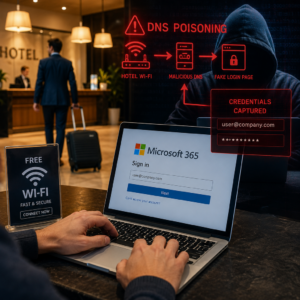
The current case makes that very clear. The attackers are not relying on crude, instantly recognizable fake pages. They are using staged redirects, cloud infrastructure, bot evasion, and a flow designed to frustrate automated security analysis. This is not an improvised mass phishing attempt. It is a carefully built attack chain. It becomes especially dangerous when not only credentials but also session cookies are stolen. At that point, it is no longer enough to simply trust two factor authentication. If the session itself is hijacked, an account can be taken over even when the login process is technically protected by an additional factor. That is where it becomes obvious how professional these campaigns have become. They are no longer aimed only at careless users. They are designed for the operational reality of modern business authentication.
TikTok is only the current example. The underlying problem is much larger. Advertising platforms, business dashboards, and social media admin environments are increasingly becoming highly attractive targets because they combine reach, monetization, and credibility. In the past, phishing often focused on direct financial gain. Today, the logic is broader. A compromised business account can be used not only for immediate fraud, but also for distributing harmful campaigns under the cover of legitimate communication. Strategically, that is far more valuable than a single stolen user login, because the attacker is not just exploiting one victim. They are hijacking an existing trust relationship at the same time.
That is especially explosive in TikTok’s ecosystem because the platform runs on speed. Content spreads fast, advertising mechanisms scale quickly, and the perception of authenticity is high. A business account that appears to be operating normally has a very different effect from an anonymous scam page. It carries an air of legitimacy by default. That is exactly why business accounts have become so valuable. They are not just an entry point. They are a multiplier. Whoever controls such an account can buy reach, target audiences, and push harmful content under conditions that may not appear suspicious to users at first glance.
There is also a second dimension that is often underestimated. Many business users do not log into a platform like TikTok in isolation, but through single sign on workflows, often using Google. What feels convenient can become the start of a chain reaction during an attack. If threat actors intercept a login flow through a reverse proxy phishing page and compromise both the business account and the linked SSO session, then this is no longer just a TikTok issue. It creates the risk that several connected systems are affected at once. That is where it becomes clear that modern attacks are no longer targeting one platform alone. They are targeting identity chains. The problem is therefore not just social media security. It is identity security, session security, and platform governance combined.
For DarkGate, that is where the strongest journalistic angle begins. The story is not simply that TikTok Business accounts are being targeted in a new phishing campaign. The real story is that digital advertising and communication platforms are increasingly becoming part of the attack economy. They are no longer just neutral tools for marketing and reach. They are turning into attack surfaces in their own right. Whoever gains access to such an account can do far more than misuse advertising tools. They can hijack credibility, damage brands, pull users into fraudulent campaigns, and potentially connect malware, scam offers, or cryptocurrency fraud to the legitimacy of a real business environment.
That also reveals a structural problem for many organizations. Social media security is still often treated as a secondary issue. Companies protect email, endpoints, cloud workloads, and identity providers, while advertising and content systems are handled more like side channels. Responsibilities are often fragmented across marketing teams, agencies, social media managers, and external partners. That distributed ownership is exactly what makes business accounts so vulnerable. Where multiple parties have access, where campaigns move under time pressure, and where login habits are optimized for convenience, the likelihood rises that a sophisticated phishing chain will succeed. The technical sophistication of the attacker meets organizational friction on the defender side. That is a dangerous combination.
At the same time, the case shows that traditional security assumptions are increasingly no longer enough. Two factor authentication remains important, but it is not a cure all if session hijacking is possible. Well known platforms remain professionally operated, but their users are still highly vulnerable. Cloud infrastructure remains legitimate, but it can also be used as cover for malicious campaigns. It is exactly this blending of legitimate infrastructure and abusive use that makes modern phishing campaigns so effective. The target does not see a primitive fake domain from some obviously shady corner of the Internet. Instead, they see a chain of technically credible steps. That increases trust and lowers natural skepticism.
The broader lesson from TikTok for Business is therefore not just operational, but strategic. Companies need to understand that business accounts on advertising and social platforms now require the same level of protection as other business critical systems. They are no longer a minor marketing concern. When one of them is compromised, the organization does not just lose access. It may lose a public trust surface. And in the digital economy, that trust surface is often more valuable than the technical account itself. It can be converted into money, reach, fraud, malicious campaigns, and manipulation.
That is why the article should begin with TikTok, but not end there. TikTok is the vivid example. The real issue is the growing professionalization of phishing campaigns aimed at business platforms and the fact that advertising accounts, social dashboards, and SSO linked corporate access points are becoming a new class of high value target. The old logic of phishing was to collect as many credentials as possible. The new logic is more refined. It targets systems that combine trust, reach, and operational leverage. That is why what looks like a narrow TikTok story suddenly becomes much larger. It is not just an attack on social media. It is an attack on digital visibility itself.
If companies continue to underestimate that shift, they will keep reading these incidents as isolated platform problems. In reality, they show how profoundly the threat landscape has changed. Attackers are no longer looking only for access. They are looking for leverage. And business accounts on platforms like TikTok provide exactly that leverage in a form that is scalable, credible, and operationally useful almost immediately. That is what makes them so valuable, and so dangerous, at the same time.