
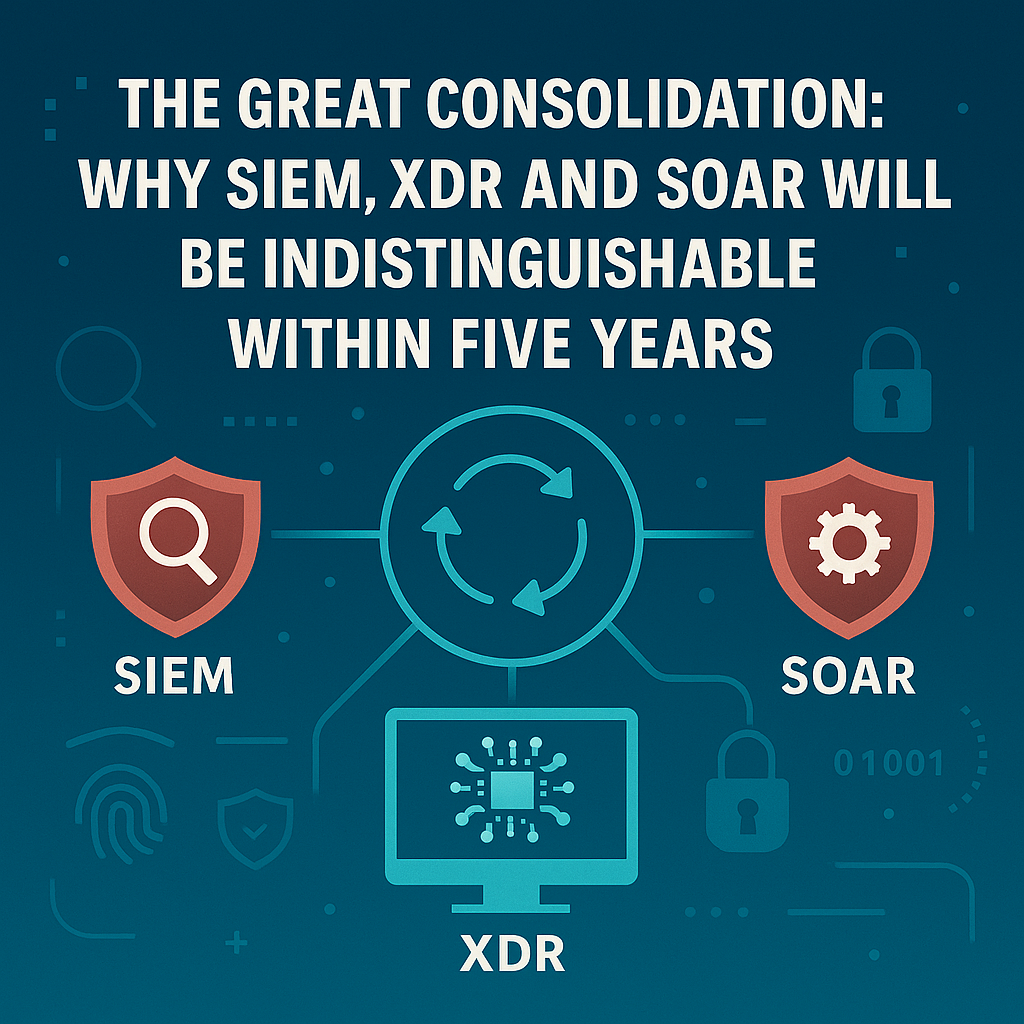
The evolution of modern cybersecurity has always been a story of specialization and at the same time, a story of convergence. For years, each security discipline developed its own ecosystem: SIEM for collecting and analyzing log data, SOAR for orchestrating and automating responses, and XDR for unifying visibility across endpoints, networks, identities, and cloud environments. Today, however, we are witnessing a moment where the boundaries between these categories are dissolving. Technologies that were once clearly separated are beginning to merge into a unified operational fabric.
This shift is not accidental, nor is it driven by short-term trends. It is the natural response to the complexity of today’s IT environments. Organizations operate hybrid infrastructures, multi-cloud ecosystems, distributed identity models, and globally connected workforces. This generates telemetry on a scale that was unthinkable just a decade ago log data, behavioral signals, identity flows, API interactions, network events, and cloud metadata. The modern SOC needs to analyze these signals quickly, consistently, and in the correct context. Consolidation is the architecture that enables this.What we see emerging now is a new class of platforms designed not to solve a single security problem, but to bring all core SOC capabilities together into one modular, cohesive ecosystem. The term “detection fabric” captures this development well: instead of separate tools stitched together, the SOC is evolving into a unified analytical layer that ingests, normalizes, correlates, and prioritizes signals across all domains. This is not about replacing existing technologies it is about combining their strengths within a shared architecture.
For years, SIEM served as the analytical backbone of security operations. It was designed to collect logs, normalize events, and correlate signals based on defined rules. As environments grew, however, organizations realized that logs alone could not capture the full picture. A log might tell you what happened, but an endpoint signal reveals how it happened and an identity context provides insight into who was involved. These complementary layers have become essential to understanding modern attacks. This is where XDR expanded the landscape. XDR does not simply aggregate data; it connects the relationships between signals. It recognizes which identity is interacting with which device, through which API, at what time, and from which geolocation. It detects subtle anomalies that arise only through multi-layered context. This relational visibility is what made XDR so transformative for SOC teams. SOAR contributed yet another critical dimension: automation. In a world where analysts may receive hundreds of alerts per day, automation is no longer optional it is an operational necessity. Yet automation can only be trusted when the underlying data is accurate and the prioritization engine is consistent. SOAR has therefore evolved from a standalone orchestration tool into a natural extension of the detection pipeline, helping teams respond to insights derived from combined analytics. These three areas are no longer separable. A SIEM without automation is too slow. An XDR without log depth is incomplete. A SOAR without contextual intelligence cannot make reliable decisions. Organizations increasingly seek platforms that bring these capabilities together, not as isolated components, but as a unified strategy: data collection, correlation, context, and automated action working in harmony.
This consolidation is also driven by practical considerations. SOC leaders around the world frequently highlight that their biggest challenge is not a lack of tools, but the complexity created by tools. Every additional system requires integration, training, maintenance, and alignment. Every extra interface splits attention. Unified platforms reduce friction and improve clarity. Analysts can work in a single environment where visibility, prioritization, and response feel naturally connected.Importantly, this trend is not about replacing legacy technologies it is about evolving them. Modern platforms are not monolithic. They are modular ecosystems in which customers can enable or disable capabilities depending on their maturity, environment, and goals. A single platform may offer log analytics, threat detection, identity enrichment, behavioral analytics, endpoint visibility, and automated incident handling all stitched together through a consistent data model. This flexibility is one of the main reasons why these unified systems create such strong trust among security leaders.
Artificial intelligence plays a significant role in accelerating this consolidation. AI thrives on context. The broader and richer the telemetry, the more accurate and meaningful the insights. Platforms that unify SIEM, XDR, and SOAR provide AI with exactly the type of cohesive dataset it needs to understand patterns, detect anomalies, and support decision-making. The result is not only faster analysis, but also a level of precision that would be difficult to achieve in isolated systems. The future of the SOC will not be defined by individual products, but by interconnected platform architectures an ecosystem in which data, analytics, context, and automation are seamlessly aligned. This helps analysts make well-informed decisions, identify risks earlier, and orchestrate responses with confidence and clarity. It is not a disruptive or negative shift, but a natural, trust-driven evolution of tools that have proven their value over many years.The great consolidation is not the end of SIEM, XDR, or SOAR it is their maturing convergence. It represents a unified operational fabric that supports security teams, reduces complexity, and strengthens the analytical backbone of global enterprises. As threats evolve, so too will this integrated model, bringing together the best of all disciplines into a single, adaptive, and intelligent security architecture.





