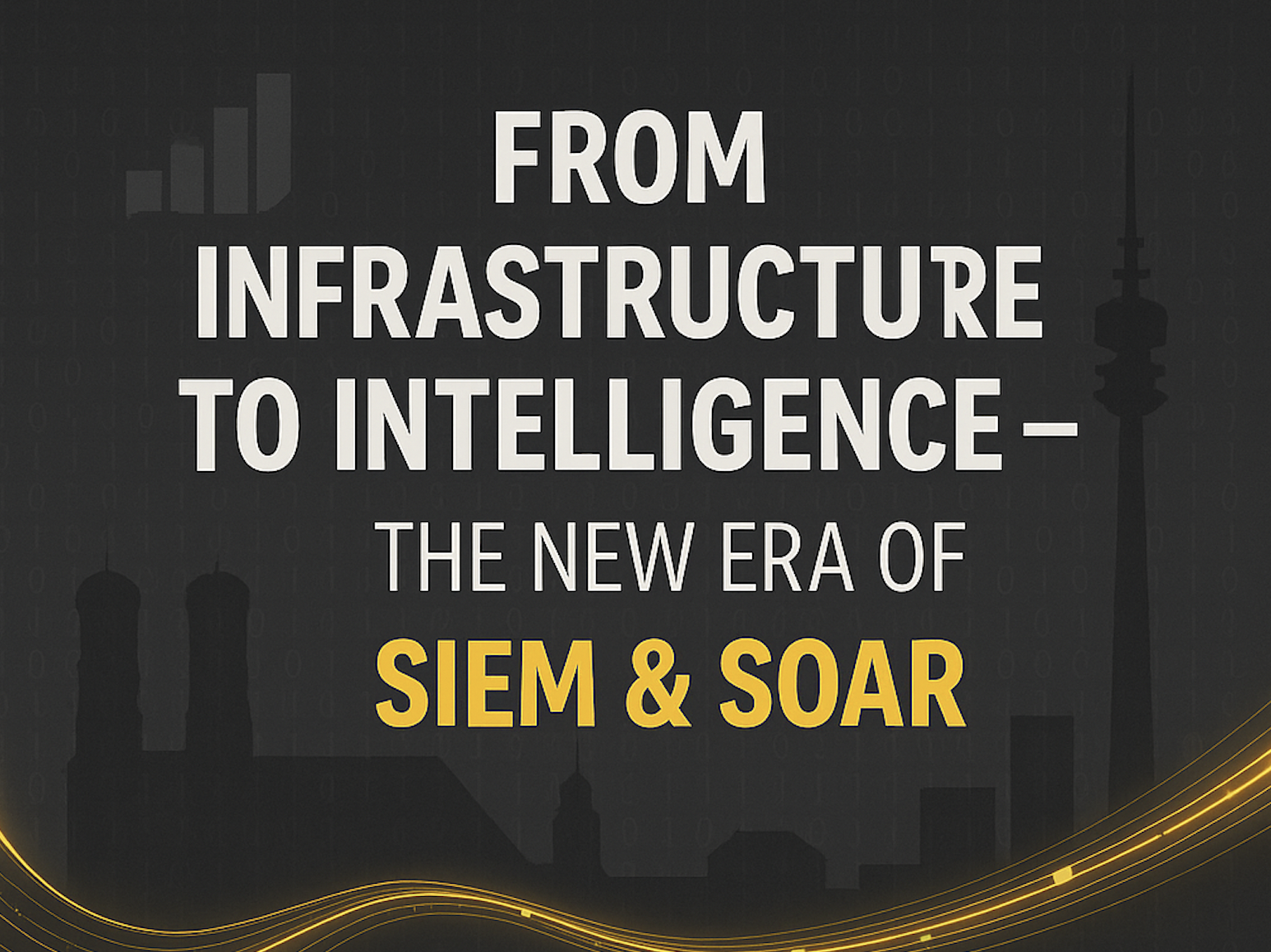
IT infrastructures once seemed predictably stable: routers connected, firewalls blocked, systems ran. But that era of control is over. Networks now evolve in real time, threats emerge and vanish in seconds, and data has become the decisive ingredient for both security and efficiency. The classic infrastructure business – dominated by hardware, maintenance, and uptime – has given way to a new logic: data-driven, correlating, orchestrating. The shift started quietly with the rise of Security Information and Event Management systems (SIEM). For the first time, organizations began bringing order to the data chaos: logs, events, anomalies all converged in one place. Suddenly, it wasn’t just about what device reported what, but about how events related. Security became intelligence.
Then orchestration and automation entered the stage. SOAR (Security Orchestration, Automation and Response) linked events to actions, alerts to playbooks, reactions to machine-driven logic. Administrators no longer simply responded – systems did. The move from reactive to correlating operations wasn’t a technological gamble; it was inevitable.
According to IDC, more than 60% of large enterprises in Europe now invest more in analytics and automation platforms than in classic infrastructure. Data is no longer a by-product- it’s the raw material. Real advantage accrues to those who can correlate in real time: spotting, reacting, planning faster than before.Manufacturers like Splunk, IBM, Palo Alto Networks and Rapid7 recognized this shift early. They no longer sell tools – they sell decision engines. “We’re not building features anymore – we’re building reactions,” an industry insider noted. Today’s IT environment isn’t a fixed system – it’s a learning ecosystem. This transformation isn’t happening in labs alone – it’s live in the field. Darkgate Magazine follows the change from up close. The team behind the magazine operates one of Europe’s leading IT recruiting agencies, with hubs in Germany, Ireland and beyond. We’ve worked numerous projects with top IT integrators, especially in the Munich region where Splunk plays a leading role – both in account management and in professional services.
In one of these projects, a Munich-based integrator with elite Splunk partner status demonstrates how monitoring has evolved. It’s no longer reactive support – it’s continuous insight. Every log, every event is captured, correlated, acted upon. Splunk is not just a tool – it’s the backbone of strategy. In our recruitment projects we are seeing fewer hardware specialists and more data interpreters: security engineers who craft dashboards and deduce business decisions from telemetry. Splunk and its peers are now platforms where enterprise intelligence is built. The shift is spreading across Europe: Munich, Dublin, Zurich and Amsterdam are quickly becoming centres of integration, analytics and security architecture. Security is not layered – it’s woven. Data streams converge; events correlate; risks prioritise. Systems don’t just work for people – they work with them.
Of course, this new era brings new responsibilities. When systems decide, who audits them? When algorithms prioritise, who weighs the variables? The future of IT intelligence demands trust – in algorithms, in processes, in partners. But those who embrace it gain speed, depth and precision. What once was infrastructure is now a neural net of data relationships. Every alert belongs to a context. Every correlation is a clue to a system that thinks. SIEM, SOAR and observability are not just technologies – they are the language of a new generation of IT. Perhaps the future of digital security begins not in the server room but in the weave of data, decisions and trust. Between event and meaning. Between analysis and action. Between infrastructure and intelligence.