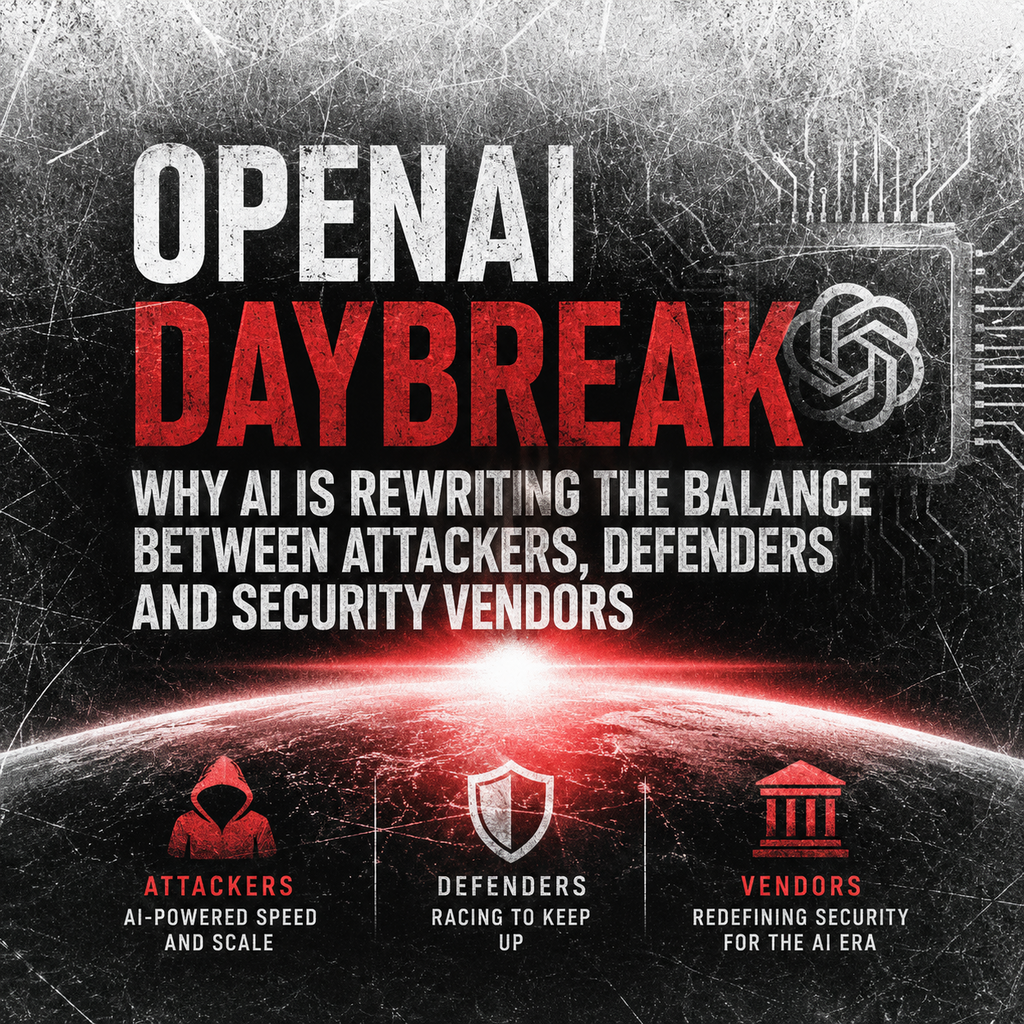
With Daybreak, OpenAI has officially launched a new cybersecurity initiative that is far more than just another AI assistant for developers. The real message behind it is much bigger: artificial intelligence is actively changing the entire balance of power between attackers, defenders, and security vendors. That is where the real story begins.
Daybreak combines GPT-5.5, Codex Security, and a controlled Trusted Access model for defensive cybersecurity work. The goal is not to detect vulnerabilities after attackers have already found them, but much earlier, directly inside the development lifecycle. Secure code review, threat modeling, dependency risk analysis, patch validation, and concrete remediation guidance are meant to happen before production, not only later inside the SOC. Major players such as Cisco, Cloudflare, CrowdStrike, Fortinet, Palo Alto Networks, and Zscaler are already integrating these capabilities.
At first glance, this sounds like a standard product announcement. AI helps developers find bugs faster. That is true, but it is not the real core of the story. The real shift is that AI-powered discovery is now scaling much faster than human remediation. Finding vulnerabilities is becoming cheaper, faster, and massively scalable. Fixing them remains expensive, slow, and organizationally messy.
In the past, security researchers often needed weeks or months to identify complex vulnerabilities, validate them properly, and turn them into a real exploit path. Today, large language models are accelerating that process dramatically. What once required deep specialization and significant manual effort is increasingly becoming a compressed workflow. Patch diffs are analyzed faster, plausible exploit chains are built faster, and multiple independent researchers often discover the same weakness almost at the same time.
This is exactly why the classic 90-day disclosure model is coming under serious pressure. When ten unrelated researchers can find the same bug within a few weeks, and AI can turn a patch diff into a working exploit in a very short time, the traditional disclosure window starts losing its protective value. The new reality is no longer disclosure management. It is time compression. Speed becomes the real security currency.
For companies, this creates a dangerous paradox. More visibility does not automatically mean more security. Many security teams today are not suffering from too little detection, but from too much of it. Too many alerts, too many findings, too many reports, and too many responsibilities without clear ownership. The result is triage fatigue. Maintainers and security teams spend more time sorting through plausible reports than actually fixing real risk. Some reports are legitimate. Others are nothing more than convincing hallucinations generated by AI systems.
This is exactly where Daybreak fits strategically. It is not simply a vulnerability detection tool. It is an indirect admission that the classic SOC-centered security model no longer scales. Security does not begin in incident response. It begins much earlier, inside the software lifecycle itself. If your SIEM is the first place where critical risk becomes visible, you are often already too late.
For security vendors, this represents a fundamental market shift. For years, visibility was the product being sold. More dashboards, more telemetry, more detection layers. But customers are increasingly realizing that additional visibility alone does not create ownership. Nobody patches a critical vulnerability just because one more alert was generated. The operational reality is much harsher: security rarely fails because of missing tools. It fails because of unclear responsibility, weak prioritization, and limited patch capacity.
That is why OpenAI Daybreak is also a signal to the broader market. The future of cybersecurity will not be defined only by better detection engines, but by AI-driven decision support directly where software is built. Security becomes part of development, procurement, and architecture decisions, rather than being treated as an isolated problem for the Security Operations Center.
For platforms like Darkgate, this is the layer that actually matters. Not the product announcement itself, but the market shift behind it. OpenAI is not simply launching another cybersecurity tool. It is showing that the industry is starting to accept a harder truth: detection alone no longer solves the problem.
The real crisis is not finding vulnerabilities.
The real crisis is ownership.
And that is where 2026 will decide who is defending and who is merely documenting failure.