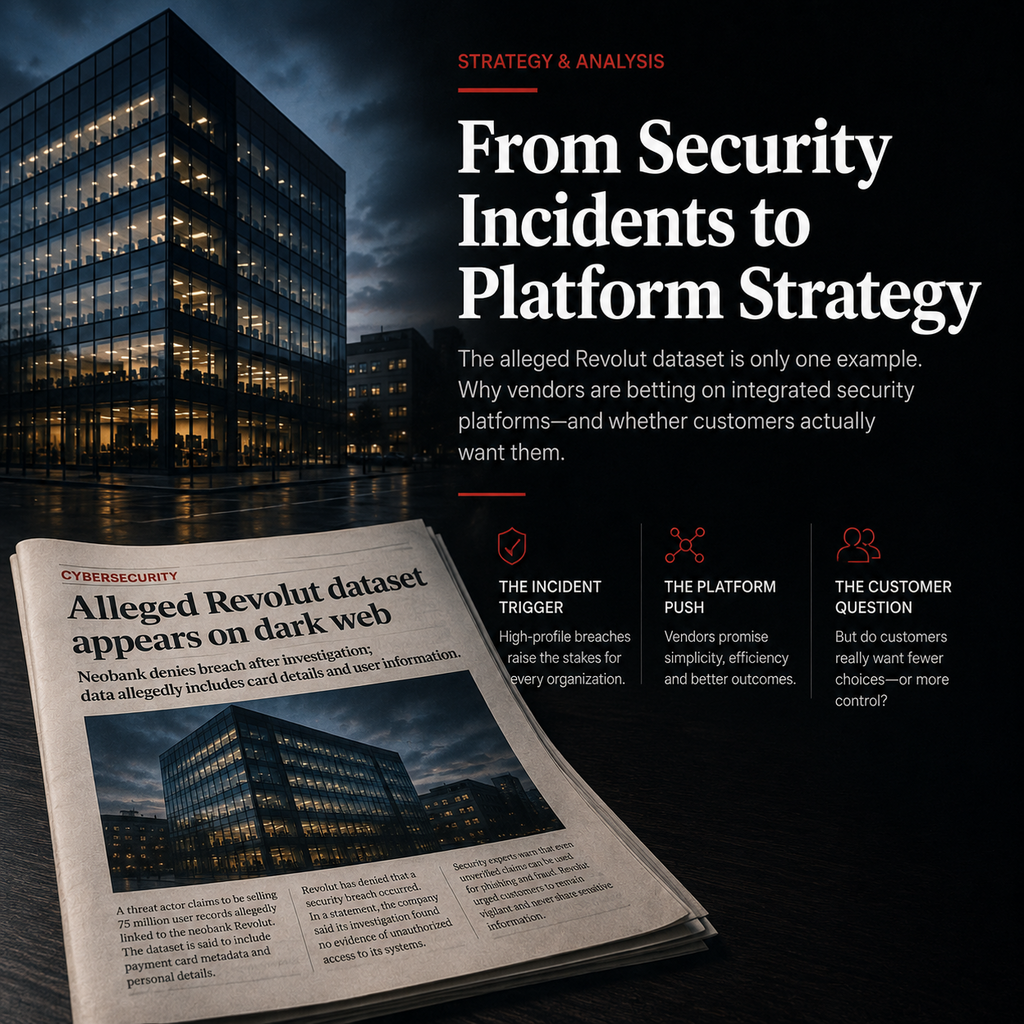
The recent reports surrounding an alleged database containing 75 million Revolut records once again demonstrate how quickly cybersecurity headlines can spread across the global technology industry. After a threat actor advertised what was claimed to be a large Revolut dataset on a dark web forum, numerous media outlets reported on the alleged breach. Within hours, however, Revolut stated that its internal investigation had found no evidence of a successful compromise. According to the company, the identifiers contained in the published sample did not match legitimate Revolut customer or card information, leading investigators to conclude that the dataset was most likely a compilation of older information or even partially fabricated records rather than evidence of a new security incident.
Whether this particular case ultimately proves to be entirely fabricated or simply a collection of historical data is almost secondary. More important is what it reveals about today’s cybersecurity landscape. Organizations are increasingly expected to assess alleged breaches, verify technical evidence, communicate transparently with customers and distinguish genuine incidents from misinformation, recycled data and online speculation – often within just a few hours.
This growing complexity has become one of the defining challenges of modern cybersecurity.
Over the past decade, enterprise security has evolved into an increasingly specialized discipline. Organizations have invested in dedicated solutions for endpoint protection, identity management, email security, cloud security, vulnerability management, threat intelligence, SIEM, SOAR, network security and numerous other domains. While this best-of-breed approach often delivered strong technical capabilities, it also introduced significant operational complexity. Security teams now manage dozens of products, hundreds of integrations and growing volumes of alerts generated by disconnected platforms.
Against this backdrop, nearly every major cybersecurity vendor is promoting a remarkably similar vision: platform consolidation.
Terms such as XDR, SASE, CNAPP, Security Cloud, Unified Security Platform and AI-driven Security Operations have become central elements of vendor messaging. The underlying promise is straightforward: fewer management consoles, fewer integrations, centralized visibility and increased automation should reduce operational complexity while improving security outcomes.
The more interesting question, however, is not whether platform consolidation offers technical advantages. It is whether this transformation is primarily being driven by customer demand or by vendor strategy.
Many cybersecurity CEOs argue that complexity itself has become one of the industry’s greatest security risks. Modern enterprises often operate dozens of overlapping security products, creating fragmented visibility and slower incident response. From this perspective, platform consolidation is presented as a logical evolution rather than simply another product strategy.
Chief Technology Officers generally acknowledge that enterprise environments have become considerably more difficult to operate. Hybrid cloud architectures, remote work, identity-centric security models and expanding regulatory requirements have significantly increased operational demands. Integrated platforms may simplify administration, provided they can coexist with existing technologies and business processes.
Senior Security Architects often offer a more cautious assessment. Very few large enterprises operate homogeneous IT environments. Years of acquisitions, legacy infrastructure, regulatory obligations and specialized business applications have created ecosystems where technologies from multiple vendors coexist. As a result, interoperability remains a fundamental architectural requirement regardless of how comprehensive any individual platform may become.
Security consultants report a similar shift in customer conversations. Organizations increasingly spend less time comparing individual firewall or endpoint products and more time discussing long-term architecture, governance, integration strategies and operational resilience. Security purchasing decisions are becoming broader business discussions rather than isolated technology evaluations.
At the same time, it remains unclear whether customers are actively requesting platform consolidation to the same extent that vendors are promoting it. Many organizations continue to focus primarily on solving immediate operational challenges rather than reducing the number of technology suppliers. Existing contracts, migration risks, regulatory obligations and budget constraints frequently influence purchasing decisions as much as technical considerations.
For systems integrators, the trend creates both opportunities and new challenges. Platform adoption often generates demand for architecture consulting, migration planning, governance frameworks and managed services. At the same time, projects become more complex. Presales activities increasingly involve executive workshops, proof-of-concept environments, architectural assessments and business case development instead of straightforward product demonstrations.
This naturally raises another question: does implementation complexity increase faster than profitability?
Several industry observers suggest that while platform projects often generate larger contract values, they also require significantly greater investment in consulting resources, solution architecture, certifications and ongoing customer support. Larger projects do not necessarily translate into higher margins if delivery effort continues to expand at an even faster pace.
The discussion also affects vendor partner ecosystems. Certification programs increasingly reward broad architectural expertise rather than deep knowledge of individual products. Larger consulting firms may be better positioned to absorb these investments, while smaller regional system integrators could face growing pressure if certification requirements and training costs continue to rise.
Recruitment trends appear to reflect this evolution as well. Demand remains strong for technical specialists, but employers increasingly seek Security Architects, Cloud Security Architects, Platform Consultants and Integration Specialists capable of designing security across multiple domains rather than focusing exclusively on individual technologies.
Managed services may also benefit from this shift. As security platforms become broader and more integrated, many organizations may decide that operating these environments internally is no longer the most efficient approach. Instead, they may increasingly rely on managed security service providers to deliver continuous monitoring, optimization and operational support.
Another recurring topic is vendor dependency. Consolidating multiple security capabilities within a single ecosystem may simplify operations, but it can also increase reliance on one strategic supplier. Some organizations consider this an acceptable trade-off in exchange for operational efficiency, while others deliberately maintain multi-vendor strategies to reduce commercial and technological risk.
Regional differences may further shape adoption. Industry participants often describe organizations in the UK and the Netherlands as somewhat more willing to adopt new platform strategies, whereas many companies across Germany, Austria and Switzerland continue to emphasize investment security, measurable return on investment and incremental modernization. These are broad tendencies rather than universal rules, but they illustrate that purchasing behavior is influenced not only by technology, but also by business culture and economic priorities.
Current economic conditions add another layer to the discussion. Although vendors frequently position consolidation as a way to reduce operational costs, many organizations remain cautious about large transformation projects. Decision-makers increasingly expect detailed business cases covering migration effort, licensing models, integration costs and long-term operational impact before committing to strategic platform initiatives.
Ultimately, the Revolut story illustrates something that extends far beyond a single alleged breach. Not every cybersecurity headline proves to represent a genuine security incident. At the same time, organizations face growing pressure to investigate, verify and communicate potential incidents with increasing speed and transparency. That expanding operational complexity – rather than any individual event—may ultimately explain why platform consolidation has become one of the cybersecurity industry’s most prominent strategic themes.
Whether it represents a lasting transformation of enterprise security or primarily reflects the current direction of vendor strategy remains an open question. The answer will likely depend less on marketing narratives and more on whether organizations can achieve measurable operational improvements, sustainable economics and long-term architectural flexibility.