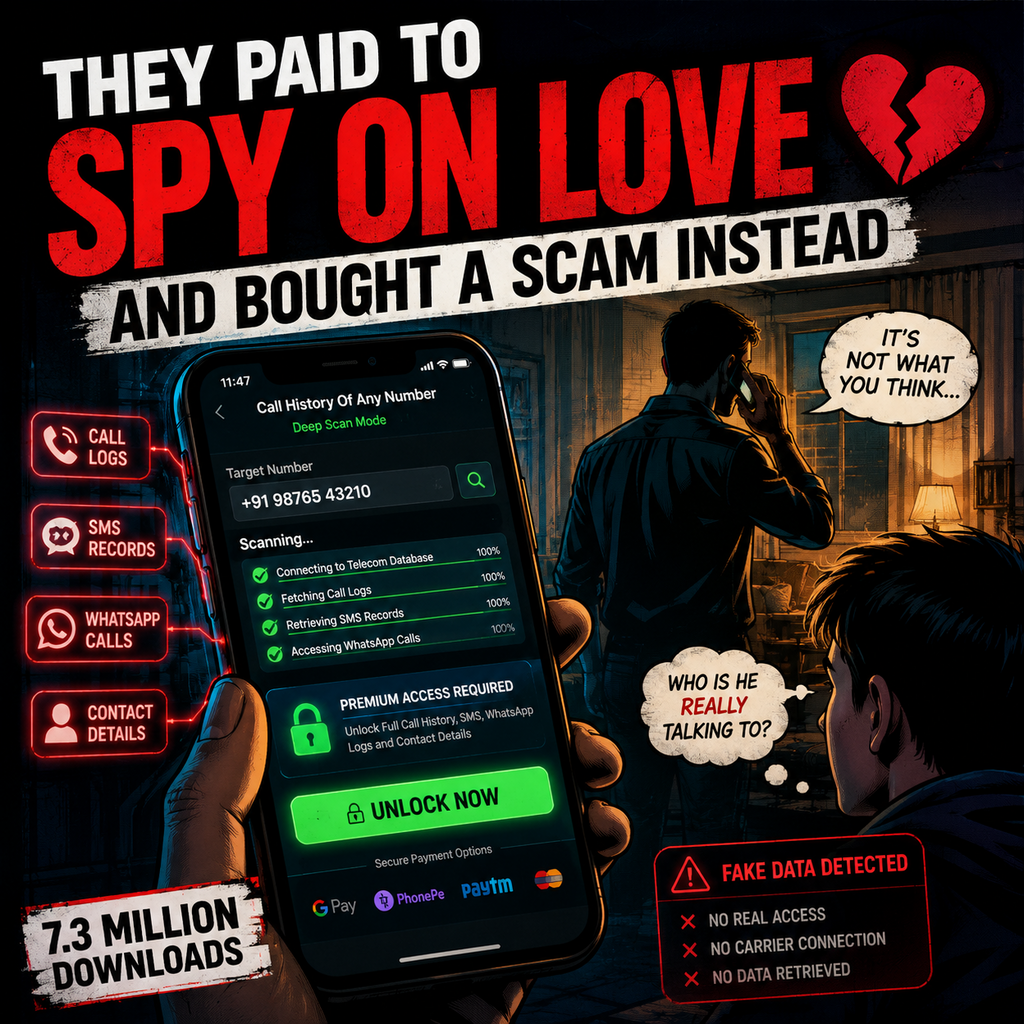
It almost never starts with cybersecurity. It starts with suspicion. A girlfriend suddenly turning her phone face down. A boyfriend taking late night WhatsApp calls outside the bedroom. A husband who is suddenly “too busy.” A wife who becomes unusually careful about who sees her screen.
That is exactly where these apps entered the game. Not through technology, but through emotion.
The operators behind the so called CallPhantom campaign did not need a sophisticated Android exploit, a zero day, remote code execution, or privilege escalation. They only needed jealousy, insecurity, and human curiosity.The apps on the Google Play Store looked simple and dangerously convincing: “Call History of Any Number,” “WhatsApp Call Tracker,” “SMS History Access,” “Phone Call History Tracker,” “Any Number Details.” The promise was always the same: enter any phone number and gain access to call logs, SMS records, WhatsApp history, contact mapping, and supposedly complete communication visibility including inbound and outbound call patterns.
For many users, it sounded like a private intelligence service for six dollars.
This worked especially well inside romantic relationships. Boyfriends wanted to know who their girlfriend was calling at night. Girlfriends wanted to verify whether their partner was really at the office or somewhere else. Family members wanted control. Suspicion became a business model.
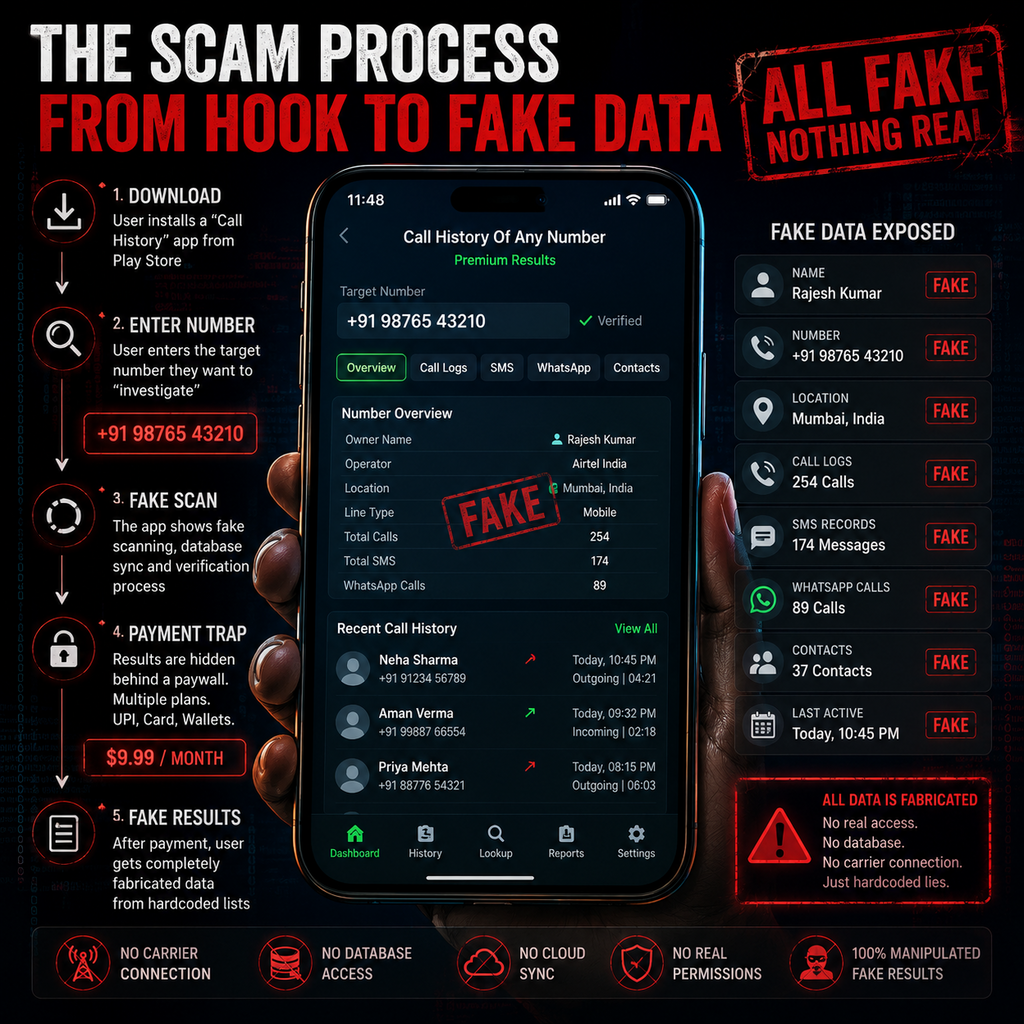
The apps projected trust. Clean interfaces. Professional sounding names. In one case, even a developer identity using “Indian gov.in” to simulate government credibility. Screens were designed to look like real OSINT dashboards. Enter the number. Loading animation. “Scanning Telecom Records.” “Syncing Call Database.” “Accessing Cloud Backup.” “Carrier Verification In Progress.”
All of it was fake.
Technically, there was no real capability to retrieve someone else’s call logs or WhatsApp data. No lawful intercept. No SS7 access. No carrier layer lookup. No CDR retrieval. No API integration with telecom providers. No signal interception. No backend access to lawful records. Nothing.
Many of these apps did not even request dangerous Android permissions. No READ_CALL_LOG. No READ_SMS. No contact harvesting. No device admin abuse. Ironically, that made them look even more trustworthy to users and allowed them to pass Play Store reviews more easily.
The real attack was pure behavioral engineering.
After entering the target number, users were shown an artificial analysis phase. Progress bars. Loading screens. Fake system messages like “Fetching WhatsApp Call Metadata” or “Decrypting SMS Logs.” Then came the real trigger: payment required.
To unlock the results, users had to purchase a premium plan. Subscription Unlock. Priority Scan Access. Deep Verification Plan. Full Number Intelligence Access. Prices ranged from six to eighty dollars. Some used official Google Play Billing. Others redirected users to third party payment systems like Google Pay, PhonePe, or Paytm. Some even included direct credit card checkout forms inside the app itself, violating Google’s own policies.
After payment, users received no real data. Instead, they were shown fake information hardcoded directly into the app. Random names. Random phone numbers. Generic contacts. In some cases, names were designed to resemble realistic local contacts to create a stronger illusion of authenticity.
One of the most effective tricks was the exit manipulation pattern.
If users tried to close the app without paying, they suddenly received a push notification claiming: “Call History Successfully Sent To Your Email.” Clicking the notification immediately redirected them back to the subscription screen. Cheap psychological conversion engineering, but highly effective.
The most interesting part is not the scam itself. It is how easily millions believed it.
More than 7.3 million downloads. Not from the dark web. Not through suspicious Telegram APK groups. Directly from the official Google Play Store.
The real issue is not malware. It is trust.
Many users still believe that official app store means automatic security. Many companies still assume that BYOD risk can be controlled mainly through MDM, EDR, or Mobile Threat Defense. But if an employee is privately willing to pay money to illegally monitor someone else’s WhatsApp calls, the real problem is not the endpoint. It is behavior.
Security teams spend millions on detection, SIEM, XDR, conditional access, and identity governance. At the same time, they fail on a much simpler question: why does an employee believe they can legally buy someone else’s WhatsApp logs for $9.99? That is where the real risk begins.
Not inside the malware sample.But in the decision before it.And that is why this story is not a mobile security incident.It is a leadership problem.