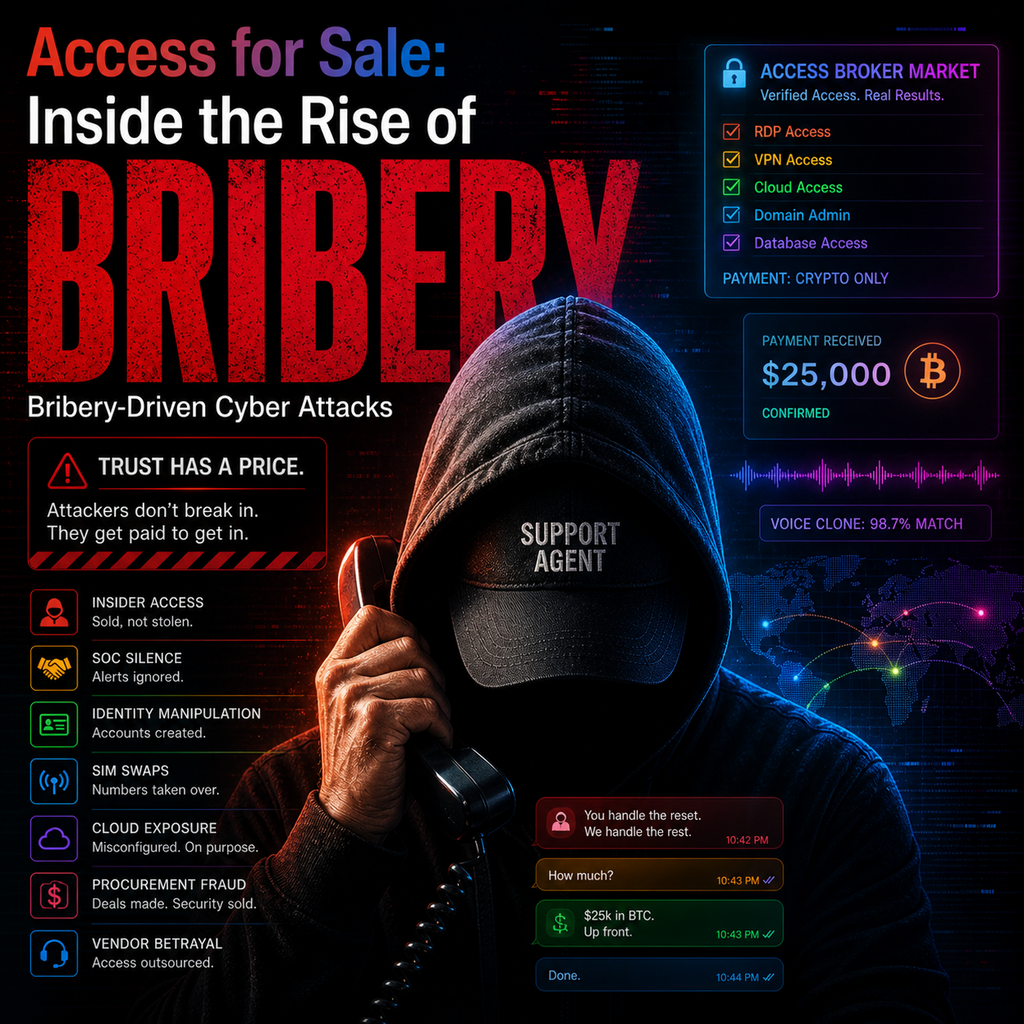
Cybersecurity has spent years talking about zero-day exploits, ransomware, advanced persistent threats, and highly sophisticated malware campaigns. Millions are invested in EDR, SIEM, XDR, threat intelligence, and security awareness programs. Companies build Security Operations Centers, invest in Cloud Security Posture Management, and discuss Zero Trust architectures as if technology alone were the answer to modern attacks. But the uncomfortable reality is much simpler — and exactly because of that, far more dangerous: many of the most successful cyberattacks do not begin with code, but with bribery.
Bribery is one of the most underestimated issues in the entire cybersecurity landscape. While organizations obsess over external attackers, the most dangerous vulnerability is often sitting inside the company and can be bought. No exploit is cheaper than a human who already has access. No phishing campaign is more effective than an employee who intentionally opens the door. No Initial Access Broker is more valuable than an administrator, a helpdesk agent, or an external service provider willing to be paid.
Bribery no longer looks like envelopes passed under the table. Modern bribery is digital, discreet, and often invisible. Cryptocurrencies replace cash. Telegram groups replace backroom meetings. Initial Access Brokers, insiders-for-hire, and access-as-a-service have become real underground markets where trust, privileged access, and operational silence are traded like commodities. The question is no longer whether a company is technically vulnerable, but whether someone inside the system is willing to cooperate for the right price.
A well-known example came from the Tesla case, where a Russian national attempted to bribe an employee with one million dollars to deploy malware inside Tesla’s internal network. No perimeter breach. No sophisticated exploit chain. Just an employee, money, and the hope of broken loyalty. That case brutally demonstrated how efficient bribery can be. The attacker did not want to break in. He wanted to be invited in.
At DarkGate, we have spoken with multiple CTOs, CISOs, and Managing Directors over the past months who confirmed exactly this pattern. One of them described it very directly: “We spent millions on security tools, but nobody asks what happens when the helpdesk itself becomes part of the problem.” That is where operational reality begins. A helpdesk employee paid to perform an MFA reset. A support agent who ignores suspicious password change requests. A telecom employee enabling a SIM swap. A SOC analyst intentionally closing critical alerts. This is not theory — this is modern bribery infrastructure.
SIM swap cases in particular show how dangerous this form of bribery has become. A single telecom employee willing to facilitate a phone number takeover for a few thousand dollars can open the door to complete access: email accounts, banking portals, cloud environments, and crypto wallets. Multi-factor authentication becomes an illusion when the second factor itself can be bought. With AI-powered voice cloning, deepfake calls, and increasingly advanced social engineering, this area will become significantly more aggressive in the coming years. Bribery combined with artificial intelligence creates a new operational threat model.
Even more dangerous is when bribery does not start the attack — but makes it invisible. Security Operations Centers depend on speed and escalation. But what happens when an analyst intentionally closes an alert? When ransomware preparation is marked as a false positive? When suspicious data movement is never escalated because operational silence was purchased? The most expensive breach is often not the visible attack, but the attack that nobody reports.
Another major bribery intersection exists in procurement. IT purchasing and security procurement are multi-billion-dollar environments. Vendor selection, managed services, cloud migrations, SIEM projects, SOC outsourcing, and identity platform decisions all pass through people whose choices directly shape the security posture of an organization. Procurement bribery is not just classic corruption — it includes manipulated tenders, preferred vendors selected for personal gain, artificially inflated project budgets, and security architectures designed around personal benefit rather than actual protection. Whoever controls procurement often controls the security architecture for the next five years.
One of the most underestimated risks lies with external service providers. The most dangerous insider is not always internal. Managed Service Providers, external security consultants, remote support vendors, and implementation partners often hold more privileged access than internal staff themselves. VPN access, domain admin rights, cloud admin roles, backup systems, remote monitoring tools — all concentrated in a single operational layer. When bribery enters that environment, one compromised provider does not affect one company, but potentially dozens of clients at once. Supply chain security becomes not only a technical issue, but a human risk issue.
HR and identity management are also becoming major bribery targets. Fake onboarding processes, privileged access for unauthorized individuals, and manipulated joiner-mover-leaver workflows create ideal attack surfaces. Whoever controls identity creation often controls the beginning of trust inside the company. A wrongly created account with excessive permissions can be more dangerous than an unpatched vulnerability.
What makes bribery so difficult to detect is the absence of traditional indicators of compromise. No antivirus alerts on broken loyalty. No SIEM automatically detects opportunism. Zero Trust fails when trust itself is deliberately sold. Organizations spend enormous amounts on technology, but very few systematically invest in insider risk management, behavioral monitoring, or procurement integrity controls. Security is still treated like an infrastructure problem, while bribery is fundamentally a governance problem.
DarkGate sees exactly here the strategic mistake many organizations continue to make. Most security strategies are built on the assumption that attackers are outside the perimeter. Modern bribery proves the opposite: the most dangerous attacker may already exist inside the org chart. Not every insider is corrupt, but every privileged access point is a potential market.
The next major cyber crisis may not begin with an exploit, but with a quiet wire transfer. Not with malware, but with a discreet Telegram message. Not with a breach, but with a decision.
Bribery is not a side note in cybersecurity. Bribery is the invisible infrastructure of modern attacks.
And that is why the most important question for security leaders is no longer simply:
“Are we technically protected?”
But rather:
“Who inside our system could, for the right price, suddenly be working for the other side?”