Networks are everywhere today. Invisible. Taken for granted. Data moves around the globe in milliseconds, applications respond in real time, entire economies depend on stable connections. Yet this state was never planned. It is the result of a development that began in 1969 with a small, almost inconspicuous research project. With this article, we are launching our Timeless Topics series in the field of IT infrastructure. A series that does not follow short-lived trends, but instead looks back at the origins of what is now considered the digital normal.
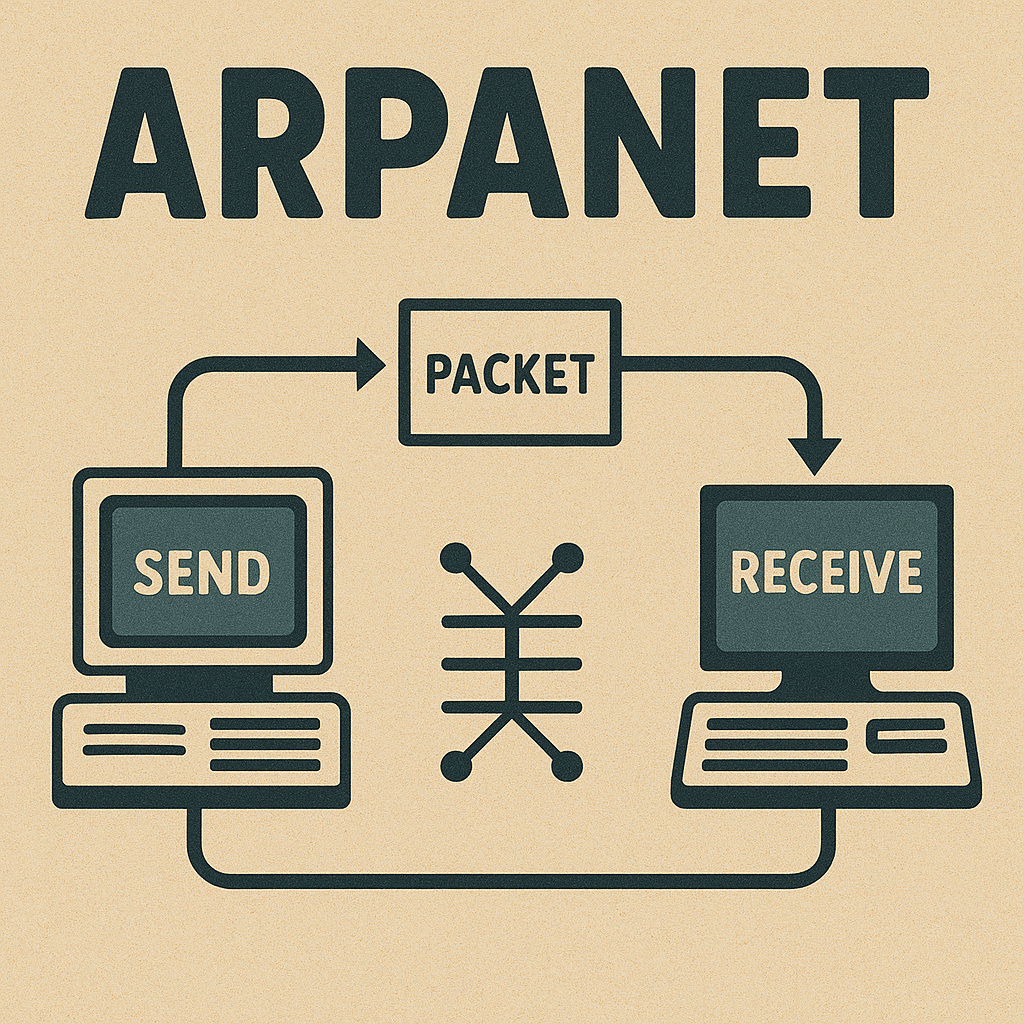
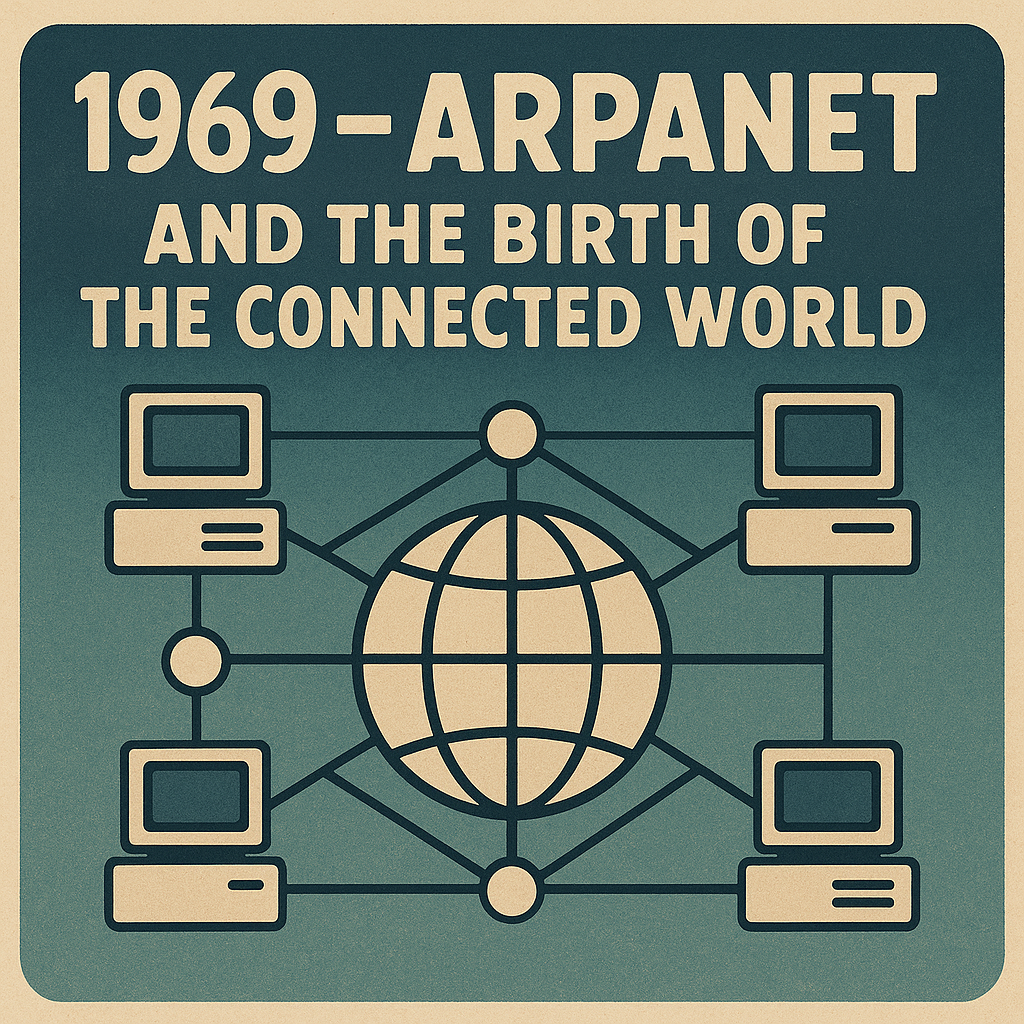
At the end of the 1960s, the U.S. Department of Defense was faced with a question that still feels surprisingly modern today: how can a communication network be built that continues to function even when individual parts fail or are destroyed? In the background were the geopolitical tensions of the Cold War, the fear of an attack on central communication nodes, and the realization that traditional line-based systems were far too vulnerable. The solution lay in a radical approach: decentralization. Instead of a fixed connection between two points, data would be broken down into small packets, transmitted independently, and reassembled at their destination.In 1969, this experiment went live for the first time. Four universities were connected: UCLA, Stanford, the University of California in Santa Barbara, and the University of Utah. That was all. No global network, no millions of users, no commercial exploitation. Just a handful of computers connected through a new technical idea. And yet, in that very moment, the foundation was laid for everything that would follow. For the internet, for cloud infrastructures, for global platforms, for cybersecurity and ultimately for the digital world order.The principle of so-called packet switching was the real breakthrough. Data was no longer transmitted as a continuous stream over a fixed line, but divided into individual packets that could each find their own way through the network. If one path failed, the packets would automatically take another. For the first time, this created a system that could not only communicate, but also react to disruptions. Networks became flexible, scalable, and resilient. Qualities that today are taken for granted, but at the time represented a true technical revolution.
In the years that followed, ARPANET grew slowly but steadily. More and more research institutions were connected, new nodes were added, and the network became denser and more powerful. At the same time, however, a fundamental problem emerged: the individual subnetworks spoke different technical languages, used different protocols. Communication was possible, but not standardized. This only changed fundamentally in 1983, when TCP/IP was introduced as a binding standard. With this step, many individual islands merged into a single network. Many see this moment as the true birth of the modern internet.What seems almost naive from today’s perspective was consistent in the early days: security played virtually no role at all. The network was built for exchange among researchers, not for a hostile environment. Trust was the basic assumption, authentication was secondary, encryption hardly a priority. Attacks, data misuse, or industrial espionage were not part of the threat model. This early openness later became a structural liability that continues to have an impact to this day. Firewalls, VPNs, intrusion detection, zero-trust models, and identity architectures are ultimately attempts to secure a foundation that was never designed for a global, conflict-driven world.
What no one could have foreseen at the time: this military and scientific experiment would become one of the most powerful economic systems in human history. Today, nearly all value chains depend directly or indirectly on functioning network infrastructure. Production, logistics, financial markets, healthcare, public administration, platform economies everything is based on the ability to transport data reliably, quickly, and globally. Estimates suggest that well over half of global economic output is now directly linked to digital networks. The origin of all this lies in that decision made in 1969.To this day, every modern IT architecture still carries the DNA of ARPANET within it. Decentralized structures, redundant paths, addressability, packet-based transmission, protocol logic instead of central control. Whether hyperscaler backbones, corporate data centers, or edge-computing environments the basic principles have remained the same, only the dimensions have multiplied. Networks still think in the same categories as they did more than fifty years ago, just with a level of performance that would have been unimaginable at the time.
At the same time, the downside of this historical decision is also evident. The original openness of the network is one of the reasons why security has become so complex today. No longer is a single, closed machine being protected, but a globally distributed system without clear boundaries. The debates around digital sovereignty, dependence on hyperscalers, government control mechanisms, and critical infrastructures are direct consequences of this open architecture. The internet was built as a platform for cooperation, not as a defensible infrastructure. This contradiction has never been fully resolved it can only be mitigated through technology.
So why is ARPANET still relevant more than five decades later? Because every strategic discussion about cloud architectures, resilience, outage scenarios, global connectivity, or cyber risks ultimately leads back to the very same fundamental question that was already being asked in 1969: how much openness does a network need in order to grow, and how much control does it need in order to remain stable? This question continues to shape IT infrastructure to this day.1969 does not mark a nostalgic moment in computer history. It marks the starting point of a development that has fundamentally transformed how we work, how we do business, how our societies function, and how political dependencies are created. From four universities emerged a global infrastructure. From a military risk emerged a global operating system. And from a technical idea emerged a system that today determines the stability, security, and competitiveness of entire nations. The discussion about how much trust, automation, and control make sense is therefore still far from over – even more than fifty years after ARPANET.