After Stuxnet, it became clear that industrial systems could be manipulated. Yet for a long time, there was still a sense of distance. Too complex, too specific, too exceptional. The attack on Ukraine’s power grid in the winter of 2015 ended that illusion. For the first time, it became publicly visible that a coordinated cyberattack could affect not just machines, but millions of people directly. Darkness was no longer a theoretical risk. It was a real, tangible outcome of digital operations.This article is the second part of our case study series on documented attacks against critical infrastructure. While Stuxnet demonstrated how precise, long-term sabotage can operate in silence, the Ukraine Power Grid Attack showed how openly, forcefully, and yet deliberately an attack on essential services can unfold. It was not a single failure or an isolated exploit, but a carefully orchestrated assault on technology, processes, and people.
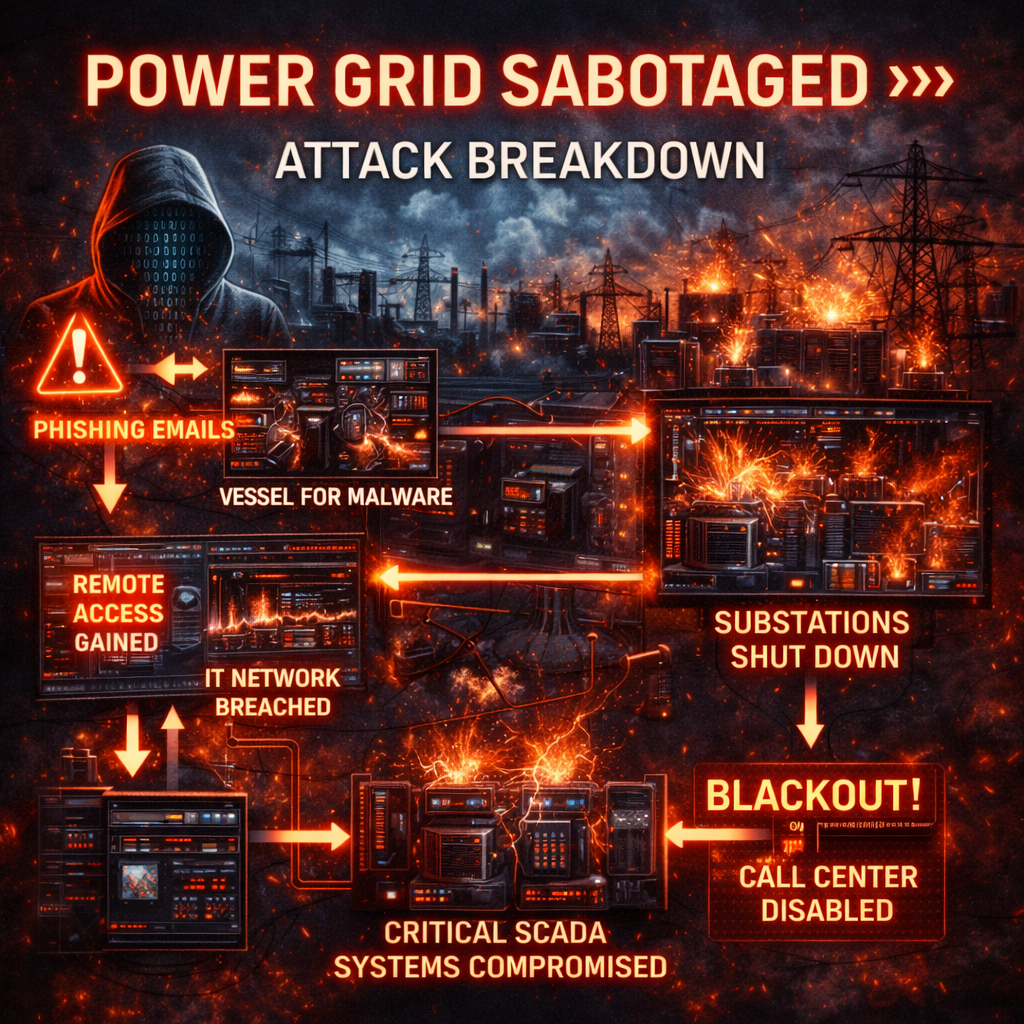
In December 2015, around 230,000 households in western Ukraine temporarily lost electricity. Several regional energy providers were affected at the same time. The attackers had gained access to internal IT networks months earlier, primarily through classic phishing emails. Employees opened infected documents, credentials were harvested, and step by step the attackers moved deeper into the infrastructure. None of this appeared unusual. There were no immediate alarms and no visible damage. That quiet persistence is what made the attack so effective.The turning point came when the attackers crossed from IT into operational technology. They took control of SCADA systems, the platforms used to operate substations and switching equipment. Unlike Stuxnet, this was not about hidden manipulation over long periods. Power lines were deliberately switched off, live and remotely, while operators watched their own systems being used against them.What made the attack especially disruptive was the combination of technical and organizational sabotage. At the same time the power was cut, the call centers of the energy companies were attacked. Telephone systems were overloaded, communication channels disrupted. Customers could not report outages, and operators could not receive feedback from the field. The human fallback layer failed alongside the technical one. The attack did not just disrupt infrastructure; it disrupted the ability to respond.
The importance of this case lies not only in the blackout itself, but in the clarity of its message. This was not a test or a warning shot. It was a demonstration. The attackers showed that they understood the systems, that they could control them, and that they were willing to use that control visibly. Power was restored after several hours, but the psychological impact remained. Trust in the resilience and invisibility of energy networks was permanently shaken.Unlike traditional IT incidents, recovery was not a matter of restoring backups or restarting systems. Engineers had to travel physically to substations, manually reset equipment, and ensure that control had fully returned to the operators. The attack forced organizations to reassess their dependence on digital control systems. Redundancy existed, but it was not designed for this type of threat.
The Ukraine case marks a decisive transition in the history of attacks on critical infrastructure. Earlier scenarios were often viewed as highly specialized or limited to state-level targets. This incident showed that well-known tools, familiar weaknesses, and human error were enough to produce large-scale consequences. No exotic zero-day chain was required. Patience, planning, and an understanding of operational workflows were sufficient.In conversations with operators of critical infrastructure, this attack is still frequently referenced. Not as a historical footnote, but as a benchmark. One operations manager at a European energy provider once put it this way: “Since Ukraine, we know that a cyberattack does not have to be loud to cause maximum impact. It only needs to strike at the right moment and the right place.” That realization has shaped the security architecture of many KRITIS organizations.Regulators also took notice. The attack provided concrete proof that IT and OT security cannot be treated separately. The traditional divide between office IT and production networks had already collapsed in practice; security models simply had not caught up. The Ukraine Power Grid Attack forced authorities to recognize this reality and rethink requirements around segmentation, monitoring, and incident response.
Looking back, the attack almost resembles a blueprint. Remote access, abuse of legitimate tools, targeted shutdowns, and simultaneous disruption of communications. Many of these elements reappear in later scenarios, adapted to different industries, countries, and political contexts. What made Ukraine in 2015 unique was that it was the first time this methodology became visible to the world.For Darkgate, this case is more than a historical analysis. It highlights why critical infrastructure depends not only on robust technology, but on experienced people who can make decisions under pressure and understand complex dependencies. In highly sensitive environments, security is not just about protecting systems. It is about maintaining the ability to act when digital control itself becomes a vulnerability.
The Ukraine Power Grid Attack of 2015 proved that cyberattacks do not stop at the server room. They reach into homes, hospitals, and entire cities. The light switch became a symbol of how tightly digital and physical worlds are now intertwined. Anyone responsible for operating, designing, or securing critical infrastructure today must take this lesson seriously. This attack was not an exception. It was a signal.
.