
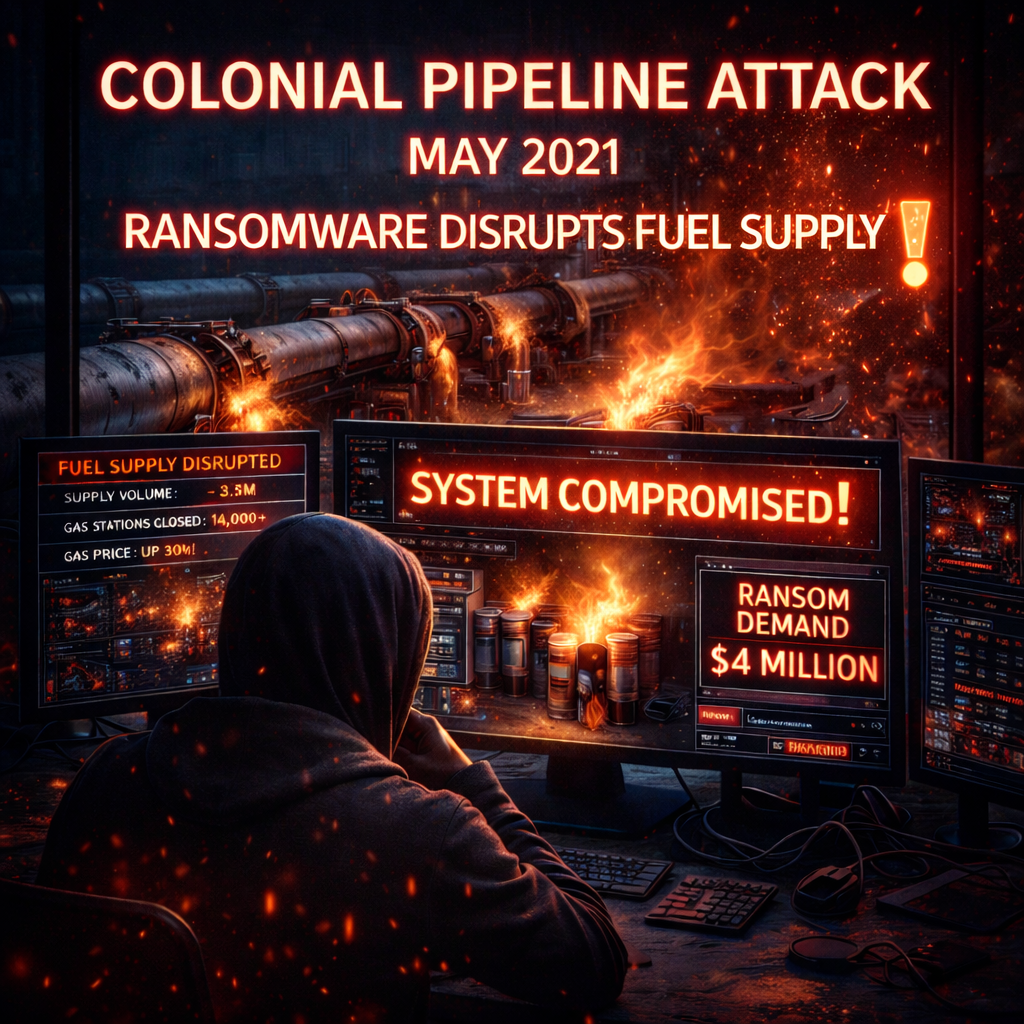
In May 2021, the United States did not experience a blackout. No refinery exploded, no valve was physically sabotaged, no control room was stormed. And yet, within days, large parts of the East Coast faced fuel shortages. Gas stations ran dry, prices surged, airlines reviewed contingency plans, and panic buying spread faster than any official statement. The trigger was not a mechanical failure. It was a decision. And that decision was forced by ransomware.The Colonial Pipeline attack was not a classic critical-infrastructure outage. It was quieter, more subtle, and ultimately more unsettling. It demonstrated how little is required today to destabilize a highly developed supply system. No manipulation of industrial controllers, no deep understanding of physical processes. A compromised IT environment was enough to bring the largest fuel pipeline in the United States to a halt.
Colonial Pipeline operates a network that transports millions of barrels of fuel every day. Gasoline, diesel, jet fuel the invisible bloodstream of an entire region. When the DarkSide ransomware group gained access to Colonial’s internal systems, the immediate damage was not physical. The pipeline itself remained intact. What was lost was confidence. Billing systems, internal monitoring, and operational data could no longer be trusted. No one could say with certainty which information was accurate and which was not.At that point, the most critical action occurred. The attackers did not shut down the pipeline. Colonial did. Out of caution. Out of responsibility. And precisely there lay the real success of the attack. Control was not achieved through destruction, but through uncertainty. Influence replaced sabotage.
The consequences unfolded rapidly. Within hours, reports of fuel shortages began to circulate. Social media amplified fears, turning isolated disruptions into a perceived national crisis. Drivers queued at gas stations, filled spare containers, altered travel plans. Markets reacted nervously. Politicians intervened. A localized IT incident escalated into a nationwide supply shock – not because the physical damage was severe, but because trust in the system’s reliability had collapsed.What makes the Colonial Pipeline attack so disturbing is how little technical sophistication was required to achieve such an impact. The attackers did not need to access industrial control systems. They did not need to interfere with physical operations. They only needed to reach far enough into the organization to create doubt. Doubt about data integrity. Doubt about operational visibility. Doubt about whether continued operation was safe.In modern infrastructure, doubt is enough to stop everything.
What actually happened was already serious. But the real significance lies in what could have followed. Had the shutdown lasted longer, supply chains would have tightened further. Fuel affects everything: logistics, healthcare, aviation, emergency services. The escalation would not have been technical, but societal. Not explosions or fires, but scarcity. Not sabotage, but cascading decisions made under uncertainty.The Colonial case revealed how thin the line is between an IT incident and a national crisis. Traditional critical-infrastructure scenarios have clear markers. A power plant fails. A substation goes offline. The damage is visible. In this case, the damage was psychological and organizational. It existed in the anticipation of what might happen if operations continued without reliable information. That ambiguity is precisely what makes such attacks so dangerous. They force operators to become the ones who pull the plug.Looking back, the incident feels like a proof of concept. Not for destroying infrastructure, but for paralyzing it. For demonstrating that modern supply systems are most vulnerable not at their physical edges, but at their decision-making core. Highly optimized environments depend on trusted information. When that trust erodes, efficiency turns into fragility.
The Colonial Pipeline attack also signaled a shift in the threat landscape. Attacks on critical infrastructure no longer need to be dramatic. They do not even need to look like attacks. It is enough to create a moment where no one can confidently say that continuing operations is responsible. From that moment on, the disruption unfolds almost automatically.In this sense, Colonial fits seamlessly into the trajectory that began with Stuxnet and became visible during the Ukraine power grid attacks. But it marks a new phase. One where the primary target is no longer machinery, but confidence. And that is what makes this case so deeply unsettling. Because confidence cannot be patched.