Over the past decade, information security in Europe has evolved from a primarily technical discipline into a strategic and regulatory cornerstone of entire industries. While ISO 27001 has long served as the universal reference framework for information security management, it is increasingly complemented and, in some sectors, overshadowed by highly specialized regulatory regimes. DORA, KRITIS and TISAX exemplify this shift. They reflect a growing understanding that generic standards alone are no longer sufficient to address the operational, systemic and supply chain risks of a highly interconnected digital economy.ISO 27001 remains a critical foundation. It provides structure, comparability and a common language for managing information security risks across organizations of all sizes. Yet its strength as a generic management standard also defines its limitations. ISO 27001 focuses on governance, processes and continuous improvement, but it deliberately avoids deep sector-specific prescriptions. In industries where failures can cascade across markets, infrastructures or entire societies, regulators and industry bodies have responded by introducing more targeted frameworks.
The Digital Operational Resilience Act, better known as DORA, represents one of the most far-reaching regulatory initiatives in this context. Primarily aimed at the financial sector, DORA extends well beyond traditional IT security requirements. Its core objective is to ensure that financial institutions and their critical ICT service providers remain operational even under severe digital stress. This includes cyberattacks, system failures, supply chain disruptions and large-scale incidents affecting third-party providers.
What distinguishes DORA from classic standards is its explicit focus on operational resilience rather than mere compliance. Organizations must demonstrate not only that they have controls in place, but that these controls work under real-world conditions. Regular resilience testing, incident response simulations and clear recovery capabilities are central elements. In addition, DORA places unprecedented emphasis on third-party risk management. Technology vendors, cloud providers and IT integrators are no longer peripheral actors but integral components of regulated financial ecosystems.KRITIS, the German framework for protecting critical infrastructures, follows a different logic but addresses a similarly systemic risk perspective. Critical infrastructures include sectors such as energy, telecommunications, healthcare, transport, water and food supply. The defining criterion is not company size or turnover, but the potential societal impact of a failure. If an outage could significantly disrupt public life, safety or economic stability, the operator falls under KRITIS obligations.
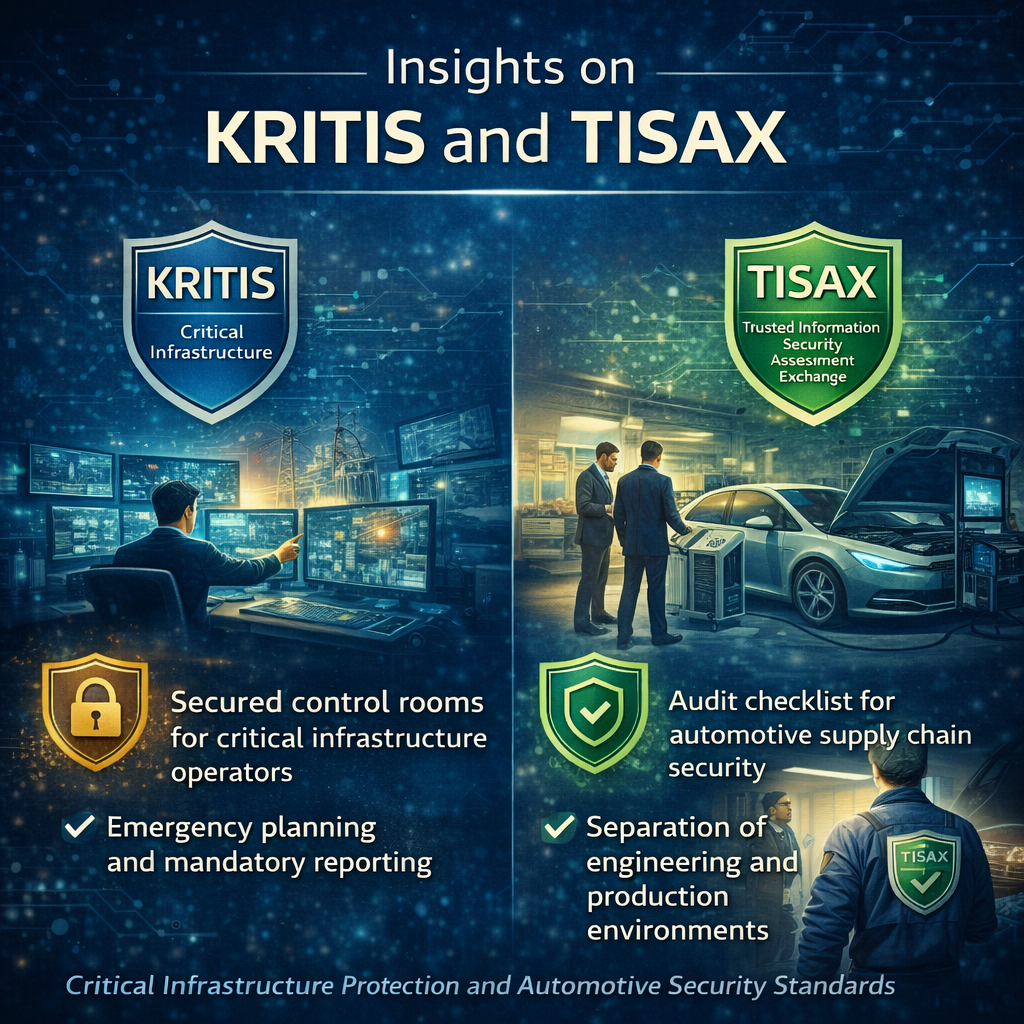
For KRITIS operators, information security is inseparable from operational continuity. Technical safeguards must be aligned with organizational measures, emergency planning and reporting structures. Cybersecurity, physical security and business continuity converge into a single risk management discipline. Unlike ISO 27001, which organizations typically adopt voluntarily, KRITIS requirements are mandatory and subject to regulatory oversight. This fundamentally changes how security investments are justified and prioritized at board level.TISAX, short for Trusted Information Security Assessment Exchange, has become the dominant security framework in the automotive industry. Initially introduced to address the specific needs of vehicle manufacturers and their suppliers, TISAX has evolved into a prerequisite for participating in large parts of the automotive value chain. Original equipment manufacturers, engineering service providers, software vendors and IT integrators increasingly require TISAX assessments as a condition for collaboration.
Compared to ISO 27001, TISAX is more concrete and more closely aligned with real operational risks. It focuses on defined protection needs, such as prototype data, production information and personal data related to connected vehicles. The emphasis is less on abstract management processes and more on practical safeguards, access controls and environment separation. In many cases, TISAX is not perceived as a one-time certification, but as an ongoing maturity journey that reflects the dynamic nature of automotive development and supply chains.
A CTO of a leading IT integrator describes this evolution as inevitable. As industries become more digitally interconnected, the consequences of failures increase exponentially. The relevant question is no longer whether a system is secure in theory, but whether an organization can continue to operate under adverse conditions. Sector-specific regulations force companies to confront this reality in a structured and measurable way.For IT integrators, these frameworks fundamentally reshape their role. They are no longer seen solely as technology implementers, but as strategic partners in regulatory compliance and operational resilience. This is particularly evident in the automotive sector, where TISAX requirements directly influence system architectures, development environments and operational processes. Without a deep understanding of the regulatory rationale behind TISAX, purely technical solutions often fall short or create unnecessary complexity.
In the financial sector, DORA has similar implications. Vendor selection, outsourcing strategies and service level agreements are increasingly assessed through the lens of resilience and regulatory risk. IT service providers must be able to demonstrate not only technical excellence, but also robust governance structures and incident response capabilities. Those who combine technical expertise with regulatory insight gain a decisive competitive advantage.
Against this backdrop, the demand for specialized talent continues to grow. Organizations are looking for professionals who understand both technology and regulation. Security architects, cloud engineers with compliance expertise and information security managers with sector knowledge are in short supply. Operators of Darkgate Magazine observe this trend closely. As part of one of the most respected recruitment agencies in the German-speaking market, we work daily with IT integrators active in highly regulated industries, including automotive, finance and critical infrastructure.
Our clients face increasing pressure to deliver projects that meet strict regulatory requirements while remaining economically viable and scalable. Traditional role profiles are often insufficient. What is needed are hybrid skill sets that bridge engineering, governance and risk management. In TISAX or KRITIS-driven environments, hands-on experience and industry understanding frequently outweigh formal certifications alone.ISO 27001 remains an essential baseline in this ecosystem. However, it is only in combination with sector-specific frameworks that organizations achieve a truly resilient security posture. Companies that treat DORA, KRITIS or TISAX as isolated compliance exercises quickly encounter organizational friction. Successful organizations integrate these frameworks into a coherent operating model that balances prevention, detection and recovery.
At a European level, this shift reflects a broader strategic ambition. Increasing regulation is not merely a reaction to rising cyber threats, but an attempt to strengthen digital sovereignty and systemic stability. For companies operating in regulated markets, these frameworks are no longer optional considerations. At the same time, they create opportunities for specialized service providers, integrators and professionals who view security not as a checkbox, but as a strategic capability.
DORA, KRITIS and TISAX thus mark a new phase in the evolution of information security. They signal a move away from purely formal certifications toward lived resilience and sector-specific depth. For organizations, this means higher effort but also greater clarity. For IT integrators and recruitment specialists, it opens new fields where technical competence, regulatory understanding and market insight converge. This is precisely where Darkgate Magazine positions itself: providing context, critical analysis and informed perspectives in an increasingly complex security landscape that is becoming central to long-term business success.