After exploring Europe’s increasingly centralized regulatory landscape through frameworks such as DORA, KRITIS, NIS2 and sector-specific security regimes, it is worth deliberately shifting perspective. Not to question the European approach, but to contextualize it. The United States follows a fundamentally different philosophy when it comes to information security, compliance and digital resilience. One that relies far less on universal regulation and far more on market forces, liability and sector-driven responsibility.
At Darkgate Magazine, we have already touched on these differences in previous articles. Due to strong interest from our readership, we are now taking a deeper look at the US model. What becomes immediately clear is that compliance in the United States is rarely driven by overarching mandates. Instead, it emerges from economic pressure, contractual risk and the very real threat of litigation. Security is not primarily enforced by regulators, but by customers, investors and courts.
As operators of Darkgate Magazine and as a Europe-wide renowned recruitment agency, we work closely with some of the largest IT integrators in the market, including organizations with a strong presence in the United States. Through these partnerships, we encounter a regulatory reality that differs significantly from Europe. The contrast is not theoretical. It shapes project structures, decision-making speed and the way security is embedded into business operations.
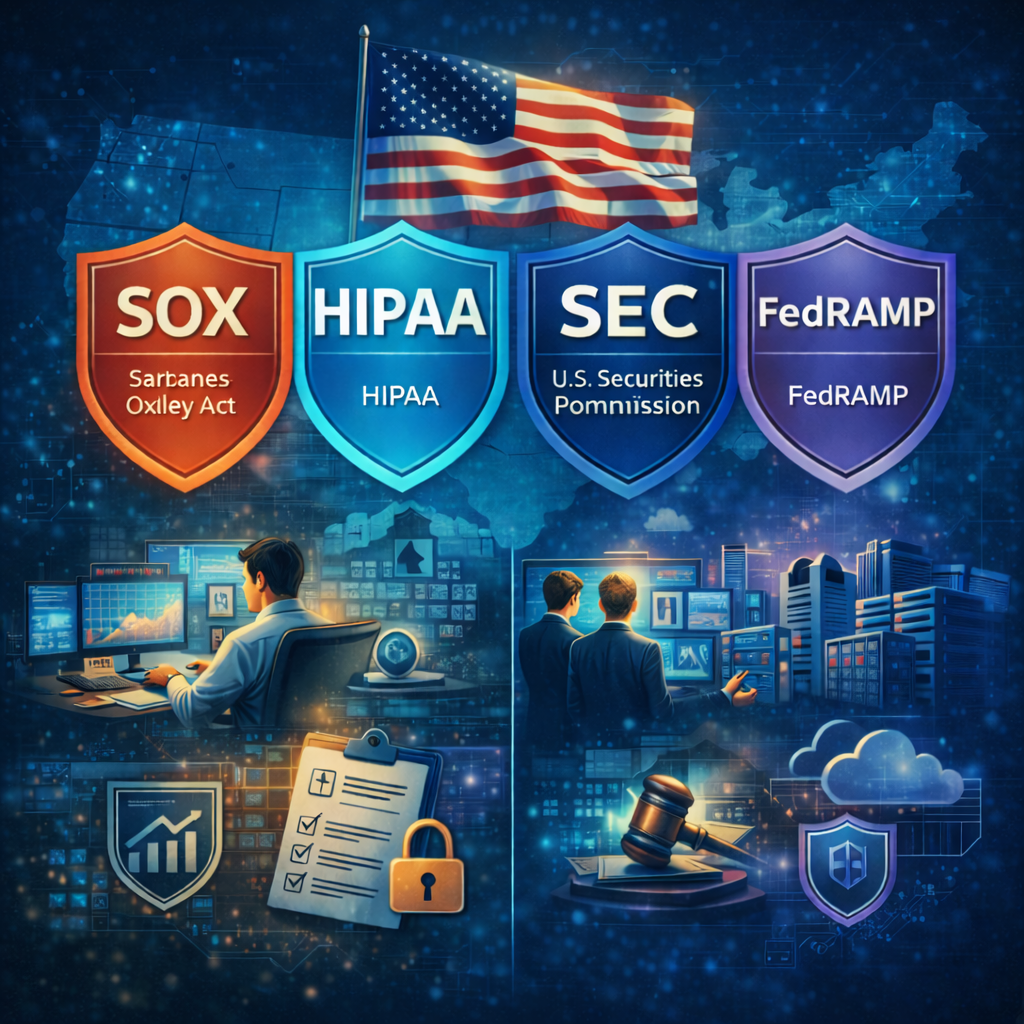
Unlike Europe, the US has no single, comprehensive cybersecurity law that applies across all industries. There is no equivalent to DORA or NIS2 that uniformly governs digital resilience. Instead, the regulatory environment is fragmented by design. Sector-specific laws, federal requirements and industry-driven frameworks coexist, each targeting a defined risk domain. This fragmentation often appears chaotic from a European perspective, but it is deeply rooted in the US market logic.One of the most influential examples is the Sarbanes-Oxley Act, commonly known as SOX. Introduced in response to major corporate accounting scandals, SOX focuses on the integrity of financial reporting for publicly traded companies. Information security plays a critical supporting role, particularly in access controls, audit trails, system integrity and change management. The key distinction lies in accountability. Under SOX, senior executives can be held personally liable for failures. Security controls are therefore not implemented to satisfy auditors, but to protect leadership from legal and financial exposure.
HIPAA illustrates a similar pattern in the healthcare sector. Rather than providing a generic security framework, HIPAA defines concrete obligations for organizations handling protected health information. The emphasis is on safeguarding patient data through appropriate technical and organizational measures. Violations are not abstract compliance issues. They carry tangible penalties, including substantial fines and reputational damage. For healthcare providers and technology vendors alike, HIPAA compliance is less about certification and more about risk survival.The role of the Securities and Exchange Commission further highlights the US approach. In recent years, the SEC has significantly increased its expectations regarding cybersecurity disclosure and governance. Public companies are required to report material cyber incidents and demonstrate oversight at board level. This shifts cybersecurity firmly into the realm of corporate governance. It is no longer an IT problem, but a leadership responsibility. The focus is not on detailed technical controls, but on transparency, accountability and decision-making structures.
FedRAMP provides perhaps the clearest example of market-driven compliance. Designed to standardize security requirements for cloud service providers working with US federal agencies, FedRAMP is demanding, complex and resource-intensive. Yet it is also highly pragmatic. There is no ambiguity about its purpose. Compliance grants access to one of the largest public-sector IT markets globally. Non-compliance means exclusion. In this model, security investment is directly linked to revenue potential.From a European viewpoint, this system often appears simpler. Companies are not burdened by universal regulatory frameworks that apply regardless of industry relevance. Organizations only engage with the regulations that directly affect their sector. A manufacturing company without healthcare data does not need to worry about HIPAA. A non-public company outside the financial markets does not face SOX obligations. This selective applicability significantly reduces regulatory overhead.
However, this simplicity comes at a price. Responsibility shifts from regulators to organizations themselves. Companies must assess their own risk exposure and decide how much security is sufficient. Failure is not mitigated by regulatory ambiguity. It is punished through lawsuits, loss of business and damaged trust. In practice, this creates a strong incentive to invest in security where it truly matters.Working with large IT integrators in the US reveals how deeply this mindset is embedded. Projects are often less formalized, decisions are made faster and security architectures are closely aligned with concrete business risks. At the same time, accountability is more direct. There is little tolerance for security theater. Controls must work, not just exist on paper.
In Europe, the trajectory is different. Regulatory frameworks aim to reduce systemic risk across entire economies. DORA seeks to strengthen the resilience of the financial sector as a whole. KRITIS focuses on safeguarding services essential to public life. NIS2 expands security obligations across a wide range of industries. This approach increases predictability and standardization, but also introduces complexity and compliance overhead.
From a talent perspective, these differences are highly visible. In Europe, demand is growing for professionals with broad regulatory literacy. Security roles increasingly combine technical expertise with governance and compliance knowledge. In the US, profiles are often more specialized. A security expert in healthcare operates under very different constraints than one in financial services or government cloud environments.As a recruitment partner serving top-tier companies across Europe, the US and Asia, we see how these models shape careers and organizational structures. Understanding information security today requires more than technical skill. It demands market awareness and regulatory intuition. Professionals who succeed in the US environment are often those who understand liability, business impact and stakeholder expectations. In Europe, success increasingly depends on navigating complex regulatory ecosystems.
Neither model is inherently superior. The US approach is faster, more market-driven and often more pragmatic. The European model is more structured, preventive and focused on systemic stability. For globally operating organizations, this duality represents a significant challenge. Security strategies must be adaptable, context-aware and aligned with regional expectations.SOX, HIPAA, SEC regulations and FedRAMP exemplify a system where compliance is enforced not through uniform rules, but through economic consequence. DORA, KRITIS and NIS2 represent a European belief in coordinated regulation and collective responsibility. Both aim to reduce risk, but they do so through fundamentally different mechanisms.
At Darkgate Magazine, we will continue to analyze these contrasts from a practical perspective. Not through the lens of policymakers, but through the experiences of integrators, executives and security professionals who operate at the intersection of technology, regulation and market reality. Because in an increasingly interconnected world, true security is not defined by geography, but by understanding how different systems shape behavior, risk and resilience.