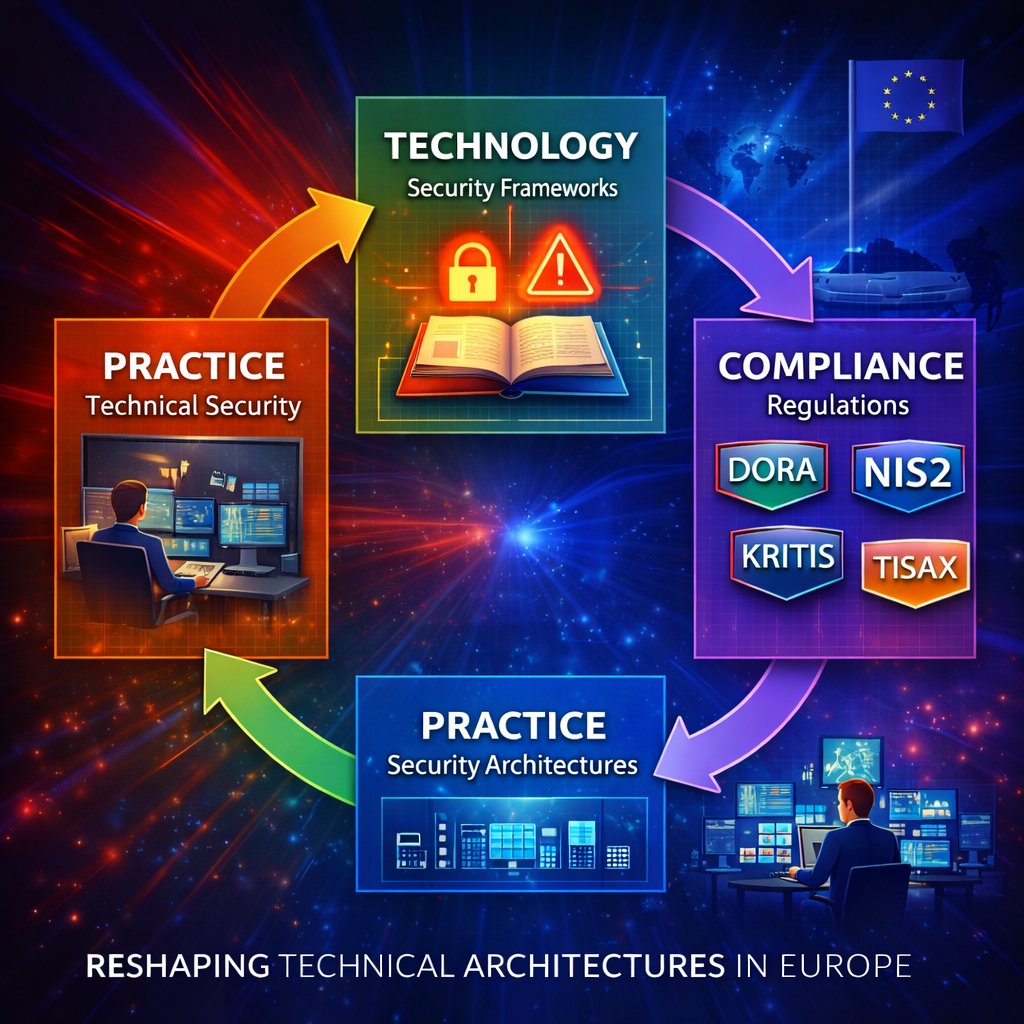
In recent Darkgate Magazine articles, we have examined European regulatory frameworks such as DORA, KRITIS, NIS2 and TISAX from multiple angles. What has become increasingly clear is that information security in Europe is no longer primarily a technical discipline. Instead, it has evolved into a regulatory and strategic domain that actively shapes how technology is designed, deployed and operated. To fully understand this shift, it is worth looking beyond individual regulations and focusing on the deeper structural change that is underway.
Historically, security architectures emerged from technical necessity. Firewalls, network segmentation, access control models and encryption mechanisms were responses to concrete threats encountered in real-world operations. Practical experience shaped defensive measures, and over time these practices crystallized into informal standards and best practices. Theory followed practice. Information security was largely reactive, grounded in operational reality.
As IT systems became more complex and more deeply embedded in business processes, this model began to change. Security incidents were no longer isolated technical failures. They turned into operational disruptions, financial risks and reputational crises. Gradually, security moved from the server room to the management level. The introduction and widespread adoption of ISO 27001 marked a turning point. Information security became formalized, documented and auditable. Governance entered a field that had previously been dominated by engineering.Today, Europe is witnessing a second and more fundamental reversal of this logic. Regulatory frameworks increasingly define the boundaries within which technical security architectures must operate. Compliance is no longer an afterthought layered on top of existing systems. It has become a primary design driver. Regulations such as DORA explicitly require operational resilience, incident reporting capabilities and demonstrable control mechanisms. NIS2 expands responsibility across entire supply chains. KRITIS focuses on availability and recoverability of essential services. TISAX directly influences development environments, data separation and access models in the automotive ecosystem.
In this new reality, theory precedes practice. Regulatory requirements are translated into architectural principles long before systems are built. Security architectures are no longer derived solely from operational experience but from anticipated auditability, traceability and accountability. Compliance defines action, not just documentation.This shift reflects a broader political and economic objective. Security is no longer seen as the protection of individual systems but as a prerequisite for sector stability. As a result, architecture must satisfy not only technical requirements but also regulatory expectations. Systems must be explainable, controllable and resilient under stress. Logging, redundancy, identity governance and segmentation are not optional enhancements. They are implicit regulatory assumptions.
A Chief Technology Officer at a large European IT integrator describes this transformation as a structural break with the past. Architectural decisions today are rarely made without regulatory considerations. Even in environments where formal obligations are not yet fully applicable, compliance logic is integrated early. The reason is pragmatic. Architectures that ignore regulatory realities inevitably require costly and risky reengineering later.This is particularly evident in large, distributed environments. Financial institutions, energy providers and industrial enterprises operating critical processes must align their architectures with regulatory expectations from the outset. Cloud strategies are shaped not only by scalability or cost but by auditability and dependency risk. Multi-cloud designs are adopted to reduce regulatory exposure. Identity and access management becomes the central control plane because it enables traceability and accountability. Zero Trust principles gain traction not as ideology, but because they align well with regulatory demands for controlled access and segmentation.
As a consequence, the role of IT organizations is changing. Security architects increasingly operate at the intersection of technology, compliance and executive management. Their task is not merely to implement controls but to translate regulatory intent into workable technical patterns. The traditional separation between governance and engineering is eroding. Security is becoming an integrative capability rather than a specialized function.This evolution inevitably creates tension. Regulation is abstract by nature, while technology is concrete. Attempting to translate regulatory requirements literally into technical implementations often leads to excessive complexity. Mature organizations recognize that compliance should define principles, not rigid blueprints. Successful architectures are those that internalize regulatory logic while remaining adaptable and efficient.
The CTO describes this as a maturity curve. Early-stage compliance efforts tend to focus on isolated requirements and tactical fixes. Over time, organizations develop a holistic understanding. Security architectures are designed to satisfy multiple regulatory regimes simultaneously. ISO 27001 provides a baseline, while DORA, NIS2 and TISAX requirements are layered on top. Architecture becomes a long-term strategic asset rather than a collection of controls.Another important consequence of this shift is the redistribution of responsibility. Where technical security was once delegated to specialists, it is now understood as an organizational capability. Architectural decisions are discussed at board level because they directly affect liability, operational continuity and market access. Compliance forces organizations to treat technical design as a strategic concern.
From the perspective of Darkgate Magazine, this transformation is highly relevant. As the operators of one of Europe’s most respected recruitment agencies in the IT sector, we work closely with integrators navigating this change. Our clients increasingly seek professionals who combine deep technical expertise with regulatory literacy. The ability to translate compliance into architecture has become a decisive differentiator in the market.At the same time, this transition is far from complete. Many organizations are still in an intermediate phase, balancing legacy architectures built on practice-driven logic with new regulatory expectations. The challenge lies in maintaining stability while enabling adaptation. Those who treat compliance as a constraint struggle. Those who use it as a structural framework build more resilient and scalable security architectures.
Europe has chosen this path deliberately. Regulation is intended not to suppress innovation, but to enforce resilience. This leads to a reversal of the historical sequence. Practice no longer exclusively informs theory. Instead, theory increasingly informs practice. Yet this theory is itself derived from collective experience across industries. In that sense, the cycle comes full circle.From technical practice to security theory, from theory to regulation, and back into technical implementation. The difference today lies in scale. What once emerged as local best practice is now a systemic requirement. Compliance is not the opposite of engineering. It has become its new starting point.Darkgate Magazine will continue to examine this evolution from a practitioner’s perspective. Not as a regulatory commentary, but as an analysis of how architecture, projects and organizations are truly changing. Because ultimately, security is not defined by regulation itself, but by the quality of the technical systems built in response to it.