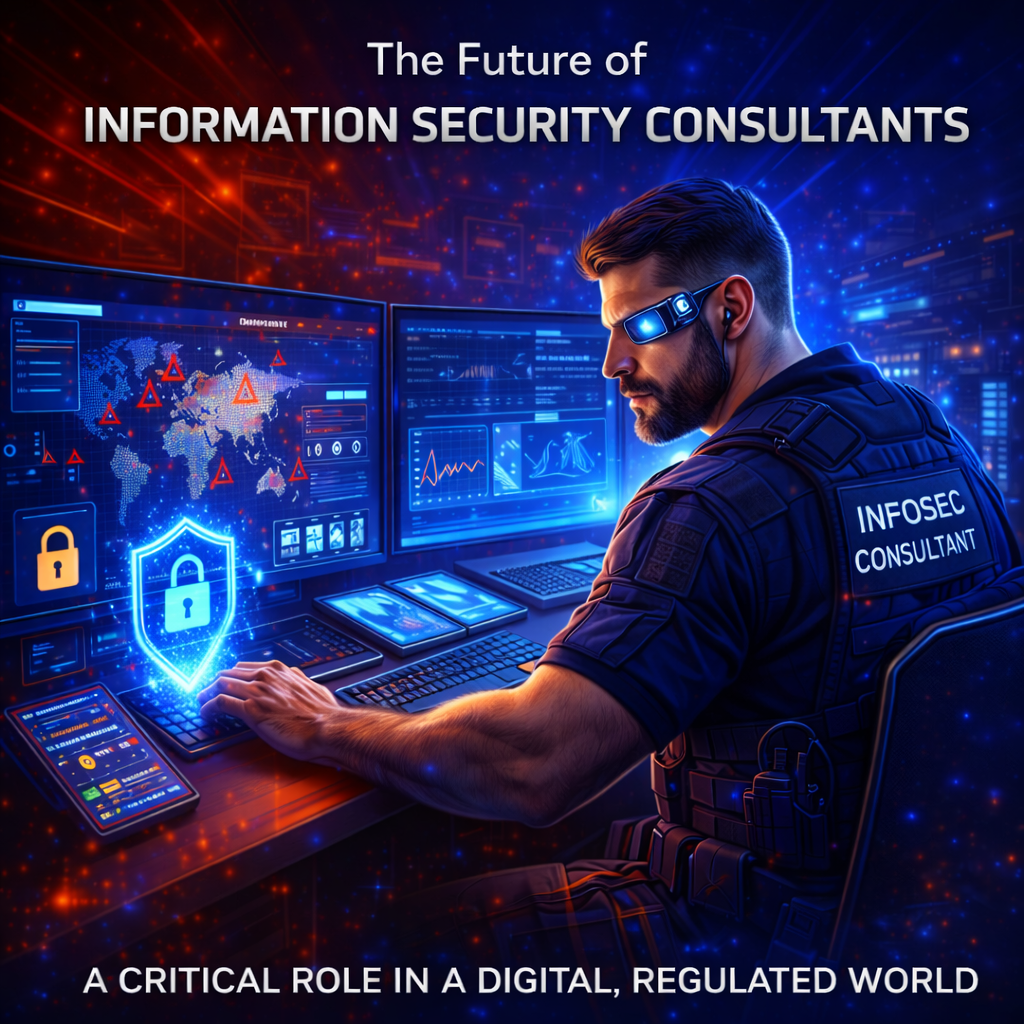

In our previous article, we explored how the role of the Information Security Consultant has already changed over the past years. We examined current responsibilities, regulatory pressures and the growing strategic relevance of the position. We also briefly touched on where this role might be heading in the medium term.
What has become increasingly clear in our daily work, however, is that this short outlook only scratches the surface. The real transformation of the Information Security Consultant does not lie in yet another framework or regulation. It lies in how the role is practiced, how the daily work changes and what kind of decisions consultants are expected to influence in the future.As a high-level recruiting agency operating at the intersection of IT, security and leadership, we are already looking several years ahead. Not out of speculation, but because the profiles we place today must still be relevant tomorrow. And when we speak with candidates, CISOs, CTOs and IT integrators across Europe, a consistent picture begins to emerge.
The role today
For many Information Security Consultants today, the workday is still largely shaped by operational and compliance-driven tasks. Risk assessments are updated, controls are reviewed, audit preparation dominates calendars. Large parts of the job revolve around documentation. Policies, procedures, risk registers and evidence repositories consume significant time and energy.Much of the interaction happens reactively. An audit is approaching. A new regulation comes into force. A customer requests certification readiness. Consultants translate requirements from ISO 27001, NIS2, TISAX or DORA into structured action plans. Success is measured by passed audits, fulfilled requirements and closed findings.In consulting environments, especially at IT integrators and system houses, this work is highly project-driven. Consultants move from customer to customer, adapt quickly to new environments and maturity levels, and deliver within tight timelines. The focus is often on accuracy, completeness and formal compliance.This work is essential. It creates stability and trust. But it also shows clear limits.
The shift already underway
Over the past few years, a gradual but fundamental shift has begun. Tools and platforms increasingly automate parts of risk management, documentation and reporting. What once required days of manual work can now be generated, updated or validated much faster.As a result, expectations change. Stakeholders are no longer impressed by perfectly formatted policies alone. They want answers. Why is a specific control necessary. Which risks really matter. Where should limited resources be invested first.The Information Security Consultant is increasingly expected to provide interpretation rather than repetition. Context instead of checklists.
The near future: a different workday
In the coming years, the daily work of an Information Security Consultant will look noticeably different.The day will start less often with documents and more often with conversations. Instead of writing policies, consultants will moderate workshops. Instead of compiling control catalogues, they will prioritize measures together with business and IT stakeholders.A typical morning might involve a strategic discussion with management about entering a new market or launching a new digital service. The consultant’s role is not to quote regulations, but to explain implications. Which regulatory requirements are critical. Which risks are acceptable. What level of security investment is necessary to remain operational and competitive.In the afternoon, the focus may shift to technical and architectural discussions. Cloud platforms, identity models, network segmentation, supplier dependencies. The consultant acts as a connector. Translating regulatory intent into technically feasible and economically reasonable solutions. Security becomes part of architecture design, not an afterthought.Documentation does not disappear, but it changes its role. It becomes a result of decisions, not the goal itself. Audits are prepared by functioning processes, not by producing paper at the last minute.
Looking further ahead
If we look five years into the future, the role evolves even further.The Information Security Consultant becomes less of a project-based specialist and more of a long-term companion to organizations. Whether internal or external, consultants increasingly work with a deep understanding of a company’s culture, risk appetite and strategic goals.
Instead of reacting to incidents or regulatory deadlines, they operate proactively. Regularly assessing the security posture, identifying trends and translating them into actionable recommendations. Security strategies are adjusted continuously, not only when something goes wrong.In this future, consultants are deeply involved in decisions about investments, suppliers, partnerships and technologies. Security is understood as a business enabler. Without robust security concepts, projects cannot start, markets cannot be entered and partnerships cannot be signed.
What this means for skills and profiles
From a recruiting perspective, this transformation has significant consequences.Pure compliance profiles, no matter how well certified, are no longer sufficient on their own. What matters are individuals who combine technical understanding, regulatory knowledge and business awareness. People who are comfortable making trade-offs, setting priorities and standing behind decisions.The Information Security Consultant of the future is not defined by a single background. Many successful profiles combine hands-on technical experience with governance and advisory skills. They can speak to engineers and executives alike. They understand constraints on both sides and know how to bridge them.Communication becomes a core skill. Not presentation skills in the superficial sense, but the ability to build trust, explain complexity and guide decision-making.
Why the role becomes more attractive
This shift makes the role more demanding, but also far more rewarding.Information Security Consultants become more visible within organizations. Their input directly influences strategic outcomes. They are no longer perceived as necessary overhead, but as partners who make growth possible.Career paths open up accordingly. Many consultants move into lead roles, security architecture, CISO positions or broader strategic functions. Others deliberately remain in consulting, attracted by the variety and impact of the role.What unites these paths is relevance. Few roles sit as close to the core questions of modern organizations.
A profession gaining weight
The future of the Information Security Consultant is not about hype or buzzwords. It is about responsibility. About shaping stability in an increasingly regulated and digital world.The role shifts from managing controls to shaping decisions. From producing documentation to enabling direction. From reacting to requirements to actively guiding organizations through complexity.At Darkgate Magazine, we observe this development daily through conversations with companies, IT integrators and candidates. We see where expectations are rising and where profiles are changing. That is why we already think ahead. Not because the future is uncertain, but because it is clearly taking shape.Choosing a career as an Information Security Consultant today means choosing a role that will continue to grow in importance. For those who enjoy structure, dialogue and impact, the future of this profession is not only secure, but genuinely exciting.