Anyone who spends years speaking with system houses, integrators, presales architects, SOC teams, account managers and managing directors across Europe starts to notice something that never appears in market reports. IT integration is not a uniform discipline across Europe. It is shaped by culture, history and organizational evolution. Nowhere is this more visible than when comparing the DACH region, the Netherlands and the United Kingdom.
At Darkgate, we speak to these people every single day. To architects from Bechtle, presales specialists at SVA, managed service leaders at Computacenter, consultants from the ecosystem around Conclusion, and service managers at Softcat. Over time, it becomes obvious that although all of them are working in “IT integration,” they think, structure projects and advise customers in very different ways.
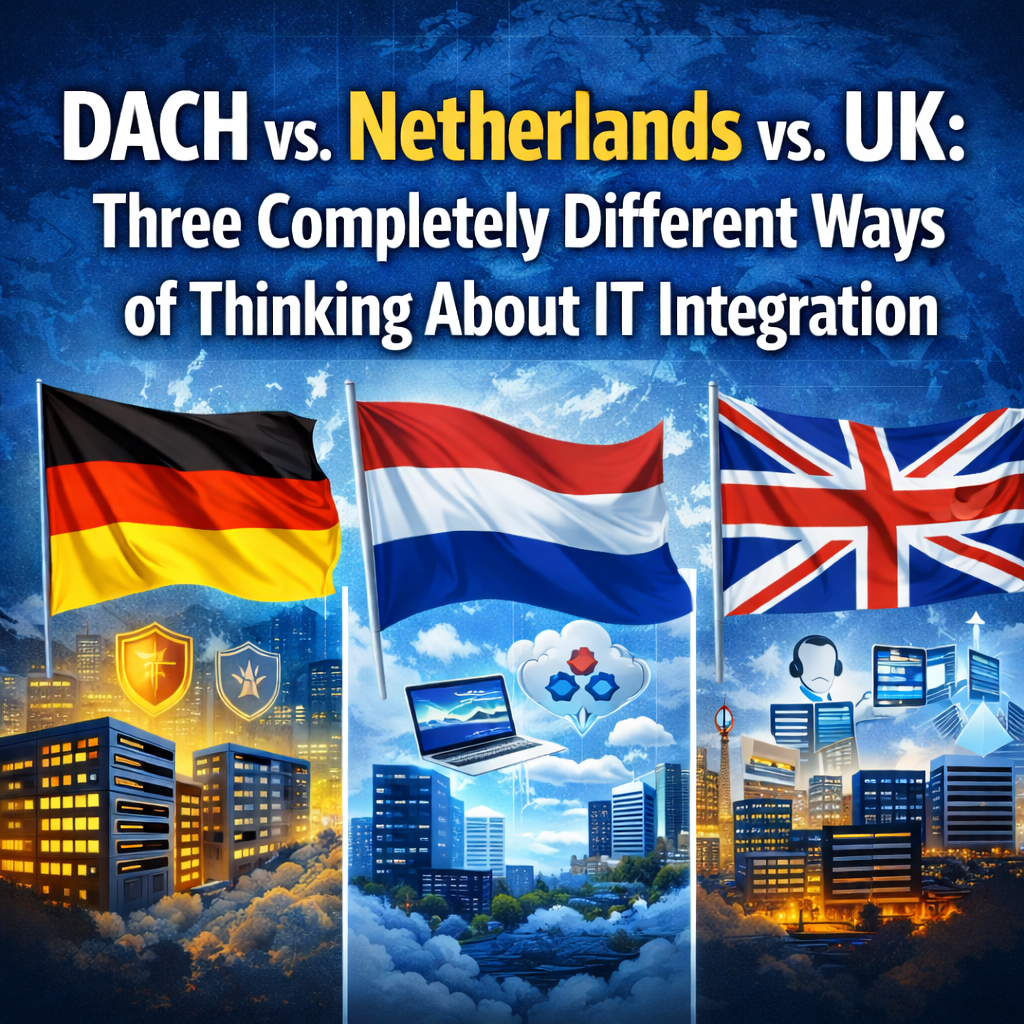
DACH stands for infrastructure and security excellence. The Netherlands stands for a cloud and consulting mentality. The United Kingdom stands for managed services and outsourcing strength. These differences are so deeply embedded that they shape entire organizational models.In the DACH region, IT integration historically grew out of networks, data centers and security. Many system houses were founded by engineers. The roots lie in routing, switching, firewalls, storage, virtualization and later cloud extensions. Even today, roles such as presales architect, network architect, security engineer and data center specialist are central. When a customer in Germany, Austria or Switzerland hires an integrator, they expect technical depth. They expect architects to draw designs, write concepts and understand solutions in detail. IT integration here means building technically perfect infrastructure.
You can feel this mindset in conversations. Candidates from DACH talk extensively about design decisions, vendor features and technical limitations. Account managers are often technically strong. Vendor managers are key roles. Manufacturer partnerships run deep. Integration is seen as a technical discipline first.The Netherlands presents a different picture. There, IT integration developed much more from consulting and transformation. Companies like Conclusion, as well as global players with a strong Dutch presence, started early to position IT as an enabler of business processes. Conversations with Dutch architects focus less on technical details of individual components and more on architectural principles, cloud models, modern workplace strategies and organizational change. The Dutch integrator thinks faster in target architectures than in individual technologies.
Cloud is not an extension of infrastructure, but the starting point. Consulting is not an add on, but a core element. Customers expect not only a working environment, but guidance through transformation. This results in very different role profiles. More consultants, more cloud architects, more strategy conversations. Less deep vendor specialization, more holistic perspective.In the United Kingdom, a third way of thinking dominates. IT integration there is heavily service driven. Managed services, outsourcing, service levels, operating models and contract structures are central. Integrators like Computacenter and Softcat are extremely strong in structuring large service contracts and running them over many years. The focus is less on the individual technical solution and more on how that solution is operated, measured and scaled over time.
Conversations with British service managers revolve around processes, SLAs, operating models and governance. Technology is important, but it is embedded in service frameworks. Customers expect stability, predictability and outsourcing capability. IT integration here is understood as operational responsibility.These three mindsets lead to very different organizational forms. DACH integrators have large presales teams, strong engineering departments and deep vendor expertise. Dutch integrators have strong consulting units and cloud focus. UK integrators have highly developed managed service organizations and service management structures.
For IT professionals, this is highly relevant. A network engineer from Germany often feels under challenged in a Dutch environment, because less technical depth is required in daily work. A Dutch cloud consultant sometimes perceives German integrators as overly technology focused and not transformation oriented enough. A British service manager often sees too much customization and too little standardization in German projects.Even the role of the account manager differs significantly. In DACH, the account manager is a technically experienced relationship manager. In the Netherlands, they are often a strategic advisor. In the UK, they are service and contract managers. This changes how customer relationships are built and how integrators grow.
These differences also explain why hiring requirements vary so much. While Germany is desperately searching for security engineers, network architects and presales specialists, the Netherlands has high demand for cloud architects and consultants. The UK needs service managers, managed service specialists and operations experts.None of these models is better or worse. They are the result of historical development. But they explain why conversations with integrators from these countries feel so different, even though everyone is talking about IT integration.
Anyone working across these markets quickly realizes that you cannot simply move candidates from one country to another. The expectations regarding role, work style and customer interaction are too different. This is where deep market knowledge becomes crucial. Understanding these nuances does not come from reports, but from hundreds of real conversations.DACH builds technically perfect environments. The Netherlands designs target architectures and transformation journeys. The UK operates and scales IT as a service. Three regions, three mindsets, one term: IT integration.