
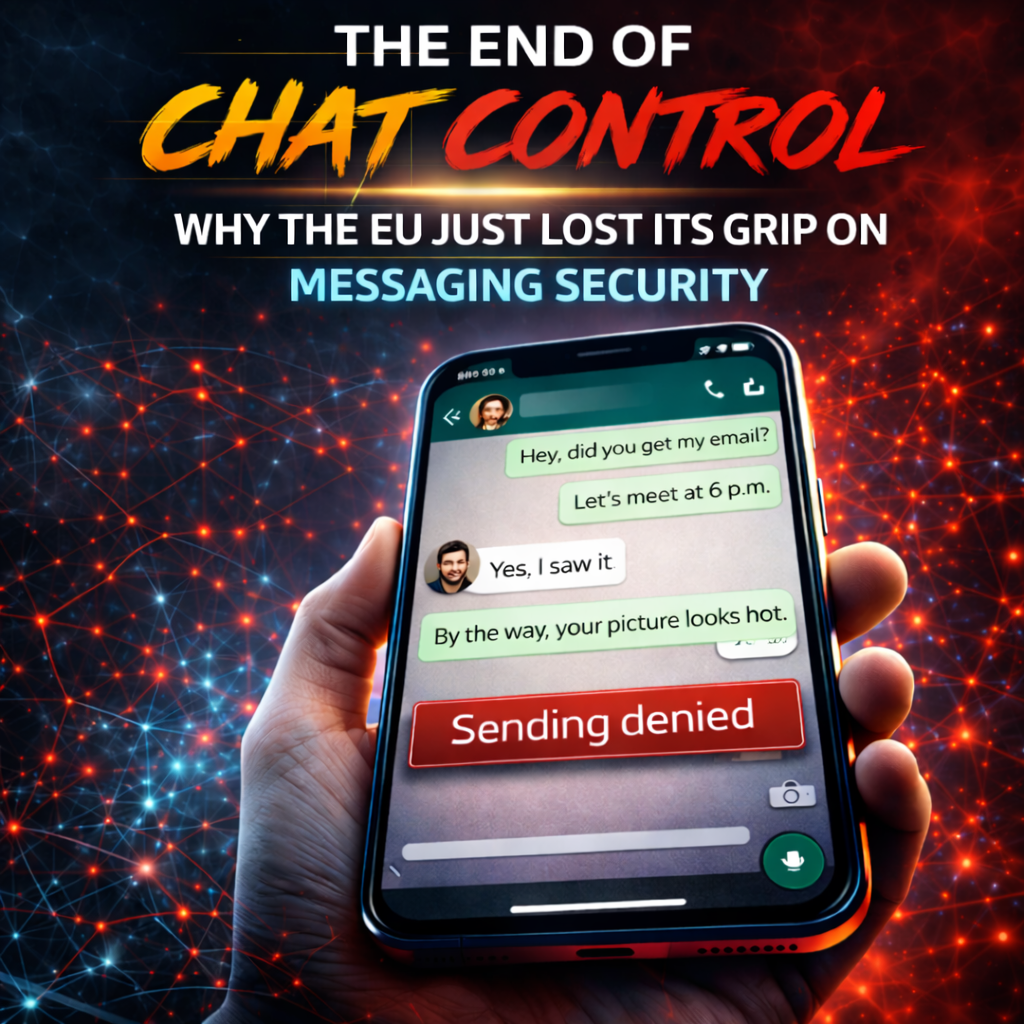
The failure to extend the EU’s so-called “voluntary chat control” is more than just another political deadlock. It marks a turning point in how Europe approaches one of the most sensitive intersections in modern technology: privacy, cybersecurity, and digital surveillance. At first glance, the situation appears to be a familiar regulatory disagreement between the European Parliament and member states. But beneath the surface, it exposes a much deeper issue. The EU is struggling to reconcile legal frameworks with the technical realities of modern communication systems. Messaging platforms are no longer simple tools for exchanging text. They have evolved into complex, encrypted ecosystems that function as communication channels, data storage environments, and increasingly, as vectors for cyber threats. Any attempt to regulate them must therefore operate within a landscape defined by both security requirements and privacy expectations.
The temporary regulation that is now expiring allowed platforms to voluntarily scan private communications for known child abuse material. Technically, this often relies on hash-matching systems such as PhotoDNA, which detect known illegal content without directly reading messages. However, even these approaches challenge the fundamental principle of end-to-end encryption. This is where the real conflict begins. End-to-end encryption is one of the core pillars of modern cybersecurity. It ensures that only the sender and the recipient can access the content of a message. Neither platform providers nor external actors can decrypt it. From a security standpoint, this is essential. From a law enforcement perspective, it creates significant blind spots. The EU is effectively facing an unsolvable equation. Strengthening privacy inevitably limits surveillance capabilities, while expanding monitoring mechanisms inevitably weakens encryption. There is no clean solution that fully satisfies both sides.
The concept of client-side scanning illustrates this dilemma perfectly. The idea is to analyze content directly on a user’s device before it is encrypted and transmitted. On paper, this appears to be a compromise. In practice, it introduces entirely new risks. Any system capable of scanning content locally can potentially be manipulated, repurposed, or exploited. From a cybersecurity perspective, this is a critical vulnerability. Systems designed to protect users can quickly become attack surfaces themselves, a point that is often underestimated in political discussions where regulation tends to focus on legal frameworks rather than technical implications. The current situation, defined by the expiration of the temporary regulation without a replacement, creates a regulatory vacuum. Messaging providers lose the legal basis for voluntary scanning, while no alternative structure has been agreed upon.
For businesses, particularly in IT services and system integration, this uncertainty is far from theoretical. Clients expect clear guidance on compliance, data protection, and security architectures, yet the regulatory environment offers little clarity. Can companies analyze messaging data for security purposes? Are they allowed to implement monitoring mechanisms, or do they risk violating privacy laws? These questions are no longer abstract. They directly impact how organizations design and operate their digital infrastructure. At the same time, the demand for specialized expertise is increasing. Privacy engineers are needed to translate legal requirements into technical solutions. Security architects must find ways to integrate encryption with monitoring capabilities. Compliance professionals are required to navigate evolving regulations and align them with business operations. This trend is particularly visible in the European market, especially in the DACH region, where system integrators and IT service providers are no longer just implementing technology but are expected to provide strategic guidance. Clients are not only asking for solutions, but for direction.
This shift creates both opportunities and risks. The EU initially framed chat control as a necessary measure to protect children in digital environments. The objective itself is not controversial. The implementation, however, highlights the complexity of aligning ethical goals with technical feasibility. The failure to extend the current regulation should not be seen purely as a setback, but rather as a reset. Existing approaches have not delivered a sustainable solution. Neither large-scale scanning nor purely voluntary mechanisms have proven to be viable long-term strategies. The next phase will be decisive. A permanent regulatory framework is inevitable, but the form it will take remains unclear. Will the EU impose stricter obligations on platform providers? Will monitoring be limited to clearly defined suspects, or will entirely new technological approaches emerge?
For the cybersecurity community, the answer is less important than the preparation. Regardless of the regulatory outcome, the underlying challenge remains unchanged. Digital communication is both a secure channel and a potential threat vector. Every move toward increased surveillance affects system security, while every move toward stronger privacy affects law enforcement capabilities. The idea that both can be fully controlled at the same time has now been fundamentally challenged. This is what makes the topic so relevant. It is not just about a failed regulation. It is about the limits of governance in a world where technology evolves faster than policy. It is about the shifting balance of power between governments, platforms, and users, and about recognizing that security and control are not the same thing.
For companies, recruiters, and decision-makers in the IT sector, this is a clear signal. Complexity is increasing, requirements are rising, and the ability to understand and navigate these dynamics is becoming a competitive advantage. The EU did not simply lose control over messaging security. It realized that this control never existed in the way it had imagined.