
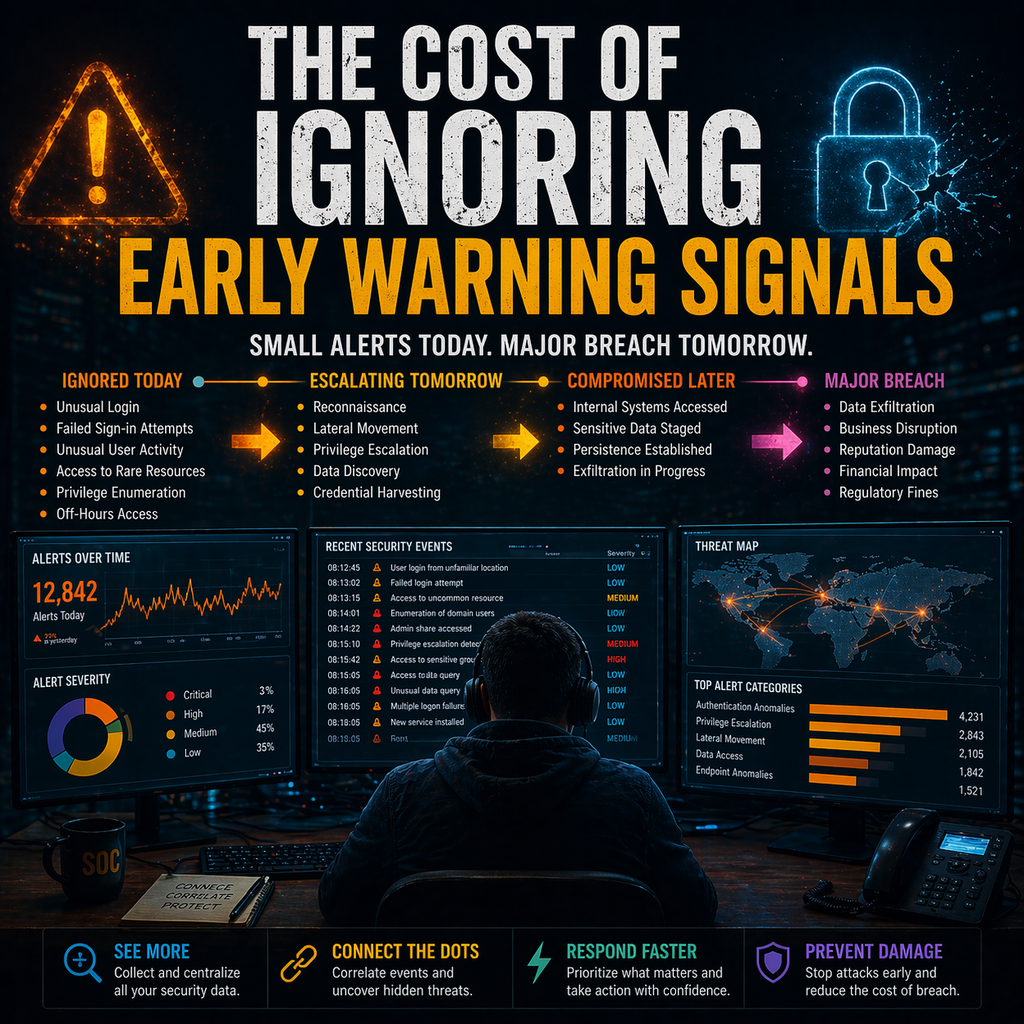
It rarely begins with a critical alarm. There is no dramatic red screen, no instant realization that a breach is already in motion, and no obvious moment where everyone in the room knows something has gone wrong. More often, it starts with something much smaller. A slightly unusual login. A low-priority authentication anomaly. A system query that looks odd, but not urgent. A user account accessing something outside its normal pattern. These are the early warning signals modern environments generate every day, and in many organizations they are not missed because they are invisible. They are missed because they are buried, downgraded, normalized, or simply lost inside operational noise. That is exactly what makes them so dangerous. The real cost of ignoring early warning signals does not lie in the signal itself. It lies in what the signal becomes when it is left unexplored.
In a modern SOC environment, the volume of data is immense. Security teams are dealing with login attempts, endpoint events, lateral traffic, privilege changes, API calls, cloud activities, identity anomalies, and behavioral deviations across dozens of systems. On paper, this is where modern SIEM and analytics platforms are supposed to shine. They collect, enrich, correlate, and prioritize. They promise visibility, faster response, and greater control. But in practice, many teams operate in a very different reality. They are not looking at one clean stream of intelligence. They are looking at layers of fragmented information, competing priorities, and constant alert pressure. In that environment, the distinction between an early warning sign and background noise becomes dangerously blurred. A low-severity signal is easy to dismiss when there are hundreds of other alerts waiting. A weak anomaly is easy to ignore when there is no obvious damage attached to it. And yet this is precisely the territory where many modern attackers choose to operate.
A realistic breach does not usually arrive as a loud, obvious event. It unfolds in increments. An attacker gets access to a legitimate account, often through phishing, credential theft, reused passwords, or a previously compromised identity. Nothing immediately looks malicious because the credentials are real. The first login may be slightly unusual, perhaps at an odd hour or from an unfamiliar source, but not enough to trigger a high-priority response. Then comes a period of cautious exploration. Systems are touched one by one. Permissions are tested. Directory structures are examined. Internal resources are queried. More logs are created, more traces appear, more weak signals accumulate. Still, each event remains explainable on its own. That is the trap. One event looks harmless. Two events look coincidental. Three events still do not create urgency if they are scattered across systems, separated by time, and viewed by different tools through different interfaces. The attacker understands this. The attacker depends on this. Early warning signals are not ignored because teams do not care. They are ignored because modern environments are full of partial truths that only become meaningful when someone has the time, visibility, and operational structure to connect them.
That is where the real failure often sits. Not in the absence of logs, but in the absence of coherence. Most organizations do not suffer from having too little telemetry. They suffer from having too much disconnected telemetry. One platform sees an identity anomaly. Another records endpoint behavior. Another captures a cloud event. Another tracks network movement. Each system tells part of the story, but the story itself never fully comes together at the right moment. This is why early warning signals matter so much to vendors focused on SOC modernization and detection operations. The real problem is not whether the signal exists. The real problem is whether the environment can convert small, early signs into operational understanding before the damage escalates. That is the space where manufacturers want the market to feel urgency, because once an organization understands how expensive delayed interpretation can be, the conversation immediately shifts from basic logging to detection maturity, platform integration, signal correlation, and faster triage. First comes the realization that there is a problem. Then comes the budget. Then comes the vendor conversation.
A failure story illustrates this better than any generic awareness message. Imagine an organization that has already invested heavily in its security stack. It has a SIEM. It has endpoint protection. It has firewalls, identity controls, cloud logging, and alerting workflows. Internally, the environment looks mature. Audits are passed. Dashboards are populated. Leadership assumes the company is reasonably well covered. Then a low-volume breach begins. A valid account logs in outside normal hours. That event is logged, but not escalated. Shortly after, the same account queries systems it rarely touches. Still not critical. A few permissions checks occur. Some internal movement follows. Perhaps there are failed attempts mixed with successful ones. A slightly unusual data request appears. An endpoint generates a weak behavioral anomaly. Across the span of several hours or days, the environment is quietly telling a story. But nobody sees it as a story. The SOC sees individual alerts, individual records, individual low-confidence indicators. Tickets are created or not created. Some events are closed. Others are filtered. The team is busy, because the team is always busy. By the time the breach becomes obvious through data staging, abnormal transfer behavior, privilege expansion, or external notification, the incident is no longer early. It is established. It has matured. And once the post-incident review begins, the most uncomfortable conclusion emerges. The attack did not come out of nowhere. It announced itself in fragments from the very beginning.
This is why the financial and operational cost of ignored signals is so high. The later a breach is understood, the more expensive every next step becomes. Containment takes longer. Forensics become larger. Business disruption expands. More systems need to be reviewed, more identities need to be reset, more stakeholders need to be involved, and the reputational cost increases because the breach appears not only severe, but prolonged. A small signal ignored in the first hours may turn into a cross-functional crisis days later. That conversion from manageable anomaly to expensive incident is exactly what makes this topic strategically powerful. It speaks to both technical and decision-level audiences. The analyst sees alert fatigue and signal loss. The SOC manager sees triage breakdown and lack of prioritization. The Head of IT sees fragmented systems and weak operational visibility. The executive sees avoidable cost. That is why this type of article is attractive for manufacturers. It does not read like product marketing, but it naturally creates demand for the capabilities vendors want to sell: better correlation, better visibility, faster investigation, more context, stronger platform alignment, and a SOC that can act on weak signals before they become strong evidence of failure.
The deeper issue is that many organizations still judge their security maturity by the existence of tools rather than by the quality of interpretation. They assume that because logs are stored, the environment is visible. They assume that because alerts are generated, risks are being managed. They assume that because there is a SOC, someone is always seeing the full picture. But modern attack chains are designed to exploit exactly these assumptions. Attackers know that large environments are noisy. They know that analysts are overloaded. They know that subtle behavior often survives because it does not look dramatic enough at the right time. They do not need perfect invisibility. They only need enough ambiguity to avoid early escalation. This is why small signals matter so much. They are the only part of the attack timeline where the defender still has an opportunity to stop the story before it becomes expensive. Once privilege escalation, persistence, internal mapping, and staged access are underway, response becomes harder, slower, and far more costly.
For organizations, this creates an uncomfortable but necessary question. What exactly is being ignored every day? Which low-confidence signals are consistently deprioritized? Which alerts are technically visible but operationally meaningless because nobody has enough context to understand them? Which logs are collected but never translated into action? These are not easy questions, because they reveal the difference between technical coverage and real defensive readiness. They also expose where security architecture is strong in appearance but weak in execution. Many environments do not fail because they lack sensors. They fail because they lack a mechanism for turning weak evidence into early judgment. And that mechanism is not just a tool. It is a combination of platform design, use case maturity, operational workflow, data quality, alert logic, staffing reality, and leadership priorities.
That is the real reason this theme matters so much for the vendor ecosystem around Splunk and SOC-centric platforms. It makes system complexity visible. It shows how failure does not happen in one catastrophic second, but in a chain of ignored or misunderstood moments. It creates space for real attack breakdowns, because every serious breach can be retold as a series of early signals that were present long before the crisis phase. It also creates urgency at exactly the right level. Not generic fear, but credible pressure. The reader starts to think: we may already be collecting the right data, but are we actually seeing what matters? That is one of the most commercially powerful questions in enterprise security, because it opens the door to a discussion about operational maturity rather than just product acquisition.
In the end, the true cost of ignoring early warning signals is not simply that one alert was missed. The true cost is that the organization loses the only phase of the attack where intervention is still relatively cheap, relatively contained, and strategically decisive. Once the pattern becomes obvious, the opportunity has already narrowed. The breach is larger, the response is more expensive, the investigation is more painful, and the business consequences are harder to control. Early signals rarely look dramatic. That is precisely why they matter. They are the point where modern security either proves its value or quietly fails. And for organizations willing to think honestly about how their systems, analysts, and workflows operate under pressure, that realization can become the starting point for a much stronger defense posture. Not because more tools are automatically needed, but because the signals already being generated have to mean something before it is too late.





