
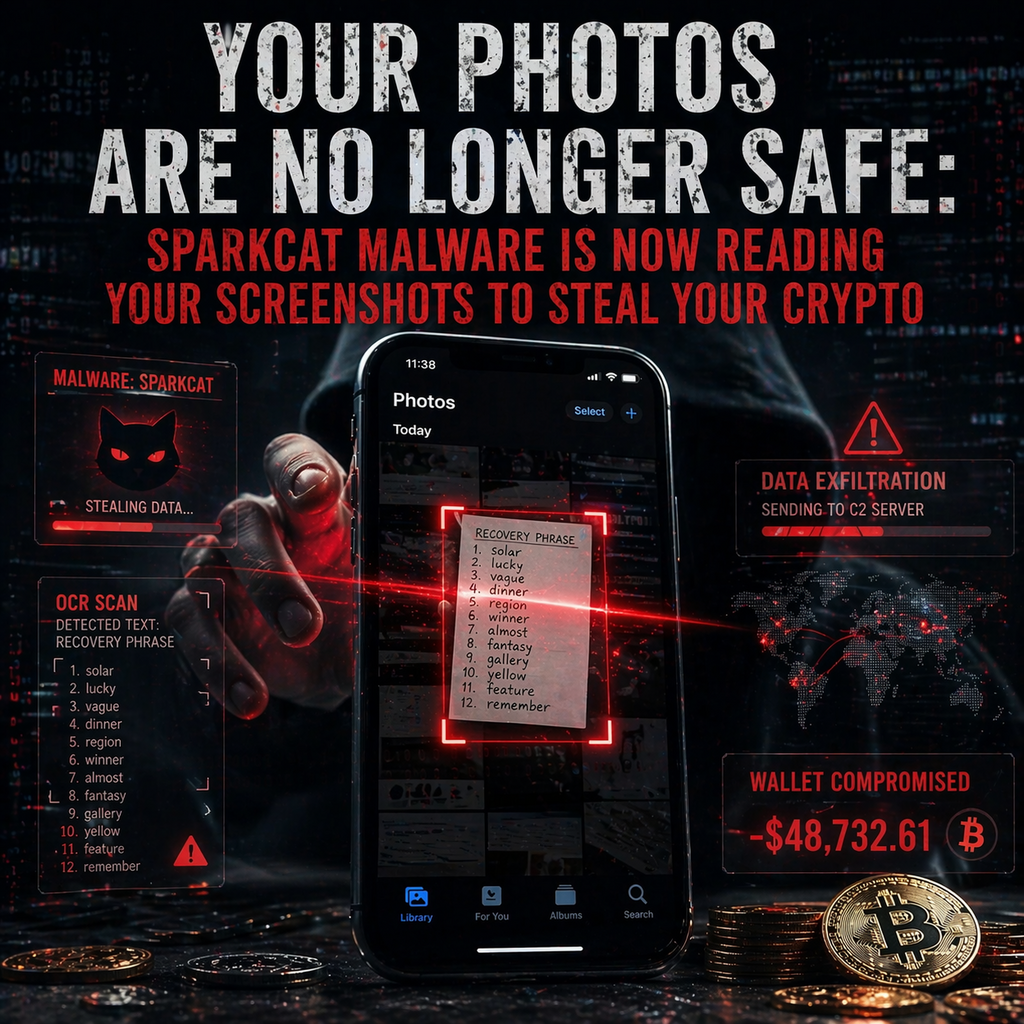
It’s a development many users completely underestimate – and that’s exactly what makes it so dangerous. While most people are still focused on not installing suspicious apps or avoiding typing their seed phrase into unknown platforms, the attack surface has already shifted. With the return of SparkCat malware, one thing becomes clear: even your photos are no longer safe.
This new wave of attacks does not rely on obvious phishing attempts or direct user input. Instead, it operates on a much more subtle level – targeting areas where users feel secure. Their personal gallery. Their screenshots. Their stored images that seem harmless at first glance.
SparkCat is a cross-platform malware affecting both iOS and Android devices, and it hides inside seemingly legitimate applications. That’s what makes it particularly dangerous. Users download normal apps — often utilities or everyday tools — without realizing that something is running silently in the background. Something that does not require interaction, clicks, or permissions that would immediately raise suspicion.
At the core of the attack is a simple but highly effective mechanism. The malware uses OCR technology – optical character recognition – to extract text from images stored on the device. In practical terms, this means screenshots are automatically scanned for sensitive information.
And that’s where the real risk emerges. Many users store important data as screenshots, including recovery phrases for crypto wallets. What feels like a convenient backup method suddenly becomes a critical vulnerability.
Once SparkCat detects a seed phrase within an image, it can extract and transmit it to the attackers. From that moment on, the wallet is effectively compromised. No password, no two-factor authentication, no additional protection layer can stop the attacker from restoring the wallet and draining its contents. The loss is immediate – and in most cases, irreversible.
What makes this situation even more concerning is that SparkCat is not limited to a single ecosystem. Variants of this malware have been identified in both the Apple App Store and Google Play Store. This means even users who strictly rely on official platforms are not automatically protected. Once again, the assumption of built-in safety is being challenged.
At Darkgate, we have repeatedly pointed out that cyberattacks are evolving beyond traditional technical exploits. SparkCat is a perfect example of this shift. It is no longer just about compromising systems — it is about exploiting user behavior. Screenshots, notes, stored data — everything becomes part of the attack surface.
The real danger lies in its invisibility. There is no clear moment when the attack begins. No suspicious login prompt, no obvious phishing page. Everything happens quietly in the background, continuously scanning and extracting information without drawing attention.
For users, this represents a difficult reality. Even practices that once felt safe can now become risks. Storing a seed phrase as a screenshot, something many consider harmless, can open the door to complete financial loss. The line between secure and insecure behavior is shifting rapidly.
SparkCat demonstrates how fundamentally the threat landscape has changed. Attacks no longer happen only where we expect them — they occur exactly where we feel most secure. And that is precisely what makes them so effective.
The key takeaway is simple but uncomfortable: being cautious is no longer enough. Understanding how these attacks work is essential. Because in a world where even your photos can betray you, security is no longer a static state — it is an ongoing process.





