
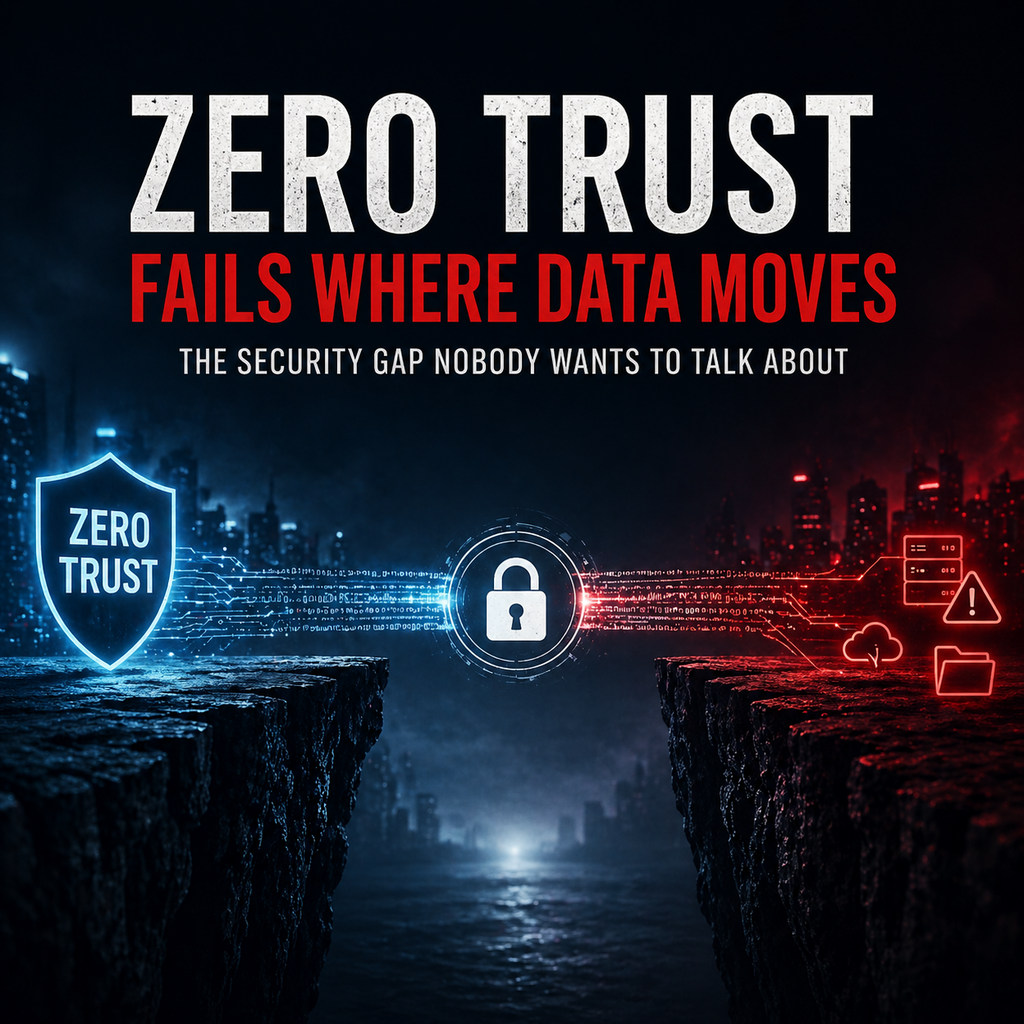
For years, Zero Trust has been positioned as the answer to modern cybersecurity. Verify every user, validate every device, restrict every session. Trust nothing, verify everything. It sounds complete, and on paper, it is. Yet in reality, many Zero Trust programs stall, not because identity controls fail, but because organizations ignore the one layer where trust actually collapses: data movement. Attackers are no longer focused only on breaking into systems. They are targeting what moves between them. The bridges have become more valuable than the walls.
Most enterprises still think connectivity equals security. If the cloud is connected to the SOC, if OT systems can talk to IT, if partners have controlled access to shared environments, the assumption is that the architecture is secure. That assumption is wrong. The moment data crosses a boundary, whether between production systems and enterprise security teams, between business partners, or between classified and unclassified environments, it stops being a routing problem and becomes a trust problem. Data must be inspected, filtered, validated, and policy-controlled before it can be trusted downstream. This is where Zero Trust often breaks. The most visible proof is the explosion of managed file transfer breaches. The attacks against MOVEit, GoAnywhere, and Cleo were not traditional perimeter failures. They were attacks against trusted data movement channels. In the case of MOVEit alone, thousands of organizations were compromised, exposing the personal data of millions. These were not failures of identity management. They were failures of trust at the transfer layer. The systems moving data across environments became the primary attack surface. This is the uncomfortable truth many Zero Trust strategies avoid.
Organizations invest heavily in MFA, endpoint detection, privileged access management, and network segmentation, but they still rely on outdated, manual, or poorly governed processes when sensitive information moves between environments. In critical infrastructure, government networks, and enterprise supply chains, this creates a dangerous contradiction. Access may be secured, but the data itself remains vulnerable in transit. The problem becomes even more severe in operational technology environments. The traditional separation between IT and OT is disappearing. Industrial systems, manufacturing networks, and critical services are increasingly connected to enterprise infrastructure for visibility, analytics, and response. Security teams want real-time telemetry from operational environments. Leadership wants instant decision-making based on live operational data. But every connection between IT and OT creates a new trust boundary. If that movement is not controlled, the security model collapses. Attackers understand this well. Many OT compromises now begin as standard IT breaches before moving laterally into production systems where the real operational damage happens.
Third-party access creates the same weakness. Modern business depends on external vendors, cloud providers, consultants, and service partners. Every one of these relationships creates a shared trust zone. The question is no longer whether a partner can log in, but whether the data exchanged between both sides remains trustworthy.
This is where many breaches now live. The attack surface is no longer the firewall. It is the transfer itself. There is also a dangerous myth that organizations must choose between speed and security. Move data fast or move it safely, but not both. Most security teams accept the delay and choose safety, relying on manual approvals, isolated gateways, and slow review cycles. That worked when response times were measured in hours. It does not work when AI is driving detection, fraud prevention, incident response, and operational decisions in seconds or milliseconds.
An AI-driven security model is only as strong as the integrity of the data feeding it. If security pipelines rely on delayed, incomplete, or manipulated information, the intelligence layer becomes unreliable. The problem is not the AI. The problem is the plumbing underneath. Zero Trust cannot function if trusted decisions are based on untrusted movement. This is why secure data movement must become a core part of Zero Trust architecture. Identity answers who.
Endpoint security answers what. Network segmentation answers where. But none of them answer what happens when data crosses domains. That requires a combination of Zero Trust principles, data-centric security, and cross-domain controls that validate trust at the boundary itself. The strongest security architectures no longer assume data becomes safe once it enters the network. They assume every transfer is hostile until proven otherwise. Validation must happen at the bridge, not after compromise. Policy must travel with the data, not remain fixed at the perimeter. This is where cross-domain solutions matter, not as compliance theater, but as operational necessity. The future of cybersecurity will not be defined by stronger walls. Most walls are already bypassed.
It will be defined by stronger bridges. Attackers know that movement is where policy collapses, where visibility weakens, and where trust is assumed instead of enforced. That is where they operate now. Zero Trust does not fail because organizations forgot identity. It fails because they forgot transfer. The real battlefield is not access. It is movement. And the organizations that understand this first will be the ones still standing when the next generation of breaches arrives.





