
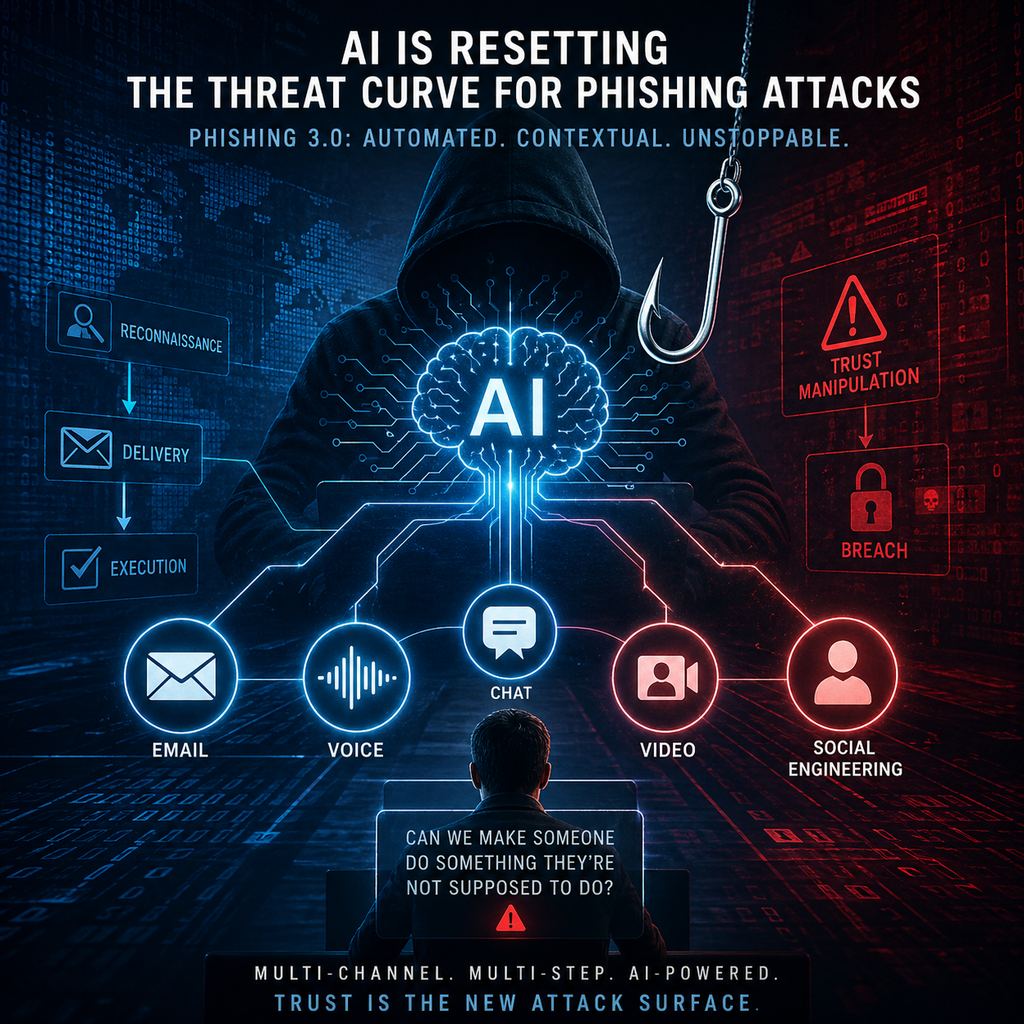
Artificial intelligence is rapidly transforming the nature of phishing attacks, pushing them far beyond traditional email-based scams and into a new phase of autonomous, multi-channel threat execution. In a recent conversation with Dark Reading, Eyal Benishti, CEO of IRONSCALES, described how AI is fundamentally reshaping the phishing landscape — and why many existing defenses are no longer sufficient.
According to Benishti, phishing has evolved into what he calls “Phishing 3.0,” a model defined by automation, contextual awareness, and multi-step attack chains. Unlike legacy phishing campaigns that relied on static templates and mass distribution, AI-driven attacks can now conduct reconnaissance, generate highly personalized content, and deliver it across multiple channels — including email, voice, messaging platforms, and even deepfake video — with minimal or no human involvement.
This shift introduces a critical change in attacker strategy. Rather than relying on known malicious indicators such as suspicious links or domains, modern phishing campaigns are increasingly focused on intent and behavioral manipulation. The objective is no longer just to bypass technical controls, but to influence human decision-making in real time. As Benishti puts it, the core question becomes: can the attacker get someone to take an action they normally wouldn’t?
The implications for organizations are significant. Traditional security models, which depend heavily on signature-based detection and predefined threat indicators, struggle to keep pace with attacks that are dynamic, adaptive, and context-aware. In this new environment, static defenses are increasingly outmatched by continuously evolving threats.
To address this shift, Benishti argues that defenders must adopt the same technological principles as attackers. This includes leveraging AI-driven security systems capable of analyzing intent, detecting anomalies in behavior, and anticipating threats before they fully materialize. The focus moves from reactive detection to proactive threat anticipation.
The broader takeaway is clear: phishing is no longer a single-channel attack vector. It is becoming an AI-powered system designed to exploit trust across digital interactions. For security teams, this means rethinking not only tools, but also the underlying assumptions about how attacks are executed — and how they should be stopped.