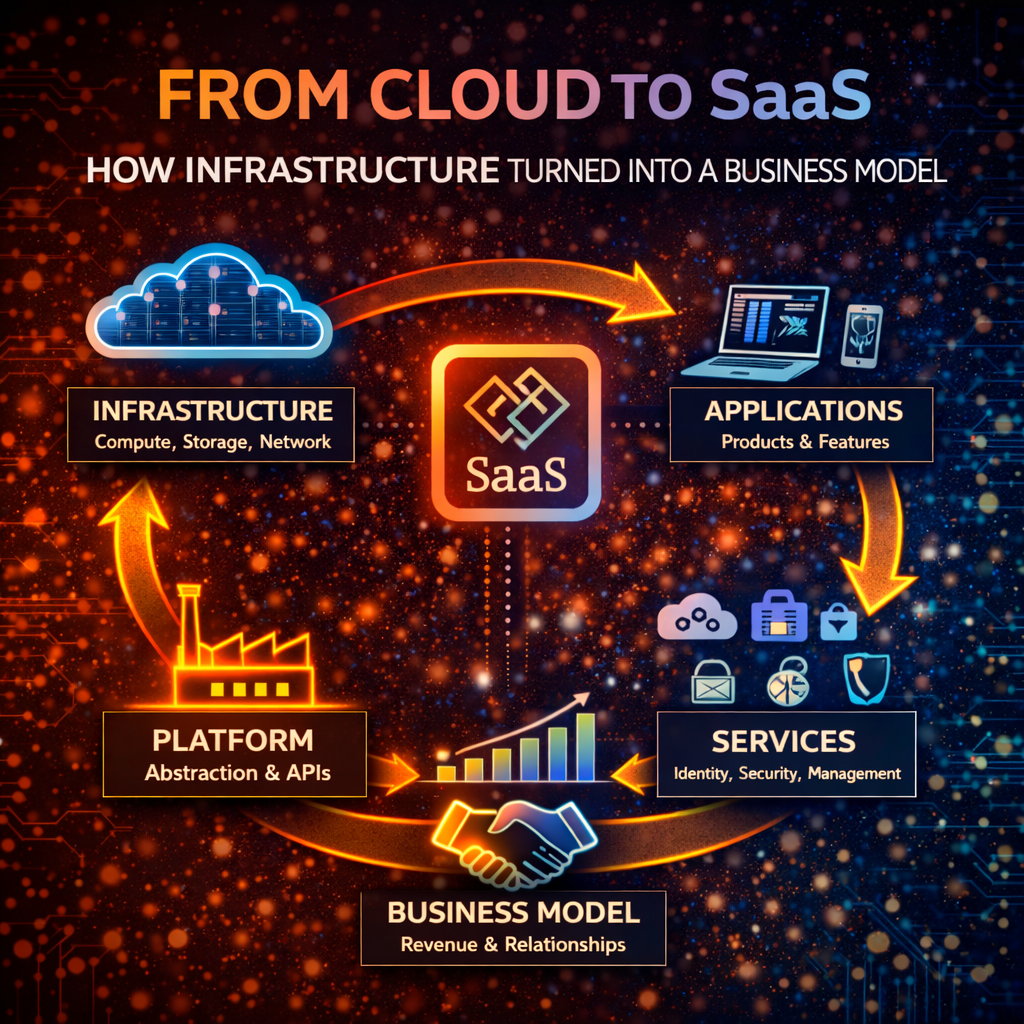
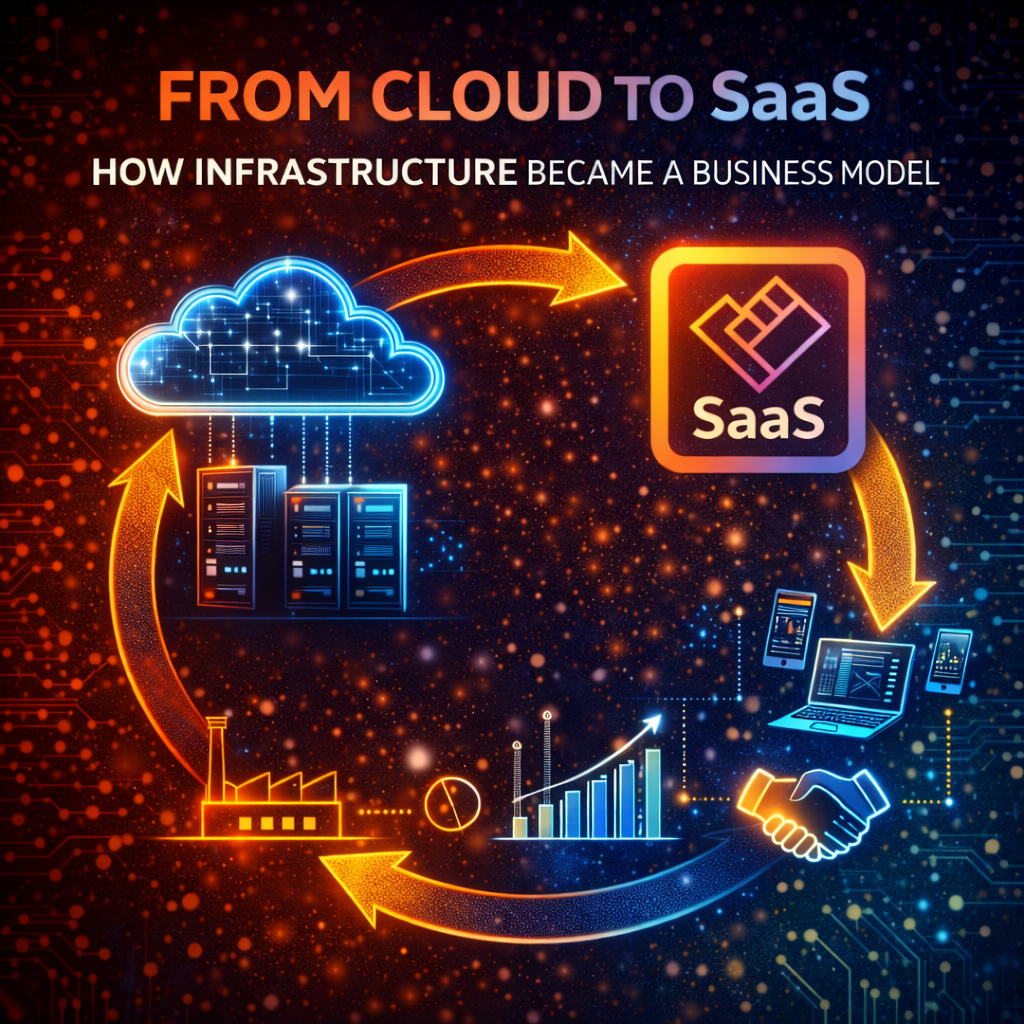
Cloud is no longer a promise about the future. It is reality. And it has changed the way organizations operate faster than many expected. According to IDC, more than 60 percent of European companies now run the majority of their business-critical workloads in public or hybrid clouds. What started as a technical shift has quietly become a structural one. Infrastructure turned into platforms, platforms turned into services, and services became the dominant organizational principle of the digital economy. But cloud itself was never the destination. It was only the foundation. The real transformation began when infrastructure stopped being something organizations owned and started being something they consumed. Not as hardware, not as software, but as a continuously delivered capability. This is where Software as a Service begins. Not as a technical model, but as the economic and organizational consequence of the cloud.
Cloud abstracted machines. SaaS abstracted software. Together they rewired the logic of digital value creation. In its early days, cloud was primarily an efficiency story. Virtual machines replaced physical servers, elastic capacity replaced fixed investment, and data centers disappeared behind APIs. This made IT more flexible, cheaper and more scalable, but it did not fundamentally change how organizations created value, structured markets or designed products. Cloud optimized operations, but it did not redefine them. That changed when software itself moved into the cloud. SaaS turned infrastructure into products and platforms into markets. It translated technical capability into economic models. Subscriptions instead of licenses, usage instead of ownership, continuous delivery instead of versions. Software shifted from a static asset to a living service. “Cloud gave us the factory, SaaS turned it into a business,” as one product leader at a European SaaS provider put it.
On the surface this looks simple. Software in the browser, automatic updates, monthly fees. But structurally it is profound. It shifts software from capital expenditure to operating expenditure, from ownership to access, from internal systems to external platforms. And it shifts power. In traditional models, organizations controlled their systems. They decided when updates happened, which features were deployed, how security was designed. With SaaS, a part of that control moves to the provider. The provider defines the roadmap, the security model, the data architecture and the governance logic. For many organizations this is a relief. For all of them it is a dependency. “We did not outsource servers, we outsourced decisions,” a security architect at a large enterprise once summarized.
This makes SaaS a governance issue. Because it does not only change technology, it changes responsibility, influence and control. It shifts the boundary between inside and outside, between organization and provider, between tool and infrastructure. It also changes economics. Companies no longer sell products, they sell relationships. Not one-off transactions, but recurring value. Not features, but reliability, continuity and trust. This reshapes incentives. Stability becomes part of the product, support becomes part of the value proposition, security becomes part of brand credibility. That is why SaaS providers invest so heavily in availability, resilience and customer experience. Not because of idealism, but because their economic survival depends on it.
Cloud made this model possible. SaaS made it effective. It translated infrastructure into markets, APIs into business models, and scalability into growth. That is why cloud providers themselves moved into the SaaS layer. They did not want to remain invisible infrastructure, but to participate in value creation, build platforms, control ecosystems and shape markets. This is how the layered structure of today’s digital economy emerged. Infrastructure at the bottom, SaaS on top of it, entire industries built on the same foundations above. This concentration creates efficiency, but also systemic relevance. When a dominant provider fails, entire value chains are affected. When prices change, markets react. When rules shift, thousands of organizations adapt.This is why SaaS is no longer an IT topic. It is a strategic one. In conversations with executives, the question is no longer whether to move to the cloud, but what it means to be there. Not whether SaaS is cheaper, but what it binds in the long term. Not who operates the system, but who controls the future. SaaS defines speed, resilience, dependency and freedom of action. Cloud enabled this. SaaS made it visible.
That is why SaaS is not the next step after cloud, but the moment when cloud becomes economically and organizationally real. Not in the data center, but in the balance sheet, in the organization and in the market. In the coming articles we will go deeper into lock-in, regulation, governance, alternatives and strategic design. But first it had to be clear what actually happened. Not the move from servers to virtual machines. Not from licenses to subscriptions. But the move from infrastructure to business model. From machines to markets. From cloud to SaaS. And once that shift has taken place, there is no going back.