Software as a Service is no longer a technical niche topic. It has become the dominant organizational model of digital work. And yet SaaS is still widely misunderstood. As a convenient subscription model. As a way to reduce costs. As a replacement for traditional software licenses. In reality, SaaS describes a much deeper shift. A shift from ownership to usage, from control to relationship, from systems to platforms and from individual convenience to structural dependency. To understand SaaS, one therefore has to look beyond delivery models and ask a different set of questions: Who does the software serve? Who depends on it? And where does it concentrate power?
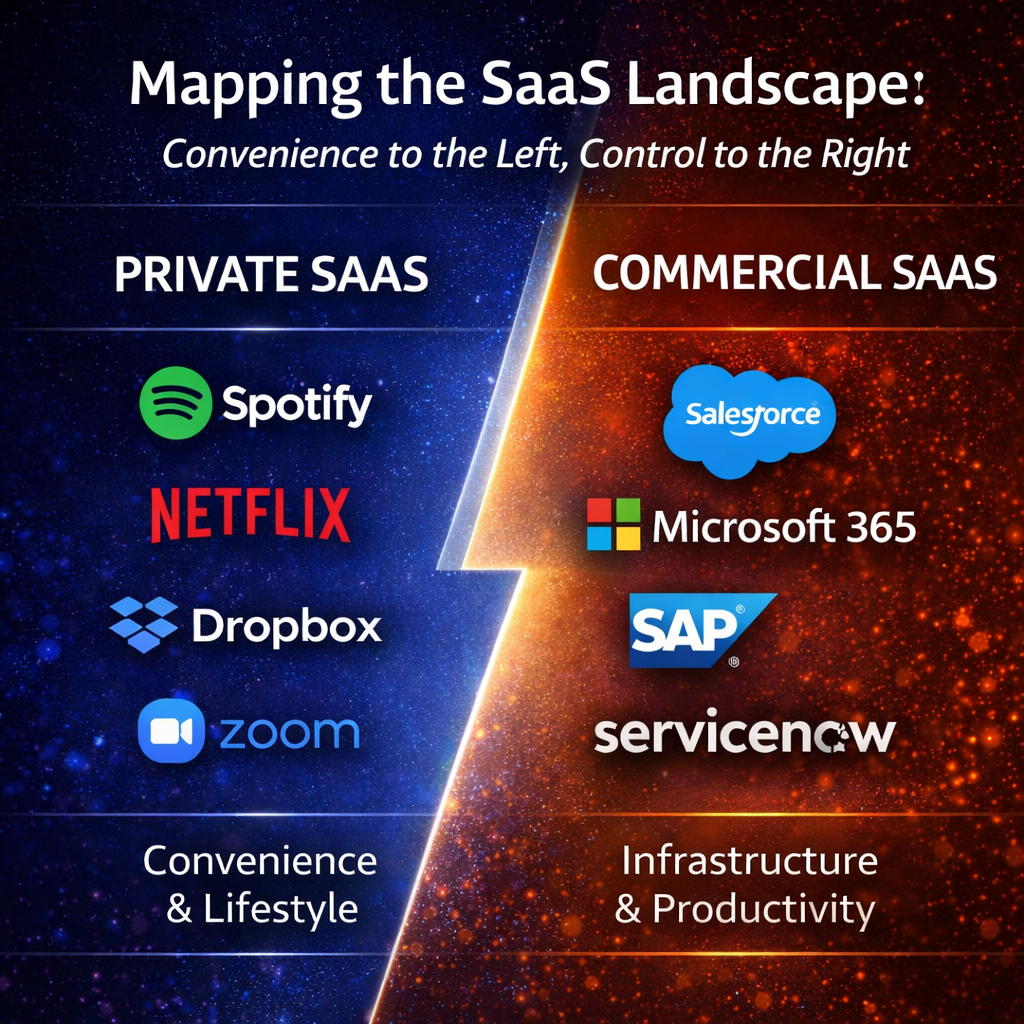
One of the most important distinctions in this context is surprisingly rarely discussed: the difference between private and commercial SaaS. Between the services that make everyday life more comfortable and the platforms that carry entire organizations. Between Spotify and Salesforce. Between Netflix and SAP. Between Google Docs and Microsoft 365. On the surface, they look similar. At their core, they are fundamentally different.Historically, SaaS started in the private domain. The first mass-adopted SaaS models were built for consumers. Webmail replaced local email clients. Streaming replaced physical media. Online tools replaced installed software. Gmail, Dropbox, Spotify, Netflix, later Zoom, Canva, Notion or ChatGPT. The value was immediately visible. No installation. No maintenance. No compatibility issues. Everything simply worked. The price was low, switching was easy, and the risk was limited. If a service was unsatisfying, users cancelled it. Dependency was convenient, not critical.
Commercial SaaS came later and more quietly. Only once cloud infrastructure became technically stable, economically efficient and organizationally accepted did software begin to move into the core of enterprises. CRM moved to the cloud. Then HR. Then finance. Then collaboration, DevOps, identity and security. Today platforms like Salesforce, Microsoft 365, Google Workspace, SAP S/4HANA Cloud, Workday, ServiceNow, Atlassian, Snowflake, GitHub, Okta and cloud-native services are no longer tools. They are operating systems for organizations. Without them, sales stops, payroll stops, development stops, communication stops, security stops.The difference is fundamental. In the private world, SaaS is consumption. In the commercial world, SaaS is infrastructure. Private SaaS changes behavior. Commercial SaaS changes structures. When Spotify goes down, the evening becomes quieter. When Salesforce goes down, sales operations freeze. When Netflix is cancelled, users switch providers. When SAP is cancelled, organizations start transformation programs.
The economic difference is just as significant. The majority of SaaS revenue today is not generated in the consumer market, but in the enterprise segment. Few customers, large contracts, long commitments. Commercial SaaS is not a mass market, it is a power market. This is where dependencies are built, lock-in effects are created, ecosystems emerge and standards are set. Whoever dominates the enterprise segment does not only shape markets, but organizational forms.This is where the strategic dimension of SaaS begins. Whoever operates the platform controls interfaces, data flows, security models, update cycles and roadmaps. Organizations do not only outsource operations with SaaS, they outsource influence. They accept external control over innovation speed, security posture, compliance frameworks and technical evolution. This is efficient. And it is structurally consequential.
We at Darkgate are part of this reality ourselves. When we started in 2019, we deliberately built on SaaS from day one. Our website, our content stack, our CRM, our collaboration, our communication all run on platforms, not on self-operated systems. This allowed us to operate professionally from the first day, to scale without friction and to focus on our core work instead of infrastructure. No server rooms. No maintenance contracts. No IT projects. This decision shaped our speed, our flexibility and our reach. And it also defined our dependencies. Both are true.That ambivalence is what makes SaaS so powerful. It liberates and binds at the same time. It reduces complexity and shifts responsibility. It democratizes access and centralizes control. For startups, it is an enabler. For enterprises, an accelerator. For providers, a source of structural power.That is why SaaS is not an IT model, but an organizational principle. It defines how fast companies can move, how deeply they are integrated, how dependent they become and how easily they can change. It defines who decides about security, who controls data, who sets innovation pace and who adapts.Private SaaS is driven by convenience. Commercial SaaS is driven by efficiency, scale and risk transfer. Both follow the same technical logic. But they produce very different economic and societal effects.
This is why it is important not to confuse these two worlds. Anyone who looks at SaaS only from the end-user perspective misses its structural impact. Anyone who understands SaaS only as a cost model overlooks its political dimension. Anyone who sees SaaS only as technology ignores its organizational force.Software as a Service is not software in the browser. It is the shift from ownership to usage, from systems to relationships, from tools to environments. It is the moment when software stops being something organizations own and becomes something they operate inside.And that is why SaaS is no longer changing just companies, but industries, markets and forms of work. Not loudly. Not through disruption in the classic sense. But quietly, gradually and structurally.