
SaaS is no longer a new pricing model.It has become the operating system of modern companies.
And it is quietly reshaping how organizations work, decide and make money.
According to recent IDC data, around 60 percent of European companies now rely on SaaS-based core systems for CRM, HR, or finance. In many organizations, these platforms are more operationally critical than traditional data centers were a decade ago. When they fail, it is no longer an IT issue. It is a business issue.“When our CRM or finance platform is unavailable, sales slows down, billing is delayed, and decisions become blind,” says the IT director of a European logistics group. “At that point, software is not a tool anymore. It is infrastructure.”
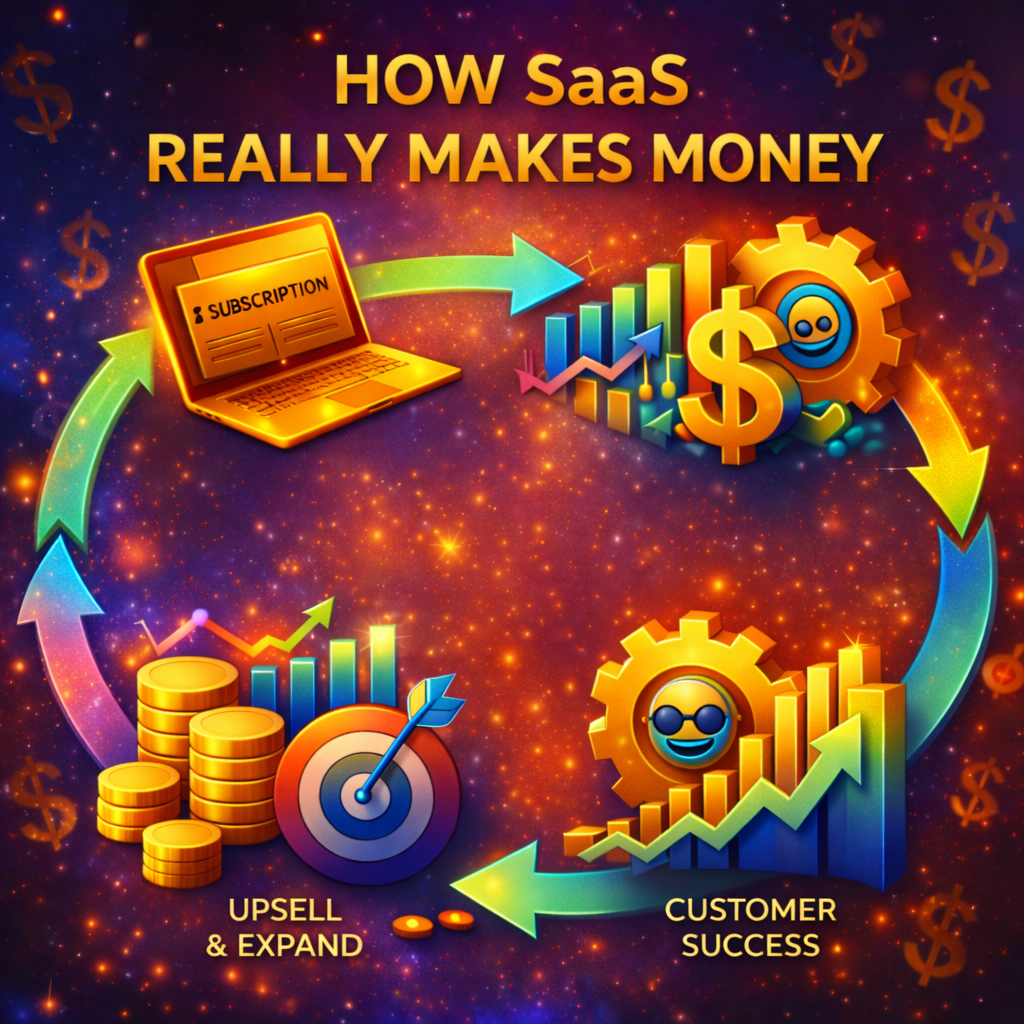
That shift explains why SaaS has become so economically powerful. Not because it sells subscriptions, but because it embeds itself into workflows, responsibilities, and decisions. SaaS does not sell software. It sells reliability.In practice, the business model of a SaaS provider is remarkably calm. There are no dramatic one-time deals, no spectacular contract wins. Instead, money flows in small, steady streams. A company starts with ten users, pays perhaps 40 or 60 euros per user per month, adds reporting, security, or automation modules, integrates additional systems. Each step is small. Together, they define the business.
Most SaaS providers earn money on three levels at the same time. First through base licenses: users, accounts, seats. Second through functionality: analytics, automation, compliance, premium support. Third through volume: data, transactions, API usage, storage, compute. What looks fragmented is actually a finely tuned system of value capture along real usage.Over a year, this does not result in a single big deal, but in a pattern of movement. Customers grow, restructure, expand into new markets, consolidate systems. Revenue follows organizations, not sales campaigns. SaaS scales with companies.
Many providers manage this model through one key metric: Annual Recurring Revenue, ARR. ARR does not measure sales success. It measures stability. It reflects how predictable relationships are, how embedded usage is, how sustainable growth becomes. ARR rewards relevance, not speed.“We focus less on closing and more on staying useful,” says a manager at a European SaaS company. “If our customers grow, we grow. If they struggle, we feel it immediately. That forces us to think long-term.”This logic reshapes sales, product, and operations. Customer success becomes more important than acquisition. Product reliability more important than feature density. Trust more important than persuasion.Over time, SaaS becomes part of organizational identity. It connects data, people, processes, and decisions. It becomes a nervous system for the enterprise. That increases speed, transparency, and coordination — but it also makes technology strategic.
Switching is no longer technical. It becomes organizational. Workflows must be redesigned, people retrained, data reorganized. Not because vendors lock doors, but because the system has become relevant.“You don’t replace software,” says an enterprise architect at an industrial group. “You replace how people work.”That is why exit and migration costs feel high. Not as penalties, but as indicators of integration. The more a system carries, the more carefully change is considered.This effect is reinforced by platform ecosystems. Modern SaaS is not a tool but a hub. Around it emerge marketplaces, integrations, partners, consultants, and specialized services. Customers buy not only functionality, but connectivity.
These ecosystems increase value – and stability.There are, of course, critical voices. “We should not blindly trust black boxes,” warns a security architect at a global hosting provider. “The more we automate, the more consciously we need to design control.”That tension is real. Efficiency and dependency grow together. Speed and responsibility too.But that is also what makes SaaS mature. It forces companies to treat technology not as a tool, but as part of their structure. Not as cost, but as infrastructure.SaaS does not make money through access. It makes money through relevance. Not through control, but through trust. Not through contracts, but through integration.
Whether SaaS will ultimately become the most stable form of digital organization or a new source of strategic dependency remains open. What is clear is this: the question is no longer whether companies use SaaS – but how consciously they do so.