SaaS is no longer an innovation topic in B2B. It has become basic infrastructure. The real shift over the last few years has not been the growing amount of software in use, but the stabilization and consolidation of the market. Between 2022 and the end of 2025, the phase of experimentation gave way to a phase of standardization. Companies stopped looking for new tools and started looking for stable structures. SaaS is no longer introduced to do something new, but to run something reliably.What became particularly visible during this period is the transition from tools to infrastructure. The winners are not the vendors with the most exciting features, but those that take over core organizational functions: identity, access, workflows, data, governance, and security. SaaS is becoming the operating system of the organization rather than its toolbox.This shift is especially clear in IT departments, among system integrators, and in large industrial enterprises. In these environments, SaaS is not optional. It is structural. It forms the layers on which IT operations, security, development, and business processes are built.
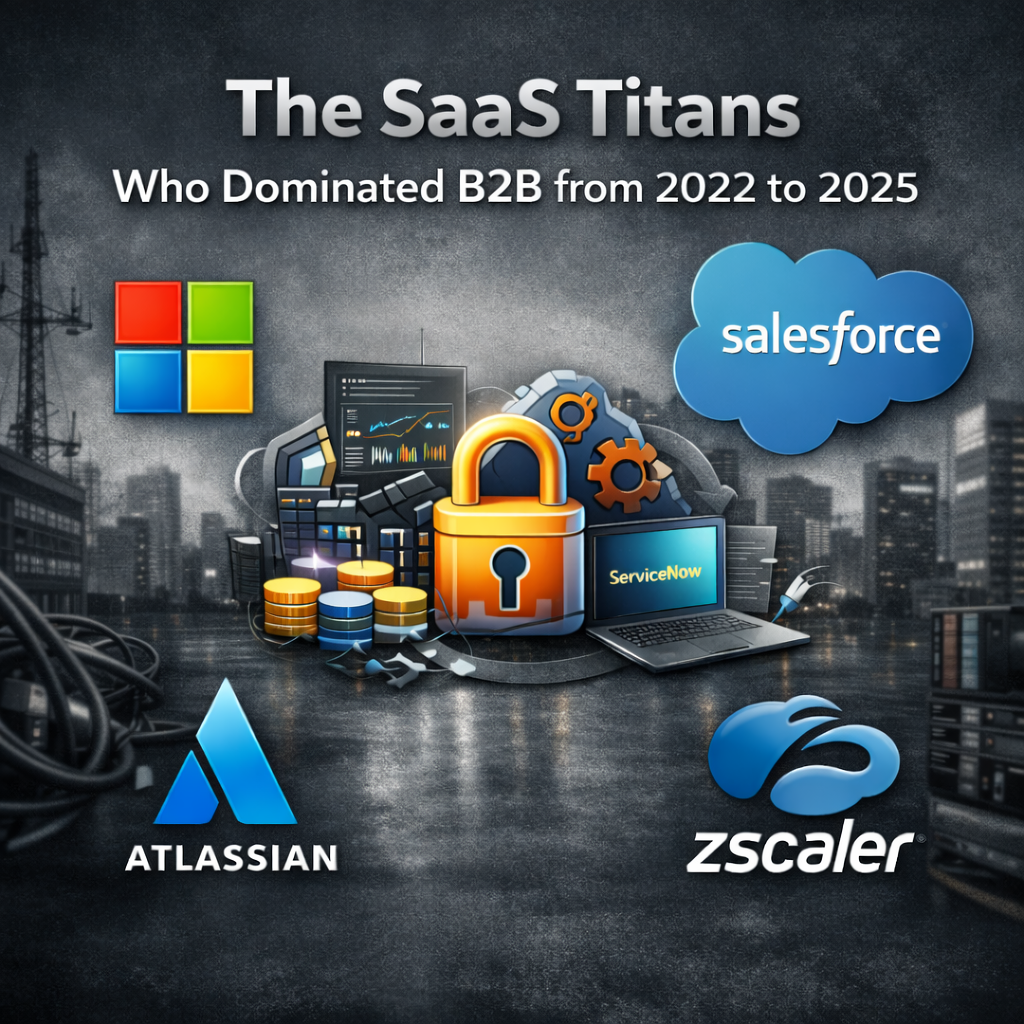
Microsoft illustrates this dominance most clearly. Microsoft 365, Azure, and Entra ID have become the baseline layer of digital organization in many companies. This is where users exist, where rights are assigned, where devices are managed, where compliance is enforced. Microsoft is not dominant because it excites everyone, but because it connects everything. For IT departments, Microsoft is no longer a vendor, but the center of gravity. For integrators, Microsoft is the starting point of almost every project, whether it is identity integration, zero trust architecture, hybrid cloud, governance, or security. Microsoft wins not through brilliance, but through structural centrality.On the business side, Salesforce remains the defining standard. In enterprise B2B, CRM is no longer sales software but a process backbone. Quoting, forecasting, service workflows, partner management, and reporting all depend on it. Salesforce is less a tool than a process engine. Companies rarely leave Salesforce because it is too expensive. They leave only when they are willing to redesign how the organization itself works.
For production-oriented IT teams, integrators, and platform groups, other vendors are just as critical. Atlassian with Jira and Confluence, together with GitHub, has become the operational workspace for development, integration, and delivery. Tickets, changes, projects, code, documentation, and institutional knowledge converge there. These platforms are not visible from the outside, but internally they structure how work actually happens. Whoever controls this layer controls the rhythm of the organization.Alongside this, a second layer has become dominant between 2022 and 2025: governance, security, and control. ServiceNow has become the process authority in many large enterprises, managing IT service management, asset tracking, change management, incident response, and increasingly security and compliance workflows. It does not design how companies work, it regulates how they remain stable. Snowflake and Splunk have established themselves as data and observability layers because organizations have realized that visibility is a prerequisite for control. Zscaler, Palo Alto Networks, and similar security providers have gained ground wherever access itself became the security boundary.
What unites these vendors is not innovation, but risk reduction. They do not promise speed. They promise stability. Not freedom, but control. And that is exactly what large organizations need.
Buying behavior has changed accordingly. Companies no longer purchase individual tools. They select layers: identity, security, ITSM, data, collaboration, CRM. These layers are consciously chosen and then kept stable for as long as possible. Switching is not avoided because it is impossible, but because it is risky, expensive, and organizationally complex. SaaS does not create technical lock-in. It creates structural inertia. And it is precisely this inertia that stabilizes the position of the dominant vendors.For system integrators, this means that relevance no longer comes from introducing new tools, but from connecting existing ones. Projects arise at the interfaces: identity and security, CRM and ERP, data and compliance, OT and IT, cloud and governance. Value is no longer in the product, but in orchestration.For industrial enterprises, this means IT is no longer an enabler, but a control function. SaaS is not adopted to experiment, but to govern: processes, risks, costs, and responsibilities.
This is why the most dominant vendors from 2022 to 2025 were not the most exciting ones, but the most stable ones. Those that do not promise to invent the future, but to make the present sustainable.Whether this concentration is ultimately healthy or problematic remains open. It creates efficiency and stability, but also dependency and shifts of power. What is clear is this: in B2B, SaaS is no longer a market. It is a structure. And the true titans are not the loudest vendors, but the ones no one can avoid anymore.