
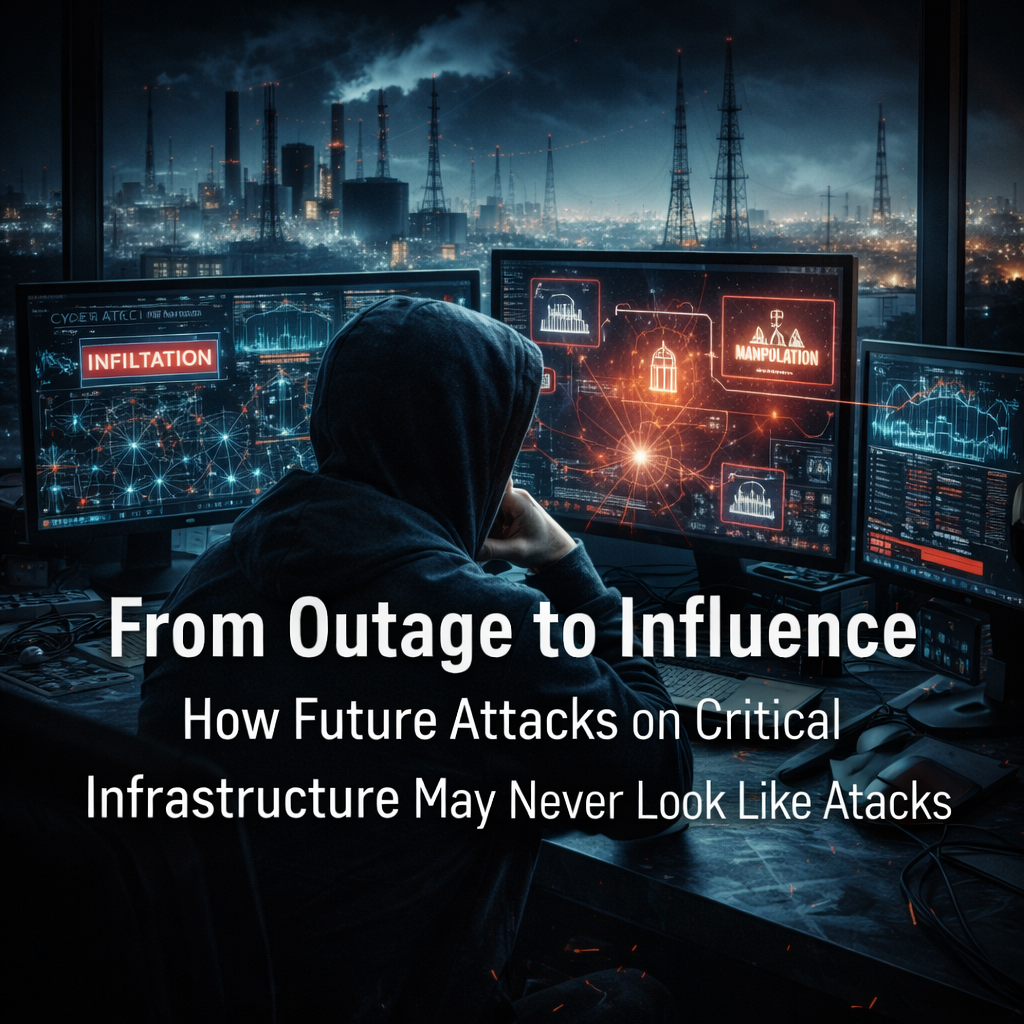
For years, attacks on critical infrastructure followed a familiar pattern. Systems went down. Screens went dark. Networks failed. Power grids collapsed. Water stopped flowing. The damage was visible, immediate, and unmistakable. That mental model still shapes how many organizations prepare for risk today. And it is increasingly outdated.Future attacks on critical infrastructure are unlikely to announce themselves through outages. Disruption draws attention. Attention triggers political response, public scrutiny, and escalation. Actors who think strategically will avoid that path. Instead, the focus is shifting toward influence. Toward shaping outcomes, decisions, and behavior without ever pulling the plug.Modern KRITIS environments are no longer isolated systems. They are deeply interconnected ecosystems built on cloud services, shared control planes, third-party APIs, centralized identity services, and automated management layers. An attacker does not need to take systems offline. Access at the right dependency can be enough to alter the behavior of many others. Systems remain operational. Dashboards stay green. But decisions are made on subtly distorted signals.
This becomes particularly dangerous where digital infrastructure directly controls physical processes. Energy distribution, traffic management, industrial production, water treatment. Small parameter changes, kept within acceptable thresholds, can slowly degrade efficiency, increase wear, or shift operational behavior. Nothing breaks immediately. The damage accumulates quietly and often goes unnoticed until the root cause is no longer traceable.Update and maintenance mechanisms represent another critical pressure point. Automation is essential to modern infrastructure, but it also concentrates trust. Configuration changes, policy updates, and security rules are distributed at scale. Manipulating these mechanisms does not require compromising individual systems. It only requires altering what those systems are told to do. The attack blends seamlessly into routine operations.
Cloud centralization further amplifies this risk. Control planes and orchestration layers have become strategic assets. They define access, priorities, and constraints across entire environments. Influence at this level does not steal data or cause downtime. It reshapes control. Power shifts without obvious technical failure.Perhaps the most subtle evolution is the targeting of decision-making itself. Operators increasingly rely on automated analytics, predictive models, and recommendation systems. When those inputs are manipulated, humans still act — but on flawed premises. The infrastructure works. People follow procedures. And yet outcomes change. The attack disappears into normal operational behavior.
Politically, this creates a new and dangerous dynamic. These actions remain below traditional thresholds of escalation. There is no blackout. No visible sabotage. No clear attribution. Influence replaces confrontation. Destabilization occurs without triggering the mechanisms designed to respond to attacks. Critical infrastructure becomes a geopolitical instrument even when it remains technically functional.For operators, this represents a fundamental shift in responsibility. Availability alone is no longer the benchmark. Trust becomes the core metric. Trust in data, trust in systems, trust in the decisions those systems enable. The question is no longer “Is the system running?” but “Can we still understand and explain why it behaves the way it does?”In many KRITIS organizations, the most serious gaps are already visible. Not in firewalls or monitoring tools, but in transparency, system comprehension, and governance. Who controls changes? Who validates automated decisions? Who detects gradual deviation rather than sudden failure? And who carries responsibility when no single fault can be identified?
Future attacks on critical infrastructure will likely be less dramatic than expected. No cascading blackouts. No cinematic collapses. Instead, persistent uncertainty. Subtle erosion of reliability. Decisions that later prove wrong, without a clear moment of failure. The real damage will not come from downtime, but from the slow degradation of confidence.This is where Darkgate draws a clear line. Critical infrastructure resilience is not purely a technical challenge. It is a human one. It depends on people who understand systems end to end, recognize dependencies, and are willing to take responsibility in ambiguous situations. Regulation and automation may support this effort, but they cannot replace judgment.The transition from outage to influence is already underway. The question is not whether critical infrastructure will become a target of these strategies. The question is whether operators will be able to recognize when something is wrong — even when everything appears to be working.