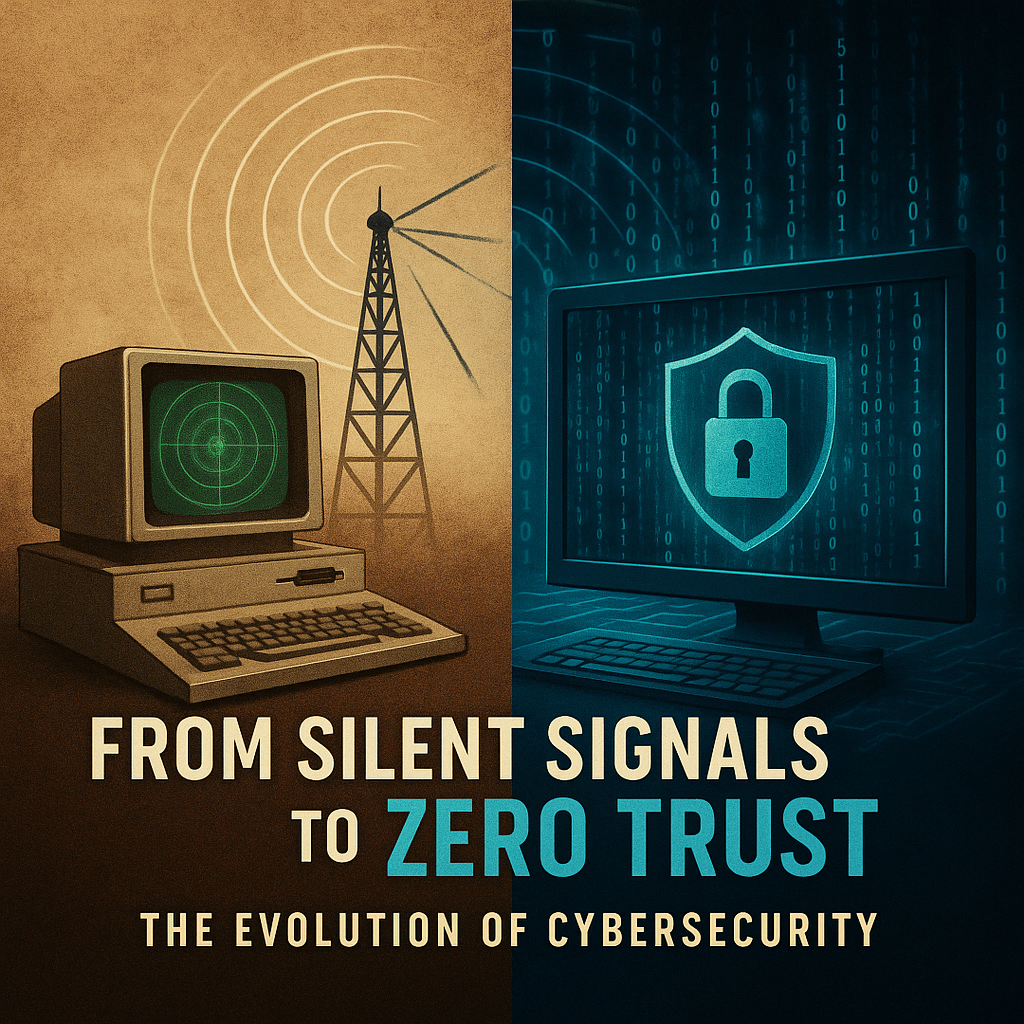
Some turning points in technology happen quietly. No explosion, no crisis broadcasted on screens just a flicker in a data stream, a signal intercepted somewhere it shouldn’t be, a transmission that reaches the wrong antenna. Long before the world talked about cyberattacks or digital warfare, global powers were already fighting for control over information. Not with weapons, but with algorithms, antennas and the steady hands of cryptographers shaping the rules of secrecy. Many of the principles that define today’s cybersecurity were born in this shadow ecosystem, engineered in places where no one outside was meant to look.
When nations first began to protect their own communication and listen to everyone else’s, a silent technological race started to unfold. While diplomats discussed treaties, engineers built machines that decoded whispers in the ether. The NSA erected massive listening fields, metallic structures blooming out of the landscape. The GCHQ turned mathematical puzzles into tools of intelligence. Soviet departments analyzed pulses, noise patterns and emerging data flows anything that could reveal how the other side thought. It was a global chess match played with oscilloscopes instead of pawns, and every captured signal shifted the balance just a little.
Computers were not everyday devices back then; they were instruments for military planners, researchers and the intelligence community. Even so, one truth became clear very early: whoever controlled the flow of information gained power without firing a single shot. Encryption wasn’t an academic exercise; it was a shield and a scalpel. The stronger the cipher, the safer the nation. The better the analysts, the deeper the access into systems that were never meant to be opened. This was the era when cryptography evolved from theory into strategy, and its influence still underpins the algorithms we trust today. As networks grew and computers became more connected, the battlefield changed again. Signals turned into structured data. Transmission lines became targets. Nations no longer intercepted messages alone they studied the machines creating them. Early cyber divisions inside agencies like NSA, GCHQ and Soviet counterparts developed ways to slip quietly into foreign systems, not to break them but to understand them. Information became raw material, and every unguarded byte was an opportunity. These groups didn’t talk about “cybersecurity” or “network defense.” They talked about access, persistence, deniability. The vocabulary was different, but the mindset was identical to modern offensive operations.
At the same time, a philosophical conflict emerged between openness and control. Scientists wanted encryption to be public, shared, improved in the open. Intelligence agencies saw it as a weapon one you don’t hand out freely. Many of the secure protocols and techniques businesses use today trace their lineage to research programs that were not meant to leave government walls. The tension between transparency and secrecy became a driving force behind the cryptographic tools that underpin secure communication today. When geopolitical tensions eased, the technical structures didn’t disappear. They expanded. They matured. The NSA built massive digital analysis platforms capable of scanning unimaginable volumes of data. The GCHQ became a nucleus for global cryptographic research. And in Eastern Europe, capabilities once confined to state institutions turned into hybrid operations blending influence, intrusion and information warfare. The competition simply changed form – from cables and radio waves to fiber, packet logs and global network routes.
Meanwhile, enterprises realized, often painfully, that their networks suffered from the same weaknesses intelligence agencies had been studying for decades. Attackers exploited the same patterns: implicit trust, oversized privileges, poorly monitored internal communication and systems that assumed everything inside their perimeter was safe. Many organizations built networks that unknowingly mirrored the vulnerabilities intelligence agencies had exploited in foreign infrastructure years before. Zero Trust feels like a modern business framework, a product of cloud computing and remote work. In truth, it is a rebranding of a philosophy that intelligence communities lived by long before the internet existed. Agencies never trusted internal signals. They never assumed legitimacy based on origin. They never accepted identity without verification. What appears to be a contemporary security model is really the structured version of a decades-old reality: trust nothing, verify everything, especially the things that claim to be “on your side.” Understanding that origin explains why Zero Trust isn’t optional today. The world is more connected, faster and more fragile than the environment in which those early systems were built. But the vulnerabilities are the same. Networks fail when they trust too broadly. Information leaks when no one questions who has access. And modern attackers whether criminal groups or state-backed play by rules that haven’t changed: exploit the invisible, hide in the expected, weaponize every assumption left unchallenged.
Zero Trust is not a trend. It is the echo of a mindset forged in quiet rooms full of radio static, cold terminals and analysts who never accepted anything at face value. And the more dependent our world becomes on digital systems, the more relevant that old lesson becomes: networks are only as secure as the assumptions they rest on. Verification is not paranoia. It is survival.