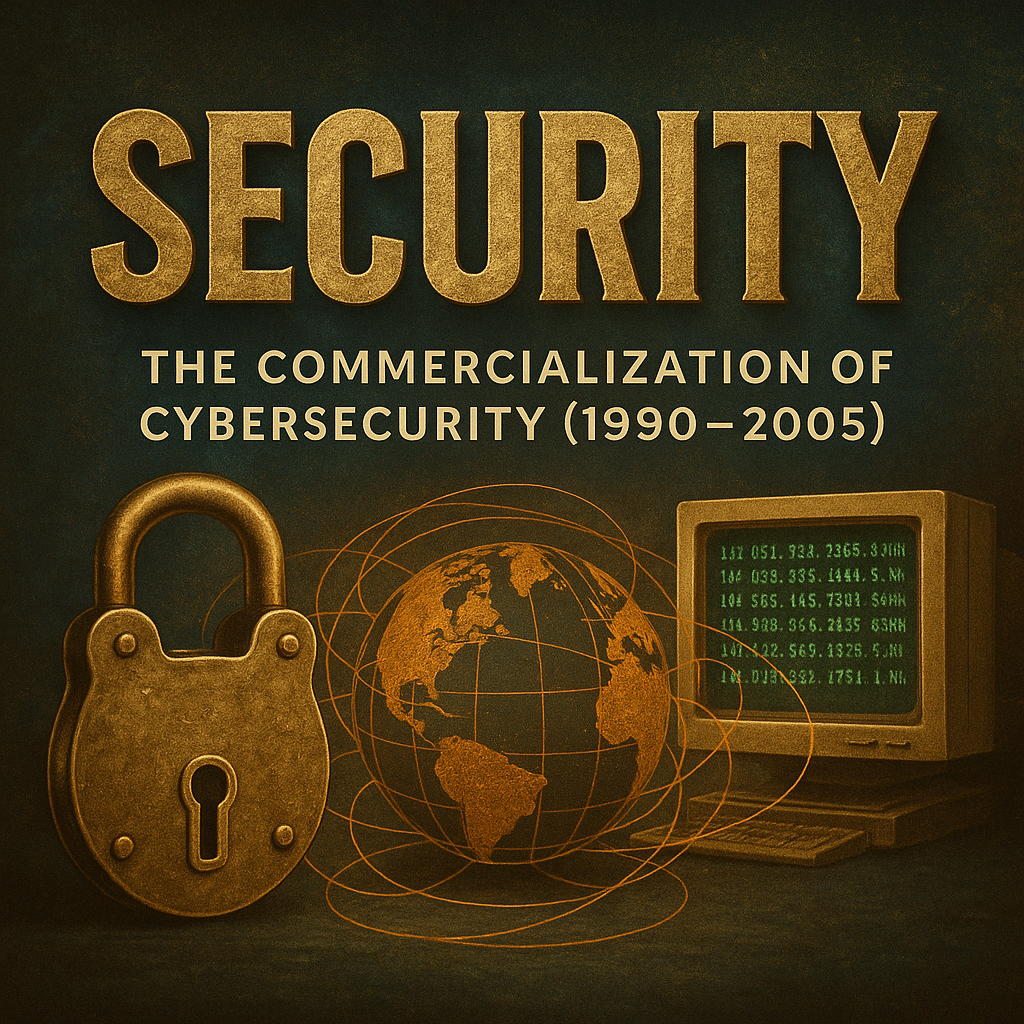
In the early 1990s, the internet was still a quiet background signal. A network for academics, research labs, and a handful of administrators who worked late at night beside humming CRT monitors. Security simply wasn’t part of the conversation. Who would attack a handful of universities that trusted each other by default.
But something was beginning to shift slowly at first, then all at once.
Companies started connecting branches, opening routers, rolling out early email systems, exposing ports that had never been exposed before. What looked like progress created an entirely new attack surface.In this period, the line between “inside” and “outside” networks began to blur. Suddenly, internal systems were no longer sealed off. And the improvised security tricks of the era – router access lists, basic filters, hastily written scripts – were not enough. Threats grew faster than defenses could adapt. Administrators realized they weren’t dealing with isolated events. They were facing a new reality.
This was the moment when cybersecurity stopped being a technical footnote and became a market.The pioneers of that time looked almost like a mix between startups and firefighters. Check Point, founded in 1993, pushed a simple but revolutionary concept: a firewall that made network traffic visible, understandable, and manageable. Not a handful of arcane commands, but a structured ruleset with a graphical interface. Something you could operate without being a programmer.It was like switching on the lights in a room that had been completely dark.
A year later, Cisco released the PIX Firewall. It wasn’t flashy, but it was stable, predictable, and built for real production networks. For many companies, PIX became their first serious line of defense between internal systems and the open internet. It brought structure to a world that had very little of it. Cisco understood early on that security wasn’t an accessory. It was part of the network fabric itself.
Juniper’s NetScreen soon added a different dimension. Networks were getting faster. Bandwidth exploded. Traffic surged. NetScreen’s appliances delivered what the moment demanded: security that could keep up with throughput. They became a favorite among service providers and global enterprises — and showed that cybersecurity was as much about hardware acceleration as about smart software.While firewalls transformed how organizations protected their networks, another market emerged at the endpoint. Symantec and McAfee became household names. In the late 1990s and early 2000s, installing antivirus software was as common as installing Windows itself. It was the moment cybersecurity entered homes and small businesses. From a niche discipline, it became a mass-market product. Between 1990 and 2005, something important happened:
Security stopped being a side topic and became a business model. Companies realized that digital growth was impossible without digital protection.
Security budgets appeared. Security teams formed. Audit requirements tightened. Risk management became a board discussion. For the first time, security had institutional weight. The speed of transformation was remarkable. Only a few years separated the first major wave of internet adoption from the first commercial firewalls. Administrators who once built their own protection scripts now deployed vendor appliances. And, perhaps even more importantly, the culture shifted. Security stopped being that “annoying thing that slows IT down” and became the difference between continuity and disaster.
The early vendors set standards that still shape the industry today. Not because the technology stayed the same, but because the fundamentals they introduced became the foundation: structured rules, segmented networks, defined trust boundaries, visibility into traffic. Everything that came later next-generation firewalls, zero trust architectures, cloud security platforms — grew out of those principles.
Looking back, the commercialization phase from 1990 to 2005 wasn’t a gradual evolution. It was a digital ignition event. A moment in which real products met a real problem, and an industry was born almost overnight. Before this period, cybersecurity barely existed as a market.
After it, it was irreversible. Today, the cybersecurity industry is worth hundreds of billions. But its DNA was forged in those early years, when the internet opened its doors, businesses embraced connectivity, and the world suddenly realized that exposure comes with consequences. For the first time, the digital world understood a simple truth: Security is not optional.
It is the price of connection.