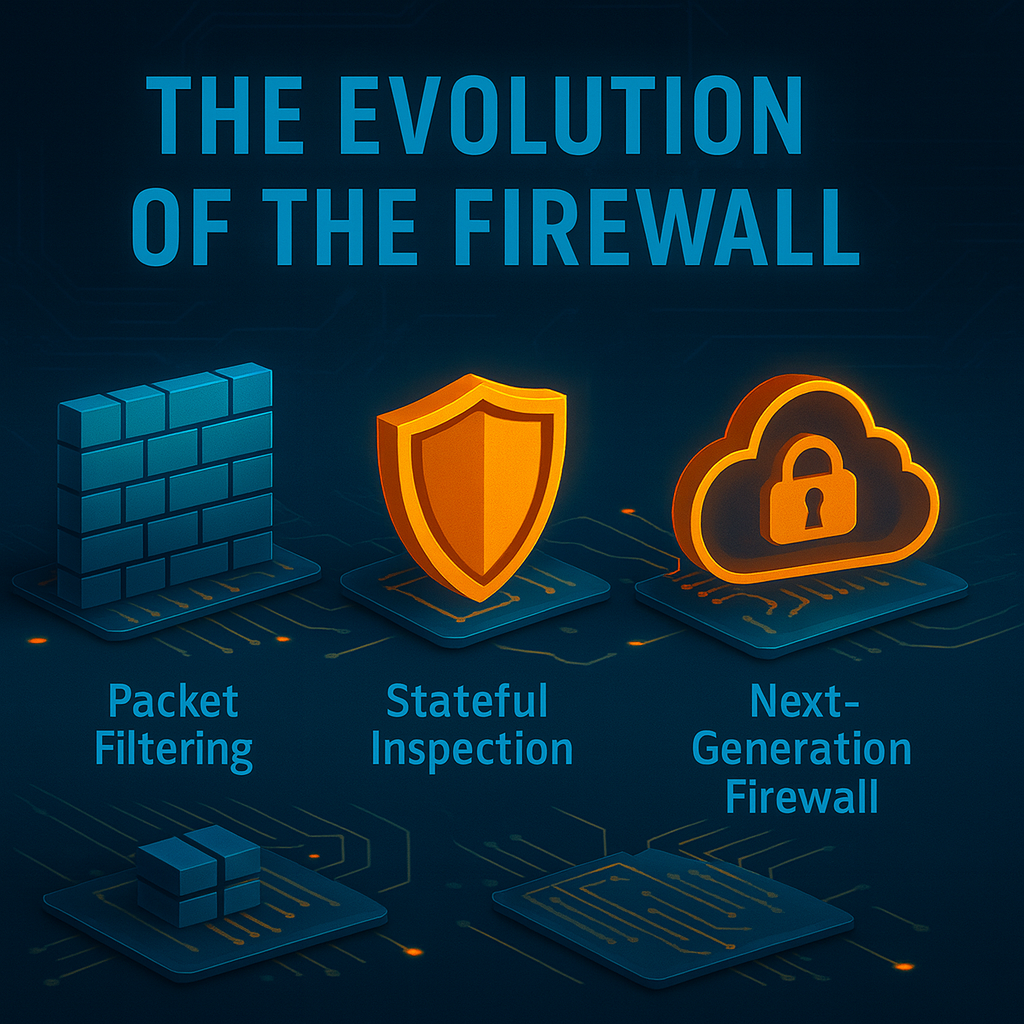
If you talk about firewalls today, everything feels obvious. Rules, sessions, identity control, cloud enforcement, distributed checkpoints. But anyone who remembers the early years knows, that is a very modern illusion. The first firewalls were simple packet filters that behaved wie schlecht gelaunte Türsteher. They looked at a port, saw a protocol, and made a quick decision. Inside was trusted, outside was dangerous. It was a world that still believed in simple boundaries, and for a short moment that belief actually worked. Then the internet exploded in every direction. Email took over offices, websites appeared everywhere, companies connected remote branches, and suddenly corporate networks looked more like busy highways than controlled infrastructures. No one had imagined the speed, the scale or the volume. And certainly not the attacks that came with it.
In this confusion, Check Point appeared and changed the entire perspective. Stateful Inspection was like switching on a light in a basement that had always been dark. For the first time, administrators could see what their networks were doing. They saw connections, not just packets. They understood the story behind the traffic. Some veterans still describe it as the moment network security finally made sense. And once something makes sense, it becomes manageable. Once it becomes manageable, it becomes a product. And once it becomes a product, it becomes a market. A bit later, Cisco arrived with its famous PIX Firewall. It looked nüchtern, aber es funktionierte zuverlässig. It became a trusted part of many infrastructures because it integrated with everything companies already owned. If your backbone and hardware stack came from Cisco, it felt natural to protect it with a Cisco device as well. Security became planbar, nicht improvisiert.
But the comfort of that era lasted only a short time. Applications became more complex, people behaved weniger vorhersehbar, and the idea that ports were a reliable indicator for anything felt increasingly absurd. Then Palo Alto Networks stepped in and introduced the Next Generation Firewall. It did not feel like an upgrade. It felt like someone had lifted a curtain. Suddenly companies saw what was really happening inside their networks. Not the clean and official applications written in documentation, but the hidden ones. Forgotten tools, unexpected services, random traffic that no one wanted to explain. Many teams were shocked. We have seen engineers sitting in silence, staring at the application reports from their NGFW and asking: “We are running all of this?” It was the moment when the firewall stopped being a simple filter and became a real source of truth. It revealed how organisations actually used their networks, not how they believed sie würden genutzt.
Yet even this breakthrough was only a pause in a much bigger transformation. As cloud services, mobile devices, remote work and SaaS platforms spread across the world, the traditional firewall saw weniger und weniger vom echten Datenverkehr. A senior engineer once described it treffend: “Our firewall guards the front door. Most of our traffic now enters through side paths we do not control.” With communication moving everywhere, the old perimeter model quietly collapsed. The firewall was no longer positioned at the natural entry point. The natural entry point no longer existed. Out of this new reality emerged the idea of SASE. Not as a product, but as eine logische Konsequenz. Firewalls moved away from hardware and into global cloud infrastructures. They followed users, not buildings. They enforced policies across regions instead of waiting at a single location. Visibility came from a network of cloud gateways, not a device in a datacenter. And so the firewall became etwas Neues: ein Prinzip, das an vielen Stellen gleichzeitig wirkt. Sometimes it is a physical appliance. Sometimes it is a cloud service. Sometimes it is an identity checkpoint. Sometimes it is a policy engine. It no longer resembles the simple device administrators once racked in the corner of a server room.
Will the traditional firewall disappear? Probably not. It will continue to transform. Gartner predicts that in the next years, most policies will be controlled through cloud layers rather than local equipment. The NGFW will remain in many places, aber häufig als Teil eines größeren Sicherheitsrahmens. Hardware firewalls werden bleiben, wo physische Netze und Industrieanlagen Stabilität brauchen. But the idea of a single, central point of control is fading. Today the firewall is everywhere, verteilt in viele kleine Entscheidungsstellen. Its true evolution is not the change of technology, but its ability to adapt to a system that grows in every direction at once. It remains what it has always been: an attempt to create order in a digital world that refuses to stand still.