
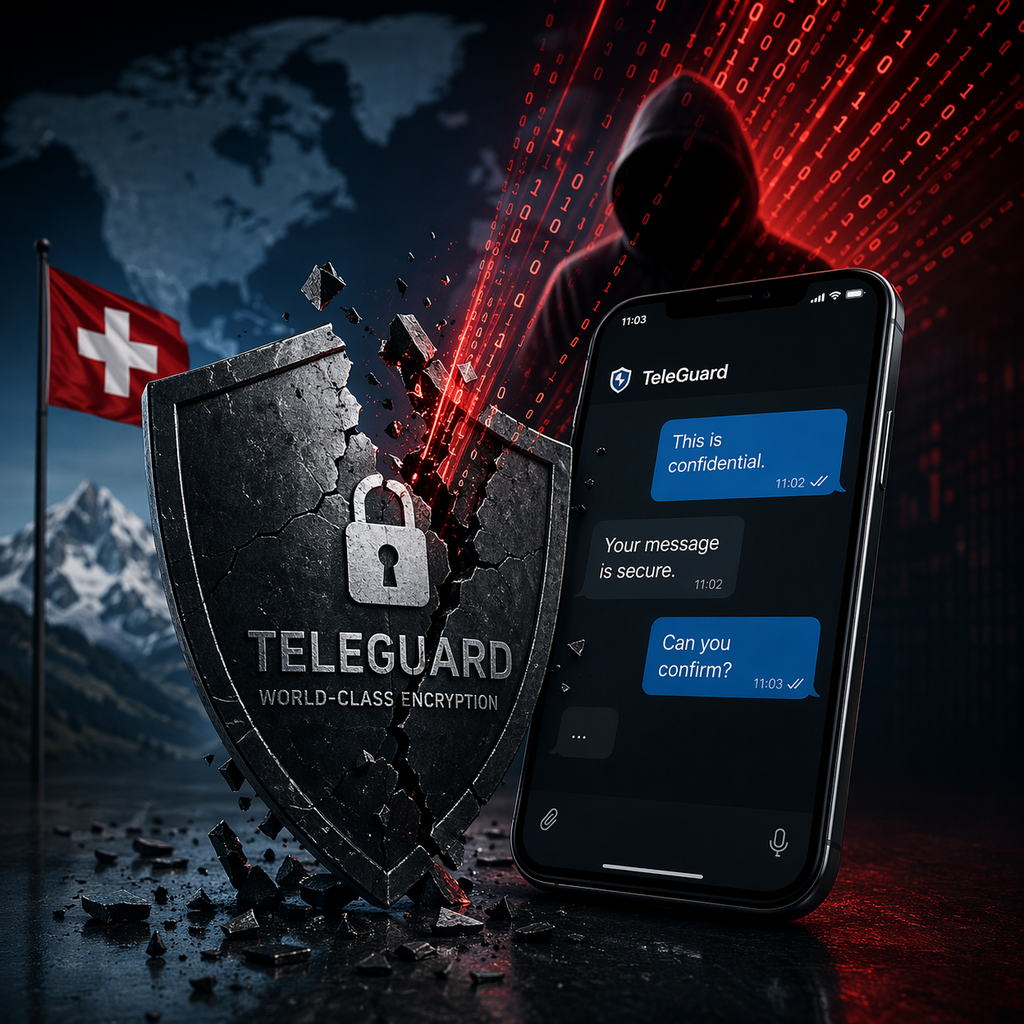
The promises sound familiar – and for many users, reassuring: “world-class encryption,” “maximum privacy,” “no storage of sensitive data.” These are the kinds of claims modern messaging platforms use to position themselves against established players like Signal or Threema. But the recent case surrounding TeleGuard shows how quickly that trust can erode – and why marketing claims alone are never enough in cybersecurity.
At the center of the debate is a report suggesting that security researchers were able to intercept and decrypt messages using a so-called man-in-the-middle (MITM) attack. This is not a trivial scenario, but it’s far from purely theoretical. It targets one of the most sensitive parts of any secure communication system: the key exchange process. And that’s exactly where the real significance of this case lies.
Modern end-to-end encryption is not a single feature – it’s an ecosystem of multiple components: key generation, key exchange, key management, and finally the encryption of the message itself. If even one of these layers is poorly implemented, the entire security model can collapse. That is precisely the concern raised in the TeleGuard case.
One of the most critical allegations is that parts of the key handling process may not be confined entirely to users’ devices. If it were true that private keys – or elements that allow reconstruction of those keys—are transmitted through or accessible via servers, it would fundamentally undermine the concept of end-to-end encryption. The core principle is simple: only the communicating parties should ever have access to the keys – no one else, not even the service provider.
TeleGuard’s operators, however, strongly dispute these claims. According to their position, the criticized RSA-related components are not responsible for the actual message encryption. Instead, they argue that message content is protected by separate symmetric encryption (reportedly based on Salsa20), with keys generated and stored exclusively on user devices. They also describe the demonstrated attack as an artificial laboratory scenario that does not reflect real-world usage conditions.
This kind of disagreement is not unusual in the cybersecurity space. Vendors and researchers often interpret findings differently. But this is exactly where a deeper structural issue becomes visible: without independent, publicly documented security audits, it is extremely difficult for outsiders to determine which side is closer to the truth.
And this is the core lesson of the TeleGuard case. Trust in digital security cannot be built on statements—it must be grounded in verifiable evidence. Platforms like Signal have earned their reputation not through marketing, but through transparent protocols, open specifications, and repeated third-party audits. That level of transparency creates trust that no slogan can replicate.
The case also raises a broader question: how do users actually evaluate the security of a messaging platform? In reality, most rely on surface-level signals—brand recognition, app store ratings, or bold claims. Concepts like forward secrecy, key rotation, or trust establishment rarely factor into decision-making, even though they are critical to real security.
For businesses and security-sensitive environments, this gap can be particularly dangerous. Organizations that rely on messaging apps for confidential communication implicitly trust their underlying architecture. If that architecture is flawed or insufficiently validated, the risk is often invisible—until it becomes a problem.
Another important angle is the role of marketing in the cybersecurity industry. Terms like “military-grade encryption” or “world-class security” are widely used, but they lack precise technical meaning. They create a perception of strength without necessarily reflecting the actual design or implementation of the system. The TeleGuard case highlights how risky this disconnect can be.
At the same time, it’s important not to jump to conclusions. Security research is complex, and not every vulnerability means a system is fundamentally broken. The real measure of a platform is how it responds: how transparent it is, how quickly it addresses issues, and whether it implements structural improvements.
This is also where the opportunity lies. Cases like this sharpen awareness of what real security looks like. They remind us that encryption is not a feature you simply “add”—it’s an ongoing process of design, implementation, verification, and iteration. And they reinforce the idea that trust in digital systems must be continuously earned.
For both individuals and organizations, the takeaway is clear: don’t rely on promises—look at the architecture behind them. True security depends on openness, independent validation, and a clear understanding of how a system actually works.
The TeleGuard case is therefore more than just a single controversy. It reflects a broader dynamic in the cybersecurity landscape—where narratives can shift quickly, and where the difference between perception and reality can be critical. In a world where digital communication underpins nearly everything we do, the ability to see beyond the surface is becoming not just valuable, but essential.