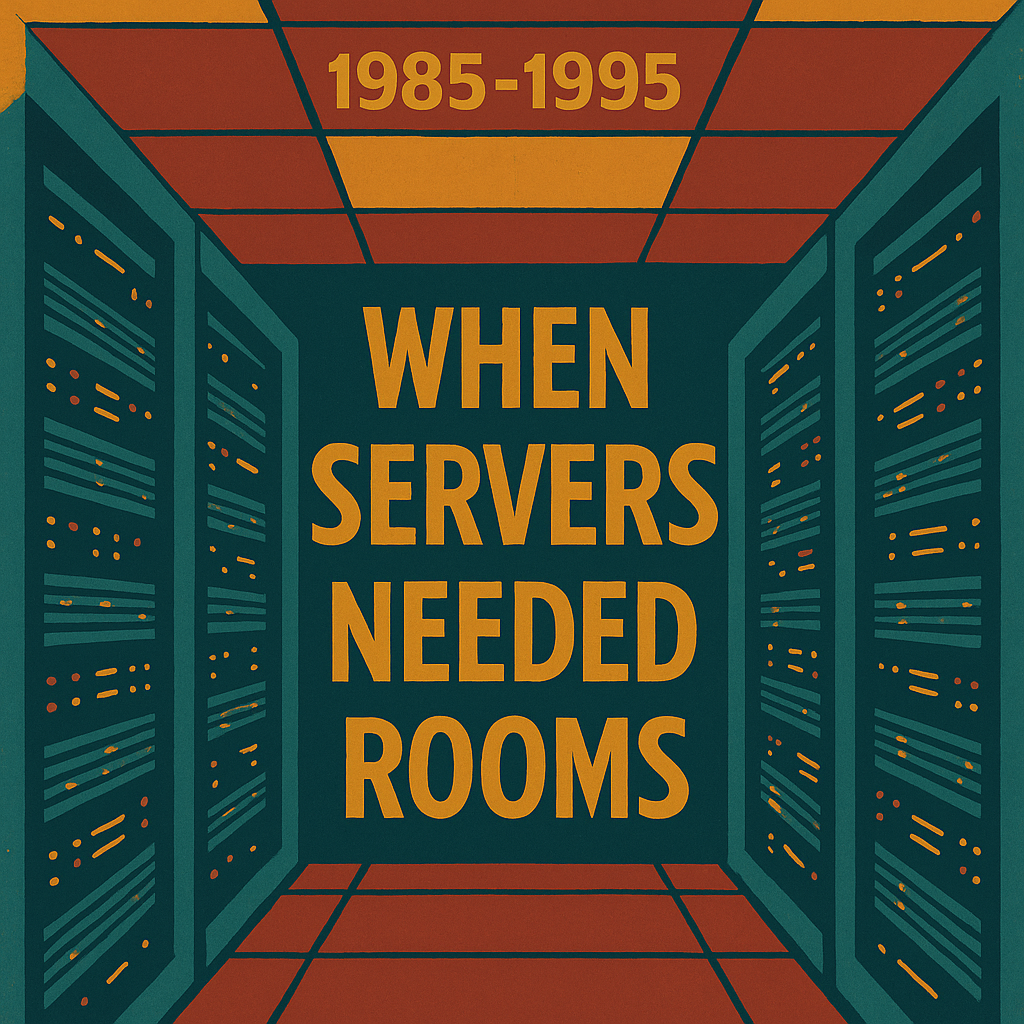
Long before enterprises began debating cloud strategies, hybrid architectures, or software-defined infrastructure, the challenge was far more basic: where to put the servers. In the late 1980s and early 1990s, IT became physically visible. Systems grew larger, louder, heavier, and far more sensitive to their environment. They no longer belonged under desks or in improvised office corners. The server room was not a strategic concept. It was a practical response to a growing technical reality.
Between 1985 and 1995, many organizations built their first dedicated server rooms. In most cases, these spaces were repurposed side rooms, storage areas, or windowless offices. Planning was minimal. Pragmatism ruled. A stable power supply, restricted access, and some form of cooling were considered sufficient. Servers at the time were not abstract resources. They were tangible machines with metal housings, heavy power supplies, spinning disks, and enough noise to make prolonged human presence uncomfortable.Technological developments accelerated this separation. Unix systems, early database servers, and proprietary platforms from vendors such as IBM, DEC, or HP required stable operating conditions. Heat, dust, and power fluctuations quickly became operational risks. Anyone responsible for IT during that period learned early that a failed fan or overloaded power circuit could bring entire business processes to a halt.
From today’s perspective, it is striking how persistent this topic has been. For decades, server infrastructure, server rooms, and data center skills have remained among the most consistently demanded areas in enterprise IT. Across years of working closely with global system integrators and infrastructure providers, one pattern has remained unchanged: technologies evolve, platforms come and go, but the need for people who understand servers, physical infrastructure, and data center operations never disappears. What was relevant at the beginning of professional IT operations continues to be relevant today.Despite their growing importance, early server rooms were often improvised environments. Cooling was rarely redundant and sometimes not even permanent. Uninterruptible power supplies were considered optional. Cabling followed convenience rather than standards. Yet these environments worked. Not efficiently. Not elegantly. But well enough. That fact explains much of their long-term influence.As organizations became increasingly dependent on IT, a more structured approach began to emerge. Raised floors appeared to separate cabling from airflow. Basic fire protection measures were introduced. Access control became more common, driven less by formal security models than by the desire for accountability and order. The server room evolved into a clearly defined place where IT lived and where responsibility was visible.
Looking back, it becomes clear that there was no standardized data center architecture during this phase. Every server room was unique, shaped by the building it occupied and the systems it housed. Redundancy was rarely designed holistically. High availability was not yet a central objective. Outages were tolerated as long as they were understandable. Responsibility was clearly assigned. Everyone knew where the systems were located and who held the key.This clarity helps explain why server rooms still carry strong symbolic value today. Even decades later, websites of system integrators and infrastructure providers continue to feature images of racks, cables, and blinking LEDs. The server room represents control, tangibility, and technical reality. Conversations with experienced infrastructure teams reveal that these images are more than marketing. They reflect a shared understanding that IT ultimately rests on a physical foundation.
Technically, almost everything has changed since the early 1990s. Servers are smaller, more powerful, and virtualized. Cooling is engineered, energy efficiency measurable, monitoring standard practice. Yet many fundamental principles remain unchanged. Power, airflow, space, and accessibility are still critical constraints. In discussions with integrators and data center operators, it is repeatedly evident that failures rarely originate in software. They arise from physical limitations. Overheating, insufficient power capacity, or lack of space remain familiar causes of disruption.Even during the 1990s, developments emerged that would eventually challenge the dominance of the on-premises server room. External data centers, colocation facilities, and early managed services offered alternatives. Still, most organizations continued to operate their own server rooms for many years. Not because they were technically superior, but because they offered proximity, control, and a clear sense of responsibility.
Today, the gradual shift away from traditional server rooms is unmistakable. New on-premises facilities are built less frequently, and existing ones are consolidated or decommissioned. At the same time, demand for server and data center expertise remains high. The server room has not vanished. It has changed its role. It has become smaller, more specialized, and increasingly embedded in hybrid architectures. It now acts as a bridge between local systems, edge environments, and external data centers.
The period between 1985 and 1995 therefore represents more than the technical beginnings of modern data centers. It marks the moment when IT gained a fixed physical place within the enterprise. That spatial anchoring continues to shape how infrastructure is perceived and managed today. Even in an increasingly abstract IT landscape, the server room remains a reference point. Not because it is technologically dominant, but because it embodies structure, responsibility, and reality.