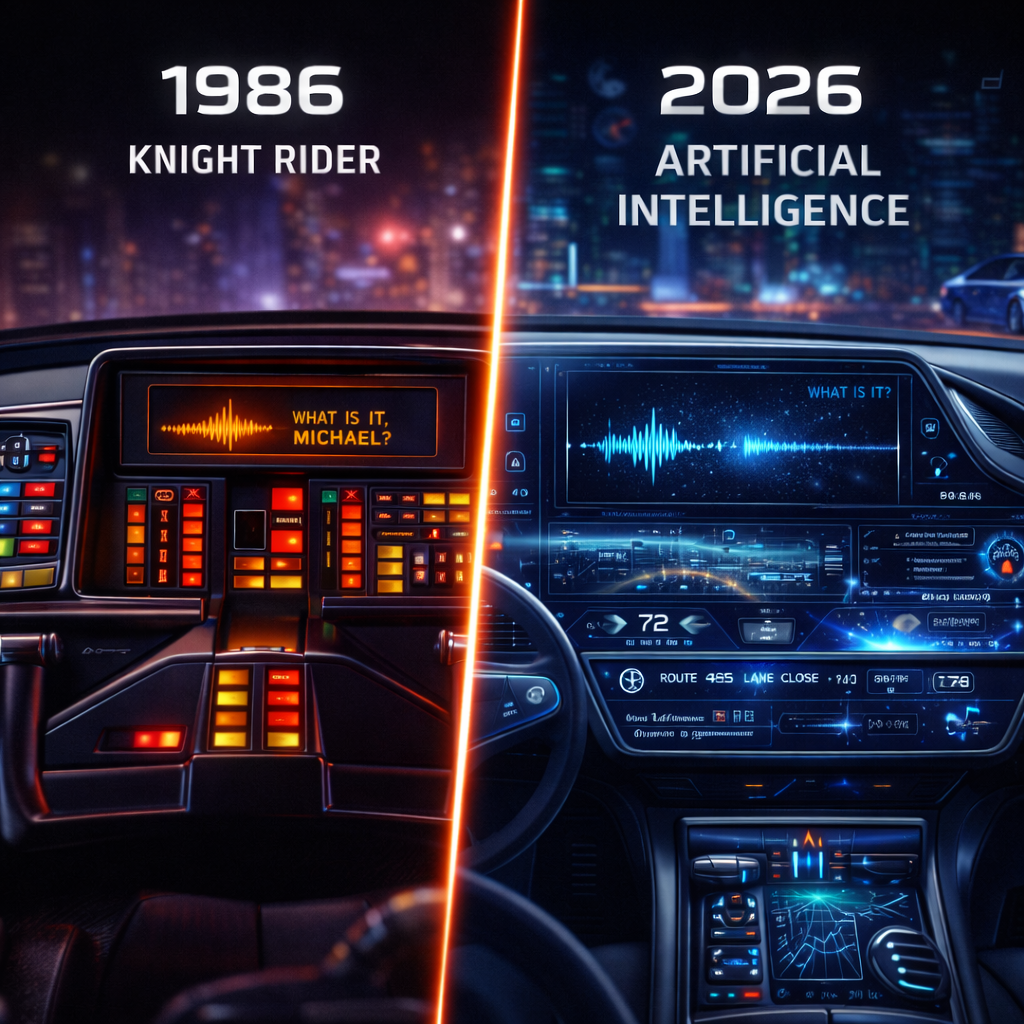
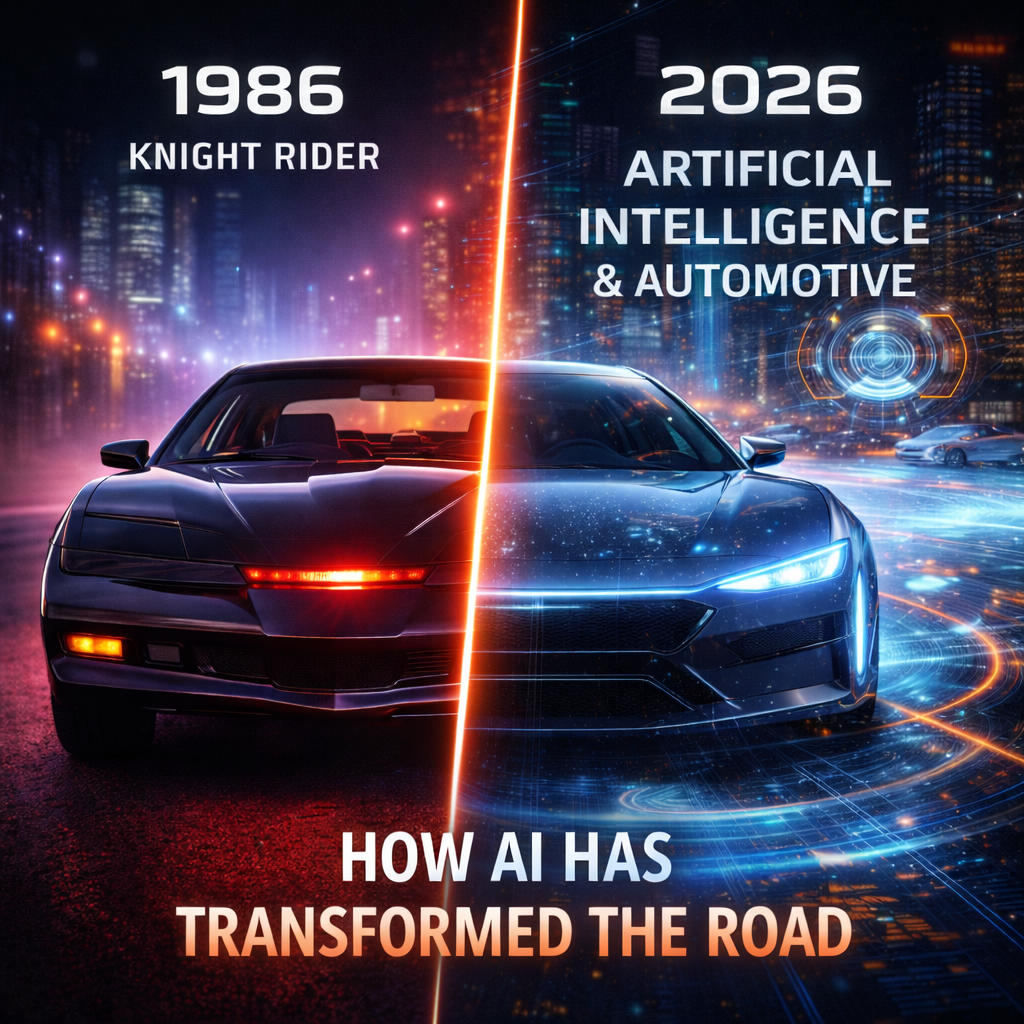
We all remember Knight Rider. For many of us, KITT was not just a car, but a symbol. A black sports car with a red scanning light, a voice, a personality, a character. A machine that could speak, think, decide, and, most importantly, one that felt somehow superior to its human driver. For anyone who grew up in the 80s or 90s, KITT represented the future: intelligence on wheels, technology with awareness, science fiction that felt almost within reach. Even for the team behind Darkgate, Knight Rider was part of our technological imagination, a weekend ritual, a cultural reference point, and a promise of what machines might one day become. That is precisely why the comparison today is so fascinating, because while KITT felt futuristic then, the reality of 2026 has moved far beyond that vision, not in a louder or more theatrical way, but in a deeper, more structural and more consequential one.What we are witnessing today is not the emergence of talking cars, but the rise of driving decision systems.
The fundamental difference is this: KITT was a character, modern vehicles are systems, and systems do not simply change what a car can do, they change what a car is. For a long time, autonomous driving was the big dream, the central narrative. Between roughly 2018 and 2020, when we at Darkgate were supporting clients in the autonomous driving and ADAS space through recruiting and advisory work, the focus was very clear: sensors, cameras, radar, lidar, mapping, real-time processing, redundancy, functional safety. The goal was to build a vehicle that could see the road, understand its surroundings and navigate safely through them. That phase was essential, but it was only the foundation.
Over the last three to four years, something much more profound has happened. Autonomous driving has stopped being primarily a hardware or sensor problem and has become an intelligence problem, a perception problem, an interpretation problem, and ultimately a decision problem. A modern vehicle does not simply see objects, it interprets situations. It does not only detect obstacles, it evaluates risk. It does not only follow rules, it builds internal models of what is normal, what is expected and what is probable. It does not just react, it anticipates.
A car today does not simply drive. It continuously observes its environment, compares it with millions of similar situations contained in global training data, evaluates deviations, calculates options and makes decisions in real time. And this is where the real transformation begins. The modern vehicle is no longer a mechanical product enhanced by software; it is a learning system integrated into physical reality.
The biggest difference to KITT is therefore not the absence of a voice or a personality, but the distribution of intelligence. KITT was a centralized, monolithic figure. Modern vehicles are part of a network. They learn not only from their own experience, but from the collective experience of an entire fleet. They benefit from thousands of other vehicles that have encountered similar situations, processed them and fed that knowledge back into the system. Intelligence is no longer local, it is collective. Knowledge no longer sits inside one car, it flows across an ecosystem.What was once imagined as “autonomy” is becoming something closer to collective intelligence in motion.
A modern vehicle does not detect ice because it has a specific ice sensor, but because hundreds of other vehicles before it reported subtle traction changes. It does not detect traffic jams because it sees them, but because braking behavior, flow data and external signals form a pattern. It does not recognize danger because it is obvious, but because it becomes statistically likely. The vehicle moves from reacting to predicting, from responding to anticipating, from following to understanding.
This is where artificial intelligence moves from being a feature to being the structure itself. AI does not decide where you go, but how safely you get there. It does not choose your route, but it evaluates the risk of every second of your journey. It does not live on the display, it lives in the internal model of the world that the vehicle continuously builds and updates.And that is what makes the next years so important.
By 2026, vehicles will not only be more autonomous, they will be more context-aware. They will not only drive more safely, they will drive more intelligently in a human sense. They will learn to distinguish between rule compliance and situational appropriateness. They will learn that human behavior is not perfect, but it is often predictable. They will learn that traffic is not a mathematical system, but a social one.
A next-generation vehicle does not just recognize a child on the side of the road, it recognizes uncertainty in the movement. It does not just detect a car in its lane, it senses hesitation, urgency, aggression or distraction. It does not only identify objects, it infers intention. And that is an enormous step, because it means that driving becomes less about physics and more about interpretation.With that, we move from technology to responsibility.
A system that makes decisions must be explainable, accountable and trustworthy. The next big challenge will not be whether the car can do something, but whether we understand why it did it. Not whether it is fast enough, but whether it is justifiable enough. Governance, transparency and trust become as important as sensors and algorithms.This is where automotive, artificial intelligence, ethics, law and society intersect.
The vehicle of the future is no longer just a product, it is an actor in public space, a participant in traffic, a presence in our social and legal reality. And that is a far greater transformation than simply removing the steering wheel.From our perspective at Darkgate, this is particularly exciting because we are not only observing this shift, we are actively involved in it. We work with companies building these systems, we recruit for the roles shaping this future, and we see new professions emerging: AI safety engineers, explainable AI architects, vehicle ethics leads, perception reliability specialists. Roles that barely existed a few years ago, but are now becoming essential.We see skill sets shift from pure engineering to system thinking, from functionality to responsibility, from code to context. The industry is not just building smarter machines, it is building frameworks for trust.And that may be the most important progress of all.Not that cars can drive themselves.
But that systems are beginning to understand the world they operate in.Knight Rider was a vision of technology as personality. 2026 is a reality of technology as structure. As invisible intelligence that does not impress, but supports. That does not perform, but protects. That does not speak, but acts quietly, continuously and responsibly.That may be less spectacular than a red scanning light on a black hood.But it is infinitely more powerful.And that is why the transformation of the road through artificial intelligence is not just a technical development. It is a cultural one. A shift in how we relate to machines, in how we understand control, and in how we define responsibility.And that might be the most important technological shift of our time.