The criminal use of generative AI has accelerated faster in the past two years than most security teams could adapt. While traditional fraud methods such as forged documents, manipulated IDs or basic social-engineering tactics have been known for decades, deepfake-driven attacks and fully synthetic digital identities introduce new threat vectors that existing processes are no longer capable of handling. Banks, financial service providers, HR departments and remote identity-verification vendors are now facing attacks that were considered theoretical just a short time ago. Today, they are part of the operational risk landscape.Integrators and security teams already report a noticeable rise in cases where digital identities can no longer be confidently tied to a real human being. A Chief Technology Officer at a European IT integrator told Darkgate that attackers successfully passed a video-KYC process in at least two incidents not with a real human in front of the camera but with a fully AI-generated face. The deepfake quality surpassed older models significantly. The verification system detected neither artefacts nor inconsistencies and classified the video as authentic.
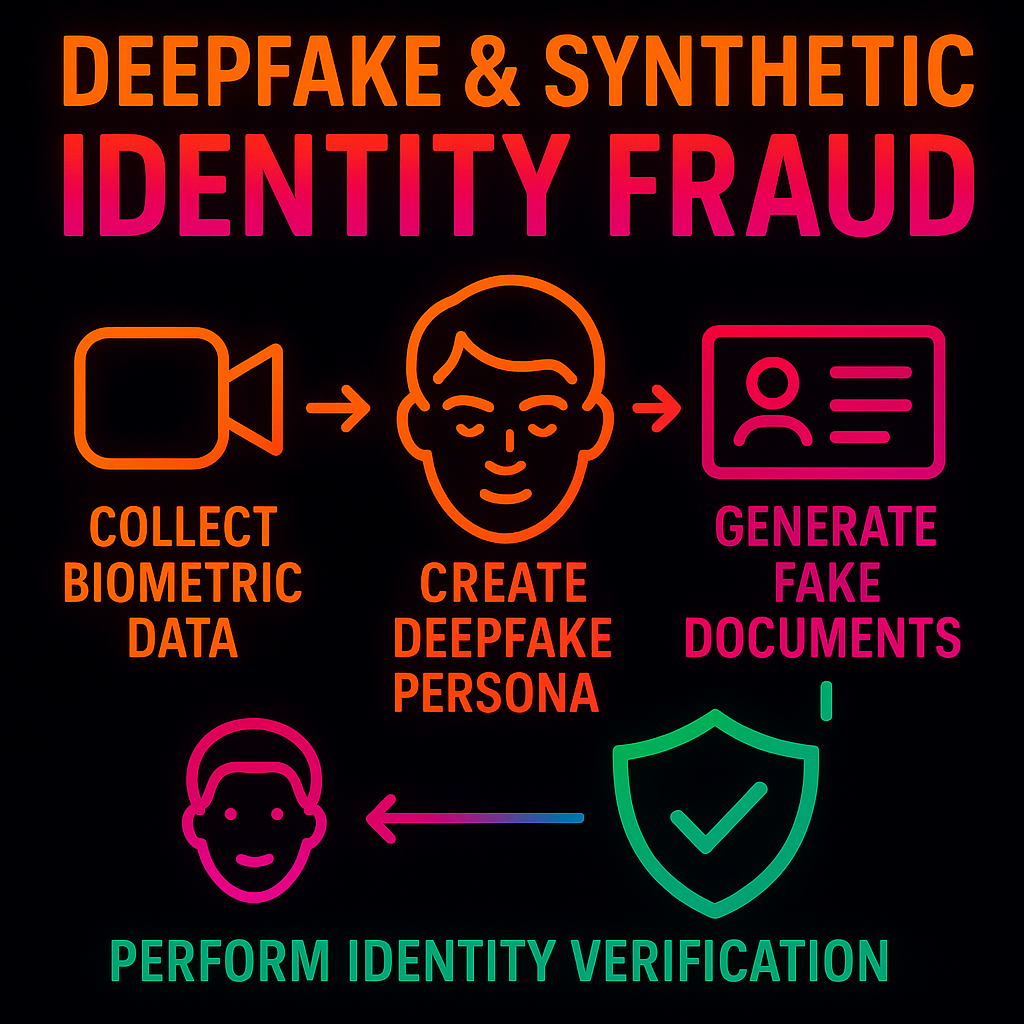
These attacks are assembled from several components. Attackers start by gathering biometric traces, such as public photos, short video clips or social-media footage of the target. They then train a bespoke face model capable of simulating expressions, micro-movements, eye reactions and head tracking in real time. In parallel, they generate stolen or synthetic ID documents and present them during the video-KYC session. The quality is now high enough that even human reviewers fail to detect inconsistencies.Banks are particularly vulnerable because many have migrated from in-branch onboarding to fully digital identity flows. KYC systems often rely on the same biometric verification modules used by telecom providers, credit issuers and payment platforms. A single successful attack can open access to credit lines, cards, trading accounts or cryptocurrency exchanges. Once funds are moved, institutions often have hours not days to stop the transactions. After 24 hours, the money is usually gone.
Another scenario reported by a Darkgate-aligned integrator involves fully fabricated employee identities in HR processes. Recruiting today is largely remote. Most interviews, background checks and initial conversations happen on video or through automated digital systems. In a 2025 case, a fraudulent “Senior Engineer” was hired a person who did not exist. The individual had a convincing online footprint, complete with deepfake videos, a polished portfolio and fully simulated reference contacts. The fraud surfaced only when the engineer repeatedly failed to deliver during onboarding. The individual had appeared in at least five video calls using a synthetic face with realistic motion and lighting.The implication is clear: organisations are no longer just dealing with social-engineering attempts; they are facing fully constructed identities capable of maintaining a presence for months. Cloud-based real-time generative models allow attackers to produce accurate lip-sync, ambient lighting, shadows and facial dynamics. For HR, talent acquisition teams and outsourcing providers, traditional video interviews and ID checks are increasingly insufficient.Short term, deepfake attacks will continue to target remote KYC processes and HR onboarding flows, because these carry the highest likelihood of success. Systems that rely on static or shallow video-based biometric checks are becoming obsolete. Verification processes without advanced challenge-response sequences, without dynamic head-tracking or without high-resolution 3D depth analysis are already being bypassed.Mid-term, the threat expands to real-time voice cloning and behavioural simulation. Financial institutions have already documented cases where attackers impersonated executives to authorise fund transfers. In one major Asian incident, a company lost several million dollars because a synthetic voice mimicking a director requested an urgent international payment. While banks typically require multifactor authentication, internal processes often still rely on voice confirmation, especially in multinational environments.
Another developing risk concerns internal IT-service desks. Attackers use cloned executive voices to request password resets. This becomes critical when support teams work under pressure and prioritise calls from senior management. A CTO from one of our integrator partners told Darkgate that after a red-team voice-cloning test successfully bypassed IT support, emergency protocols had to be rewritten. The simulated voice was indistinguishable from the original.Long term, fully autonomous synthetic identities become realistic. These identities will not depend on a real person as a baseline. Instead, they may come with generated tax histories, fake credit records, synthetic social-media activity and deepfake interactions across professional platforms. They can be used for money laundering, loan fraud, insurance abuse, crypto-exchange exploits or even insider impersonation in critical infrastructure. Today, attackers still require fragments of real data. In two to four years, entirely artificial identities could become common.For banks, HR teams and identity-verification providers, collecting more documents or adding additional selfies will not stop these attacks. Instead, they need technologies that exceed classical biometrics. This includes neural liveness-detection systems, high-frequency micro-motion tracking, 3D depth data, model-agnostic deepfake-detection layers and hardware-bound identity signals. Integrators report that financial institutions are testing more aggressive head-tracking challenges that generative models struggle to reproduce.
The reality is that deepfake-driven fraud will not disappear. It will become cheaper, faster and more precise. Organisations should assume that a significant portion of their identity-verification processes will require redesign within the next three years. The current moment resembles the early days of phishing: first dismissed, then underestimated, and eventually acknowledged as one of the most persistent cyber risks. Deepfake identity fraud has now reached that turning point — and the attacks are already arriving.