
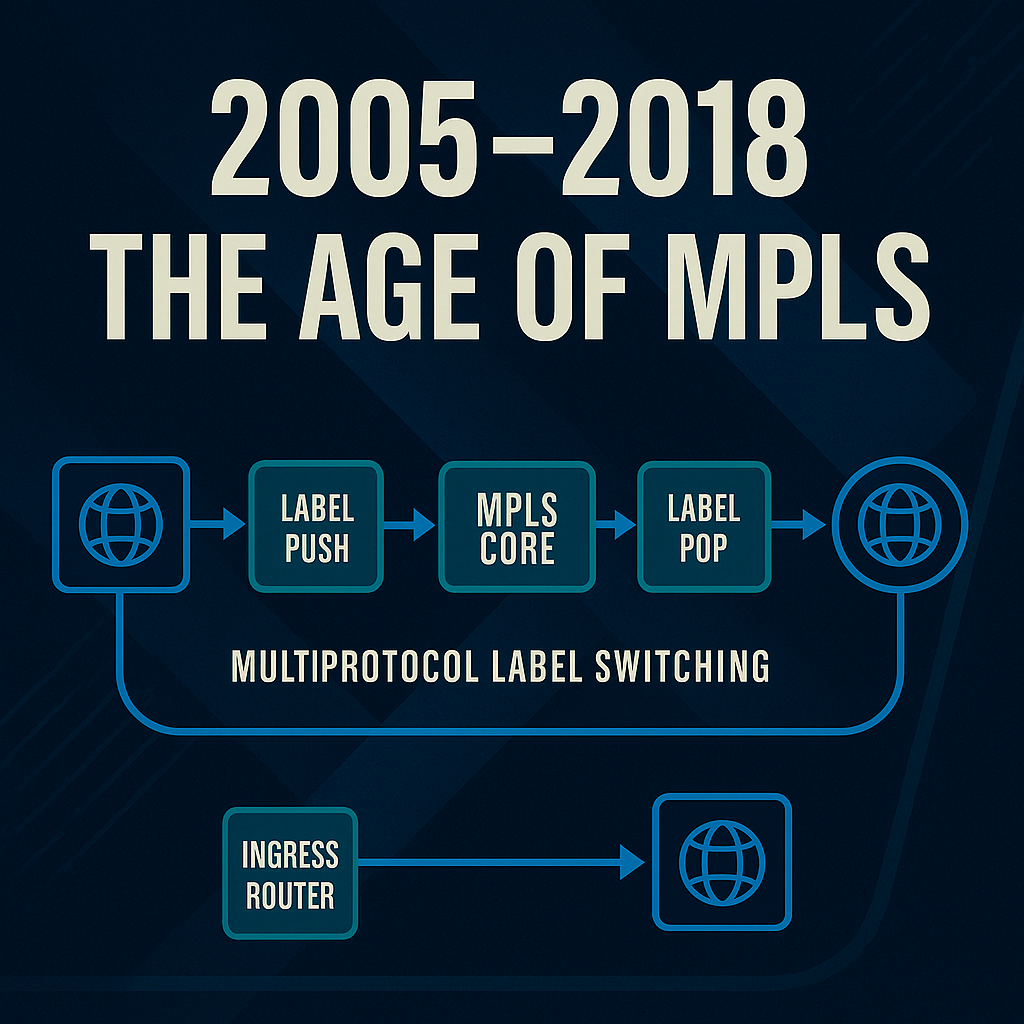
There was a time when enterprise networks were not free. They were planned, engineered, contract-bound, and predictable down to the last detail. Between roughly 2005 and 2018, this way of thinking shaped global enterprise connectivity almost completely – and with it, one technology that became nearly without alternative: MPLS. Multiprotocol Label Switching was not simply a transport method. It became the symbolic backbone of a centralized IT world in which control mattered more than agility.
MPLS emerged at a moment when classical IP routing began to show its limits. Enterprises required guaranteed bandwidth, predictable latency, prioritized voice and video, and above all: determinism. MPLS delivered exactly that by no longer relying solely on dynamic routing decisions, but by steering traffic along predefined label-switched paths through carrier networks. Data flows became calculable, enforceable, and contractually secured. Quality of service was no longer best effort – it was written into SLAs. For telephony, video conferencing, ERP systems, and production networks, this represented a decisive leap forward.
Yet the true power of MPLS did not lie in the technology alone. It lay in the IT world model it perfectly supported. Enterprise infrastructure was strongly centralized. Data centers formed the gravitational core. Applications were on-prem. Branch offices functioned as satellites, connected in star-shaped topologies to a small number of core hubs. Traffic almost always flowed from the branch to the data center and back again. MPLS was built precisely for this north-south model. Anyone running international offices, manufacturing plants, logistics hubs, or retail networks received a closed, controllable system in which every connection was predictable.
According to a Gartner survey from 2012, more than 85 percent of international large enterprises were already using MPLS as their primary WAN technology. Especially in highly regulated industries, mission-critical production environments, and global organizations financial services, manufacturing, energy, telecommunications – MPLS was not an option. It was a requirement. The costs were high, the contract terms long, and bandwidth modest by today’s standards. But it worked. And in a world where stability outweighed everything else, that was enough.
MPLS also took on a security role it was never explicitly designed for. The MPLS network itself became an implicit trust zone. Anyone inside the network was considered trusted. Security controls concentrated at a small number of central choke points, usually inside the data center. The perimeter was clearly defined. Security followed the circuit. Identity was secondary to location and topology. This model was stable but rigid. It worked perfectly as long as users, applications, and work itself remained largely immobile.
That assumption began to erode quietly long before the open break became visible. Mobile devices entered the enterprise. Collaboration slowly shifted toward the public Internet. SaaS appeared first as an experiment, then as a necessity. Bandwidth demand grew far faster than MPLS could match economically. New sites required weeks or months to be provisioned. Redundancy became expensive. International expansion turned complex. Every change became a technical and contractual project.Beneath the surface, the MPLS model was already stretching itself thin. It was being forced to handle things it had never been designed for: dynamic Internet access, distributed applications, real-time global scalability. Enterprises compensated with hybrid constructs – Internet breakouts, parallel firewall stacks, tunneled overlays. Yet the conceptual foundation remained centralized.
The real turning point arrived between roughly 2018 and 2020, not as a single disruptive event, but as the collision of multiple fundamental shifts. First, the cloud shattered the gravitational center of the data center. Applications moved to AWS, Azure, and an expanding universe of SaaS platforms. Traffic no longer needed to return to corporate data centers. It flowed directly to the cloud. MPLS suddenly became a detour, no longer the ideal path. At the same time, SD-WAN emerged as a new operational control layer. For the first time, traffic steering became independent of the underlying transport medium. DSL, fiber, 5G, and MPLS could all be used in parallel, orchestrated by software. MPLS lost its monopoly over traffic control.Security underwent its own paradigm shift. Zero Trust dismantled the idea of trusted locations. SASE moved security functions directly into the cloud. Security no longer followed the circuit, but the user, the identity, the application. With this, MPLS lost its role as an implicit security container. And finally, economics applied relentless pressure. While broadband became faster, cheaper, and globally available, MPLS contracts remained expensive, inflexible, and long-term. The cost-benefit equation visibly collapsed.
A CIO at a European retail group later summarized the moment with striking clarity:
“We didn’t shut down MPLS because it failed technically. We shut it down because our entire IT logic had changed.”By around 2020, MPLS had not disappeared. But its dominance was broken. It shifted from being the exclusive backbone to becoming a supplementary stability layer. Hybrid WAN architectures became the norm. Internet-driven branches replaced star-shaped headquarters models. Cloud-first designs displaced centralized traffic gravity. Security became identity-based. Control moved into software overlays. MPLS lost its status as the unquestioned foundation.In hindsight, the age of MPLS dominance marks the final great chapter of an IT world built on centralization, circuit logic, and physical control. Its decline overlaps historically with the Mobile First revolution starting around 2015, which placed mobility, decentralization, and user freedom at the center of enterprise design. While Mobile First reshaped campuses and WLAN architectures, cloud and SD-WAN dismantled the centralized WAN. Both movements contradicted the same old logic – and slowly made it unsustainable.
What remains is not a dead technology, but a dethroned one. MPLS still exists – often as a stability anchor for critical connections. But it no longer defines the network. It has become one component among many inside a layered model governed by cloud platforms, identity, software-defined control, SD-WAN, Zero Trust, and SASE.