
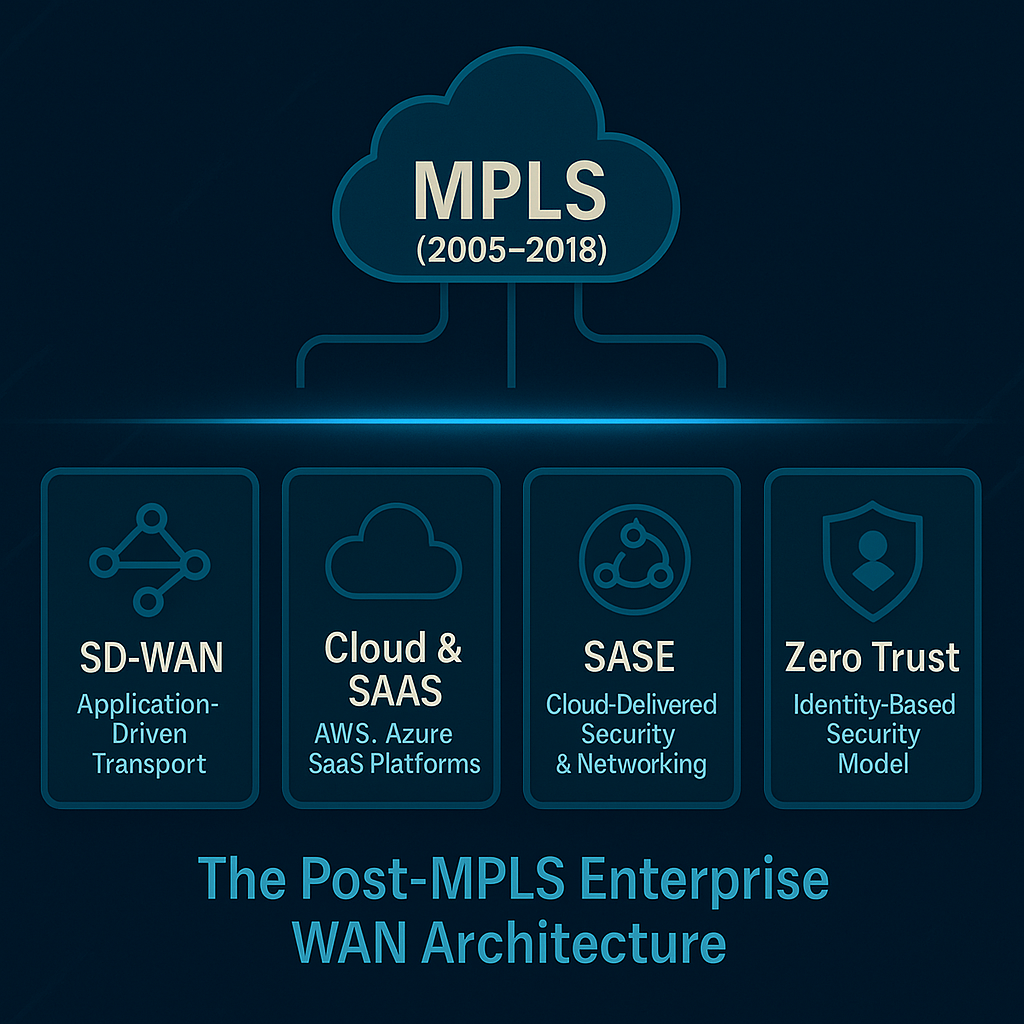
MPLS did not disappear overnight. It was not overthrown, and it was not suddenly declared obsolete. What began around 2018 was not a collapse, but a quiet transition. A gradual shift of weight. A slow change in expectations. MPLS did not become worse – the world around MPLS simply became different. Enterprises no longer worked only between fixed locations, but between clouds, SaaS platforms, mobile workplaces, external partner networks, and highly dynamic user groups. The WAN stopped being a closed system. It became open, distributed, layered. And in that moment, the silent transformation after the great MPLS era began.
Between 2005 and 2018, enterprise networking followed a predictable logic. Central data centers, clearly defined sites, stable circuits, fixed bandwidths, measurable SLAs. MPLS was built precisely for that world. It delivered control, prioritization, guaranteed quality, predictable latency, and stable operational models. Companies invested deliberately in that stability. But from around 2018 onward, the center of gravity shifted. Workloads moved out of private data centers into hyperscaler environments such as AWS and Azure. Applications were no longer installed – they were consumed. SaaS stopped being an exception and became the default. And suddenly, the most important data flows no longer ran from site to site, but directly from endpoints into the cloud.
With that shift, the role of the WAN changed almost unnoticed. MPLS had never been designed for a world where primary traffic no longer terminates in corporate data centers but flows straight into the public cloud. The classic hub-and-spoke logic that had carried MPLS for decades began to feel increasingly heavy. Users wanted direct access to Microsoft 365, Salesforce, SAP S/4HANA Cloud, collaboration platforms, development environments, analytics tools, and entire SaaS ecosystems. Technically, MPLS could still deliver this traffic through centralized breakouts but operationally, it increasingly felt like a detour.It was in this transition phase that SD-WAN gained real momentum. Not as a rebellion against MPLS, but as a practical extension for a world that suddenly required multiple transport paths at once. Internet, broadband, LTE, fiber, MPLS – all could be used in parallel. SD-WAN introduced not just dynamic path selection, but a new level of flexibility into what had previously been a strictly static network model. Bandwidth became elastic. Load distribution became adaptive. Failover was no longer tied to fixed circuits. Availability was no longer created solely through guaranteed lines, but through intelligent use of many paths at once.
At the same time, the entire security philosophy began to shift. The network was no longer a clearly bounded space. The old idea of “inside equals trusted, outside equals untrusted” started to dissolve. Zero Trust emerged as a new security principle. Trust was no longer derived from location, but from identity, device posture, application context, and continuous risk evaluation. Security moved closer to the user and the workload. With SASE, networking and security functions increasingly merged into cloud-based control layers. MPLS remained a transport component, but it gradually lost its former role as the primary security boundary.Economic reality added further momentum to this transition. MPLS circuits had always been predictable in cost but also consistently expensive. As bandwidth demands increased, cloud usage exploded, and east-west application traffic multiplied, WAN costs rose sharply. At the same time, high-performance Internet connectivity became cheaper, faster, and globally available. Enterprises did not abandon MPLS out of cost pressure alone, but out of rational optimization. Not because MPLS failed – but because it was no longer the most economical option for every use case.
The core transformation after 2018 did not lie in the disappearance of MPLS. It lay in the end of its monopoly. Where one single WAN technology had previously carried nearly all enterprise traffic, layered architectures began to emerge. MPLS remained in place for critical applications, for real-time services, for regulated environments, for industrial control systems, and for latency-sensitive workloads. At the same time, Internet backbones, cloud direct connections, SD-WAN overlays, and SASE-based access took over growing portions of everyday traffic. The WAN became multi-dimensional. Not weaker but more versatile.This new versatility also reshaped the role of network architects. Design no longer meant circuit planning alone, but traffic engineering, identity models, application prioritization, security zoning, cloud integration, and user experience management all at once. The traditional separation between networking and security began to blur. Access became more important than transport. Policy more important than circuits. Identity more important than IP addresses. The WAN was not replaced – it was reinterpreted.
Today, years into this quiet transition, the enterprise WAN is neither a monolithic MPLS structure nor an uncontrolled Internet patchwork. It is a controlled interplay of several worlds. Cloud-first architectures, SD-WAN intelligence, Zero Trust access, and SASE platforms work together – not against MPLS, but alongside it. Many enterprises continue to operate MPLS where maximum stability, guaranteed quality, and fixed SLAs remain essential. At the same time, they use Internet-based paths wherever flexibility, scale, and cost efficiency matter most.
The transition after the MPLS era was not a rejection of the past, but an expansion of the toolbox. MPLS formed the stable foundation on which everything else could evolve. Without the reliability of the 2005–2018 era, today’s hybrid WAN landscape would hardly be possible. The post-MPLS era is not a break it is a continuation with new instruments. Not less controlled. But more adaptive. Not less professional. But closer to the reality of modern digital business models.