SD-WAN arrived quietly. It was not announced with banners, not celebrated as a revolution, not sold as a dramatic disruption. It simply slipped into real networks — first into branch locations, then into international structures, and finally into the daily routine of remote teams, industrial sites, and decentralized organizations. While other technologies were loudly debated, SD-WAN quietly reshaped how enterprises think about connectivity, operations, and economic efficiency.
When early production-grade SD-WAN deployments began to appear around 2012 in larger enterprise environments, the conversation was not about vision. It was about relief. Traditional WAN architectures were expensive, slow to deploy, and rigid by design. Meanwhile, the workplace was becoming distributed. The network, however, was still built for centralization. The disconnect was obvious. By 2022, IDC reported that more than 60 percent of European enterprises were already using SD-WAN as either a primary or secondary WAN technology. Not because it sounded innovative but because it worked.
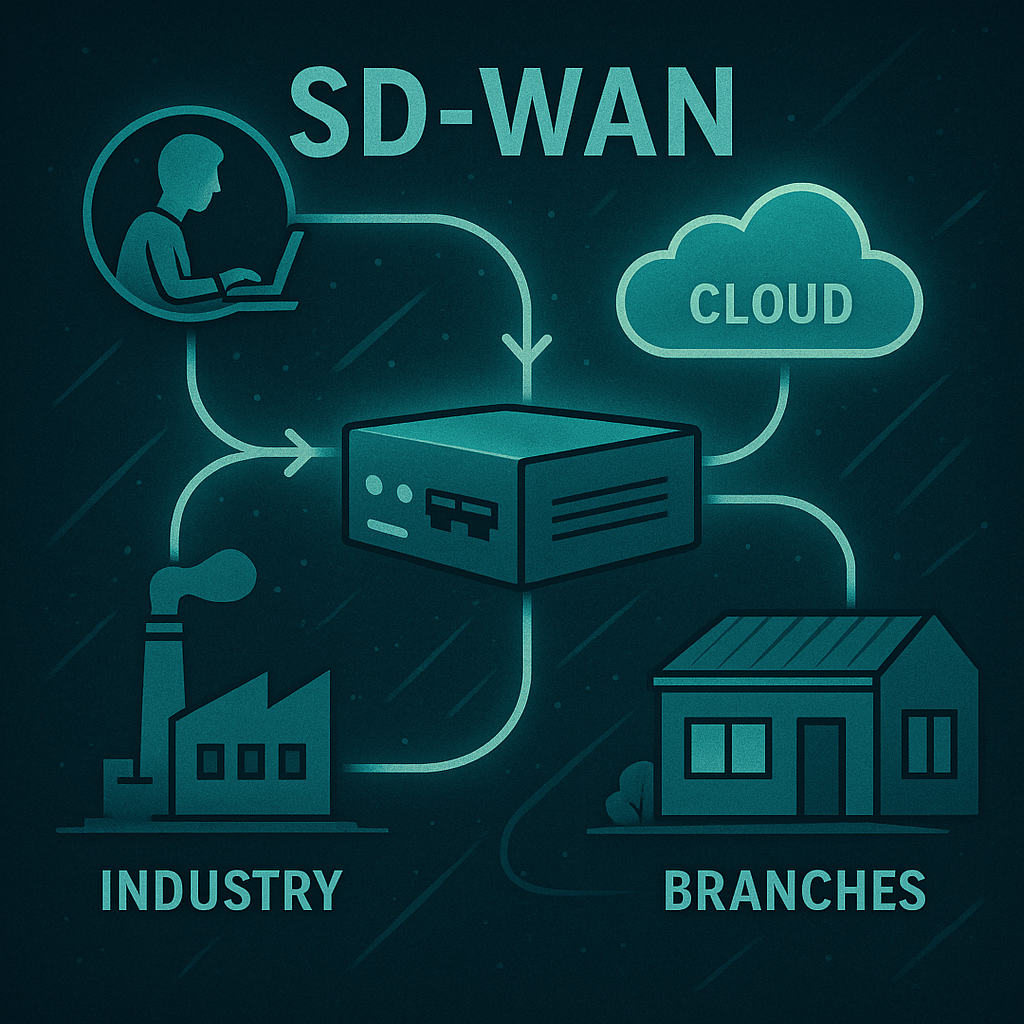
Branch networks were the first place where the shift became fully visible. Retail chains, banks, franchising models, service organizations all faced the same reality. New locations had to go live faster. Renovations could not interrupt operations. Long-term carrier contracts no longer matched business dynamics. MPLS remained stable, but it was slow, costly, and inflexible. SD-WAN inverted the logic. A site was no longer the endpoint of a circuit. It became an active network node with its own intelligence. Internet access, LTE backup, centralized policies deployed in days instead of months. The network stopped being a project. It became an operational function.“At some point we stopped discussing bandwidth and started discussing availability,” says the head of IT operations of a globally active retail group. That statement captures the real shift. The question was no longer how powerful the connection was, but whether the site could operate reliably regardless of which physical path the traffic followed. SD-WAN stopped being a purely technical decision and became a business instrument.
Industrial environments revealed another dimension. Production sites are not comfortable office landscapes. They run machines, control systems, logistics flows, time-critical processes. Failures do not cost minutes they cost production cycles. Traditional WAN models were designed for stable administrative networks, not for real-time manufacturing traffic between plant, service, supply chain, and headquarters. SD-WAN made it possible to prioritize connections based on business relevance. Production data, remote maintenance, quality control, supply chain integration — all flowing through one programmable network logic.
A network manager at a major automotive supplier puts it this way: “The network used to be fixed infrastructure. Now it’s a growing operational resource.” But this transformation also introduces new responsibility. When networks become dynamic, operations, documentation, security, and governance must evolve at the same speed. Flexibility does not automatically create safety it relocates it.International branch networks were once the supreme discipline of classic WAN design. Different providers, regional regulations, fluctuating line quality, contract complexity. SD-WAN entered these environments first as a cost-optimization tool — and quickly became a stability mechanism. The perfect line was no longer decisive. The ability to combine multiple imperfect lines became the new standard. Circuits turned into services. Redundancy became control. Physical dependency turned into logical governance.
Then came remote work the unplanned accelerator. What had once been considered a niche scenario suddenly became the default within weeks. VPN concentrators collapsed under load. Central access points shifted. Latency became operationally critical. SD-WAN changed the logic here as well. The direct path to the application became more important than routing traffic through central gateways. Workstations detached from physical sites. The network followed the user not the other way around.
It is also clear that SD-WAN does not magically solve every structural issue. It shifts complexity rather than eliminating it. Routing decisions are no longer pure technical settings. They become operational decisions. Which application deserves priority? Which data may take which path? Which outages are acceptable? The network becomes a management topic. It is no longer defined solely by IT business processes, operating models, and risk frameworks now directly shape the WAN architecture.At the same time, SD-WAN is not a single technology. Behind the term lie very different philosophies. Hardware-based appliances stand beside fully cloud-native platforms. Security-integrated models compete with pure transport logic. For some enterprises, SD-WAN is an interim bridge. For others, it is the permanent backbone of all site connectivity. There is no universal design only scenarios derived from business needs.
In many discussions with operations managers, it is striking how rarely classic topologies are mentioned today. Stars, rings, hubs these conceptual models quietly lost relevance. Instead, availability, user experience, load balancing, and failover behavior dominate the dialogue. Networks are no longer built. They are operated as services. That shift represents one of the deepest cultural transformations triggered by SD-WAN — subtle, almost invisible, but undeniably permanent.
Yet skeptics remain. A senior network architect in the healthcare sector summarizes it soberly: “We gain flexibility, but we lose physical tangibility.” Failures no longer appear as cut cables or broken ports. They emerge inside policies, control layers, and dependencies between providers and platforms. The network becomes more abstract and therefore harder to explain.Economically, SD-WAN is not automatically a cost-saver either. Yes, MPLS spending can be reduced. But orchestration platforms, security layers, monitoring systems, operations overhead, training, and governance reshape the cost structure. It does not always become cheaper. It becomes different. Capital investment shifts toward flexible operating models.
What remains is a clear reality. SD-WAN does not live in slide decks. It lives in retail locations, production halls, pop-up project offices, kitchen-table laptops, and international branches without guaranteed carrier stability. It lives where the network is no longer infrastructure but the prerequisite for work itself.And that is its true significance. SD-WAN is neither a loud revolution nor a gentle evolution. It is the logical network response to a business world that moves faster than any static circuit ever could. Whether this logic will hold long-term or create new dependencies remains open. What is certain, however, is this: the classical WAN, as it was once designed, is not coming back. The network has become fluid. And with it, the responsibility to govern it intelligently.