
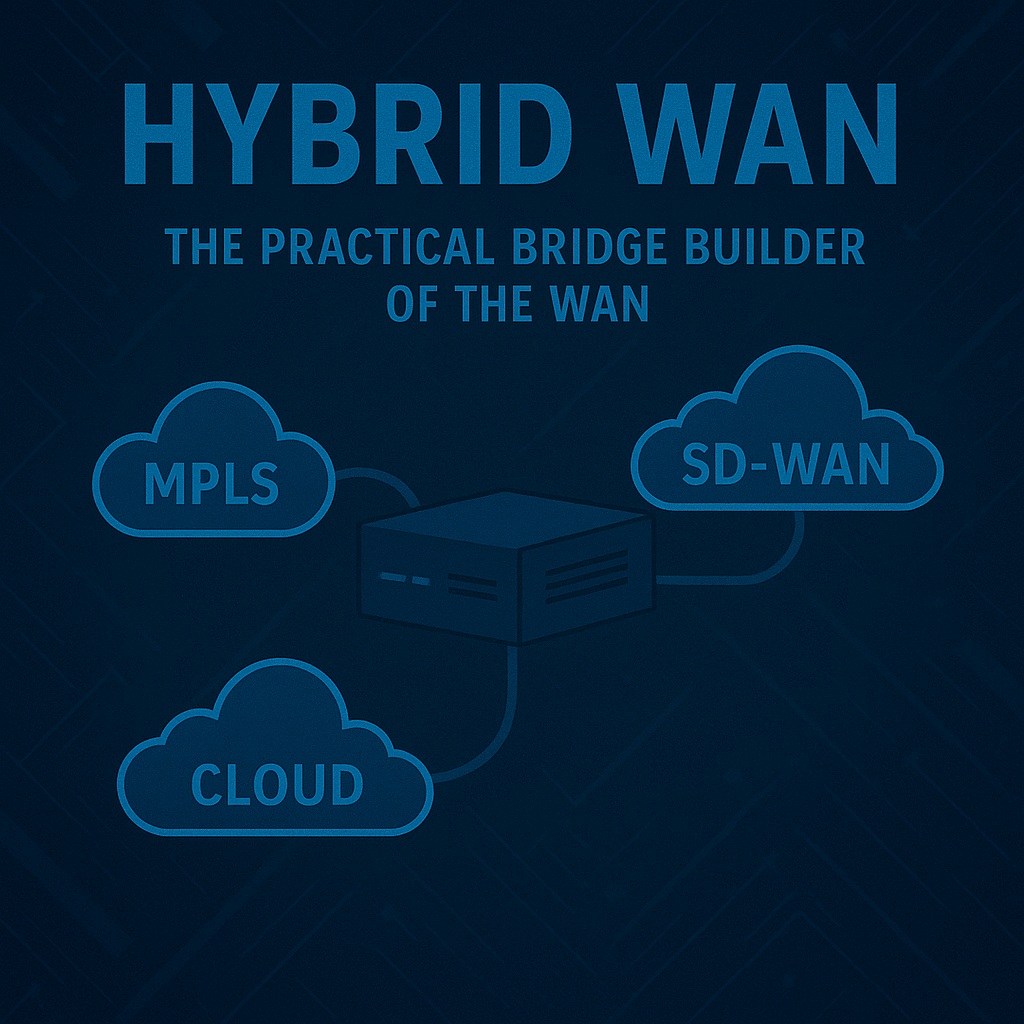
Hybrid WAN is neither a trend nor a future vision. It is the state that emerges when ideal architectures collide with operational reality. Quietly, permanently, and now deeply embedded in almost every enterprise network, whether officially acknowledged or not. Anyone looking into large corporate infrastructures rarely sees clean, linear designs anymore. Instead, MPLS contracts continue to run, SD-WAN deployments are underway but unfinished, and internet circuits that once served as backups now carry productive traffic. This coexistence is Hybrid WAN. Not a target state, but a long-living in-between that has proven far more persistent than vendors ever anticipated.
Technically, Hybrid WAN describes the parallel operation of multiple WAN technologies within one architecture, most commonly a combination of MPLS, public internet, and SD-WAN overlays. And the distinction matters: SD-WAN is the control layer, Hybrid WAN is the physical and logical reality underneath. Many companies introduced SD-WAN without shutting down MPLS. Others reduced private circuits without fully replacing them. What emerges is not migration, but coexistence. A constant balancing act between security, control, cost optimization, and operational flexibility.
The first true Hybrid WAN architectures existed long before the term itself became popular. As early as 2010, enterprises began adding broadband internet alongside MPLS to reduce costs and improve redundancy. Initially as pure backup. Then for non-critical applications. Eventually for entire sites. When SD-WAN gained serious momentum around 2014, this hybrid condition became centrally steerable for the first time. SD-WAN did not create Hybrid WAN. It exposed it, stabilized it, and made it scalable.The primary driver behind Hybrid WAN adoption is not innovation, but economics. MPLS contracts often run for five, seven, sometimes ten years. Exiting them prematurely rarely makes financial sense. At the same time, pressure rises to connect cloud platforms directly, deploy branches faster, and cut recurring transport costs. The result is not a clean break, but a layered architecture: new locations go live on SD-WAN from day one, legacy sites stay on MPLS, broadband becomes production transport, and critical applications continue to run on reserved paths. Hybrid WAN becomes an insurance policy against operational errors, strategic dead ends, and unexpected traffic spikes.
Yet the uncomfortable truth is that Hybrid WAN, while technically manageable, is organizationally demanding. Multiple cost models exist in parallel. Multiple providers, different SLAs, different failure patterns, different escalation paths. Network operations do not become simpler. They become layered. SD-WAN promises abstraction and centralized control, but physical heterogeneity remains. A European manufacturing network lead once summarized it with dry precision: “We see more, but we also have to think more. Visibility went up. Simplicity did not.”Despite this complexity, Hybrid WAN delivers something pure architectures rarely achieve: resilience through diversity. When MPLS degrades, internet carries the load. When broadband collapses, private circuits absorb impact. When SD-WAN overlays misbehave, physical paths still exist underneath. Hybrid WAN may be less elegant than any single-technology design, but in many environments it is more tolerant to failure. Especially in regulated industries, healthcare, manufacturing, and critical infrastructure, Hybrid WAN is not a reluctant compromise. It is a deliberate safety architecture.The reason this transition phase lasts so long is rooted in three forces that resist acceleration: legacy applications with tight latency and jitter sensitivity, long provider contracts that block rapid transformation, and deeply ingrained perceptions that still associate MPLS with safety and broadband with risk. Hybrid WAN is therefore not a sign of technical hesitation. It is organized risk management at scale.
Security becomes the most delicate dimension of Hybrid WAN. For years, MPLS lived inside a bubble of implicit trust. The internet never did. SD-WAN dissolved this boundary by bringing encryption, segmentation, and application-aware routing directly into the WAN fabric. But this also created new gray zones. Traffic appears identical, yet its transport paths differ fundamentally in exposure and risk. A European security architect described it without euphemism: “Hybrid WAN isn’t a security problem. But it punishes every mistake.”What is striking is how rarely Hybrid WAN is openly designed as a long-term architecture. Most organizations know exactly where they came from, and they have a vague idea of where they might want to end up. The space in between, however, is almost never fully engineered. Hybrid WAN emerges through budget cycles, contract expirations, cloud adoption waves, geopolitical disruptions, internal restructurings, and sometimes through security incidents. It is not a product roadmap. It is corporate reality.And when does Hybrid WAN end? The honest answer is uncomfortable: possibly never. Not in three years. Not in five. Even SASE architectures do not eliminate Hybrid WAN. They overlay it. The diversity of transport persists. Only the control plane moves higher into the cloud. Hybrid WAN may become the longest transition phase the enterprise network has ever seen.
In the end, Hybrid WAN says less about technology and far more about organizations themselves. About how decisions are made, how risk is priced, how legacy is treated, how security culture matures, and how budgets constrain ambition. Some enterprises run Hybrid WAN intentionally, with formal governance and long-term strategy. Others simply live in it without ever naming it as such. Hybrid WAN is the phase nobody sells, nobody advertises, and nobody celebrates. But it is very real. And it reveals with brutal clarity how wide the gap between strategic blueprints and operational life truly is.