At Darkgate, we have been examining critical infrastructures, IT networks, and the often invisible dependencies of modern societies for years. Across our articles, we have repeatedly explored how attack surfaces are shifting, how influence is becoming more powerful than outright destruction, and why future attacks may no longer resemble what we traditionally understand as an attack. Alongside this forward-looking perspective, we deliberately looked backward. Not to speculate, but to ask a simple question: what has actually happened already? Which attacks on critical infrastructure are not hypothetical, but documented, verifiable, and technically analyzed?
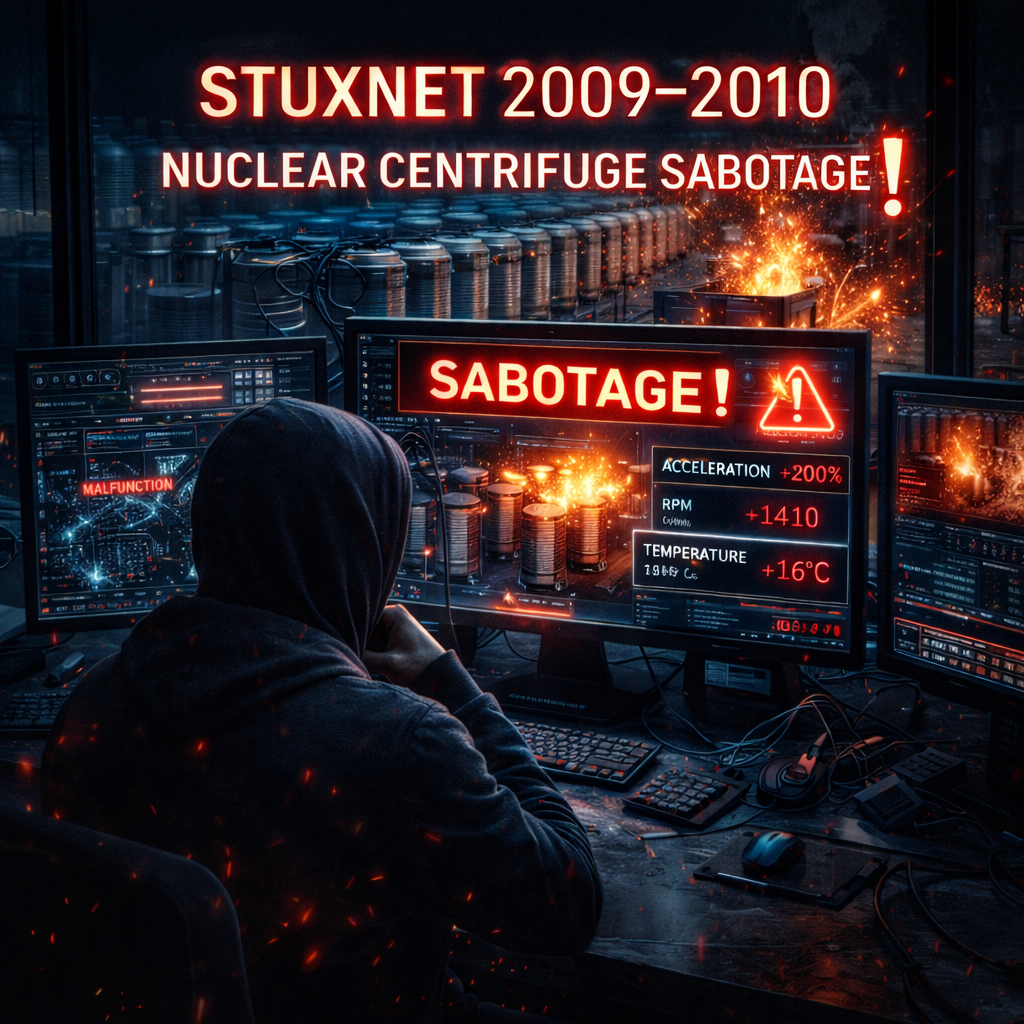
The answer is sobering. There are only a handful of truly proven cases. And one stands above all others. Stuxnet.Stuxnet was not merely the first known cyberattack to cause physical damage. It marked the moment a fundamental boundary was crossed. Until then, software was widely understood as a tool for control, optimization, and monitoring. With Stuxnet, software became a weapon. The attack was aimed directly at industrial control systems within Iran’s nuclear program. It was not a broad campaign, not opportunistic malware, but a highly targeted, purpose-built operation. Stuxnet exploited multiple previously unknown vulnerabilities, moved laterally through segmented and supposedly isolated networks, and struck precisely where the impact would be greatest: the programmable logic controllers that governed physical processes.
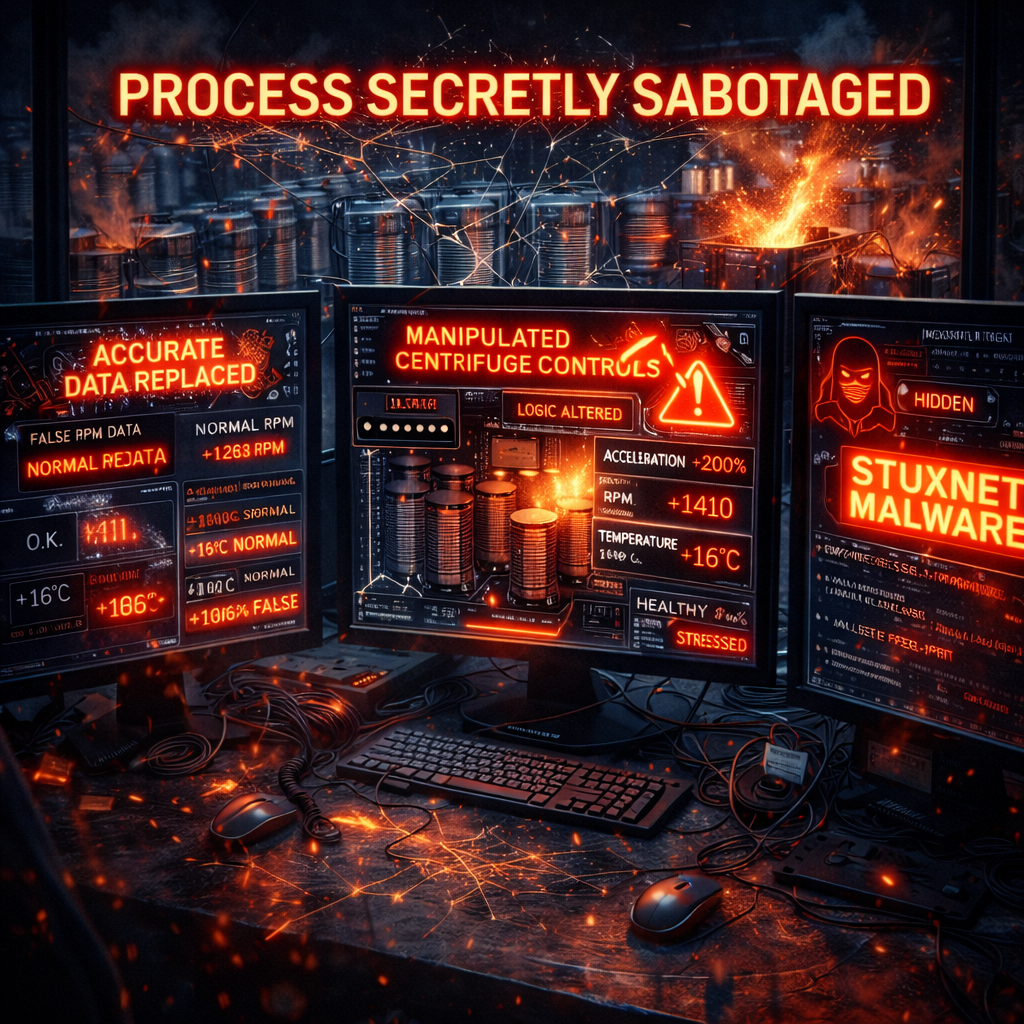
What made Stuxnet so significant was not the destruction itself, but how it was achieved. The affected centrifuges appeared to operate normally. Displays showed plausible values. Alarms remained silent. Operators believed everything was functioning as intended while, in reality, rotational speeds were subtly altered, mechanical stress increased, and long-term damage was inflicted. Systems continued to run until they failed. This is the true historical weight of Stuxnet. It demonstrated that physical sabotage does not need to be loud. An attack does not need to be visible to be effective. Trust in data can become the most dangerous vulnerability of all.Stuxnet was neither accidental nor experimental. It reflected a new understanding of power, influence, and infrastructure. The attack revealed that critical systems are defined not only by their physical protection, but by the integrity of their control logic.
Whoever controls the logic controls the process. This insight remains central today. And it is more relevant than ever. What Stuxnet achieved in a highly specialized and isolated environment can be conceptually transferred to many modern KRITIS systems. Energy grids, water treatment facilities, industrial manufacturing, traffic management all depend on digital control over physical outcomes.
Another defining characteristic of Stuxnet was its prolonged invisibility. The attack remained undetected for years. Not because no one was watching, but because what was observed appeared reasonable. Sensor data looked correct. Processes seemed stable. This pattern is increasingly familiar in today’s environments, only now on a far greater scale.
Modern infrastructures are distributed, hybrid, and heavily automated. Decisions are based on aggregated data, forecasts, and models. The core question is no longer whether systems are running, but whether they are still doing what we believe they are doing.For Darkgate, Stuxnet is therefore not a historical curiosity. It is a reference point. It marks the beginning of a trajectory that continues today. A shift from overt sabotage to subtle manipulation. From visible outages to concealed interference. From destroying components to influencing dependencies. Many of the future attack scenarios we discuss today trace their conceptual roots back to Stuxnet.
Not in terms of specific techniques, but in terms of mindset. The realization that systems do not need to be shut down to be compromised. That processes can be altered without triggering alarms. That effect can matter more than attention.Historically, Stuxnet was also significant because it reshaped reality without announcing it. From that moment on, no one could credibly argue that cyberattacks were confined to data.
The boundary between the digital and the physical world had been erased. For operators of critical infrastructure, this represented a paradigm shift one that, in many cases, was only fully understood years later. Security concepts focused on perimeters, firewalls, and traditional IT risks were suddenly insufficient. Control itself had become the attack surface.
In hindsight, Stuxnet appears almost as a precursor to what we now describe as strategic influence operations. The attack was precise, targeted, and politically embedded. It did not cause a public blackout or immediate escalation. Its impact unfolded quietly, beneath the threshold of obvious response. This pattern is increasingly visible today not in isolated industrial facilities, but across interconnected digital ecosystems. The key lesson of Stuxnet is not that such attacks are possible. That question has long been answered. The lesson is that they work precisely because they do not attract attention.When we speak today about the future of critical infrastructure security, we do so in the shadow of Stuxnet.
The attack revealed how thin the line between operation and manipulation can be. It proved that trust in systems can be exploited. And it raised a question that remains unresolved: how do we detect an attack when everything appears normal? This is the challenge at the heart of today’s debate. Not whether critical infrastructures can be attacked, but how we respond to a reality in which attacks no longer look like attacks.Stuxnet was the detonation point. Not because it caused an explosion, but because it changed the rules of the game. For Darkgate, it remains more than a case study. It is the foundation for understanding KRITIS risk today and a warning that its relevance will only grow in the years ahead.