This is another Darkgate article dedicated to real cyberattacks that did not live in slide decks or strategy papers but actually happened. Attacks that did not steal files or lock screens but did something far more subtle. They disconnected things. They isolated systems. They exposed how fragile the technical skin has become that holds our modern world together.This time it is about an attack on the KA SAT network operated by Viasat. An infrastructure most people never see, yet use every single day. It connects wind farms to control rooms, ships to ports, industrial plants to their operators and remote regions to the rest of the digital world. It does not sit in a data center, not in an office building and not even on Earth. It floats above it. Quiet. Invisible. Taken for granted. Until it suddenly is not.
The attack was not loud. It was not spectacular. It was more like someone switching off the light in a room where thousands of people are working without knowing where the switch is. Suddenly the connection was gone. Not broken. Not destroyed. Simply absent. Systems kept running. Machines kept operating. Processes kept flowing. But they were alone. Without feedback. Without coordination. Without the invisible nervous system that turns many components into one system.Thousands of installations lost their link to central control at the same time. Among them wind turbines in Germany that could no longer be remotely monitored for a while. No catastrophe in the classical sense. No smoke. No fire. Just a quiet moment in which it became clear how much of our stability now depends on something we barely notice. Connection.
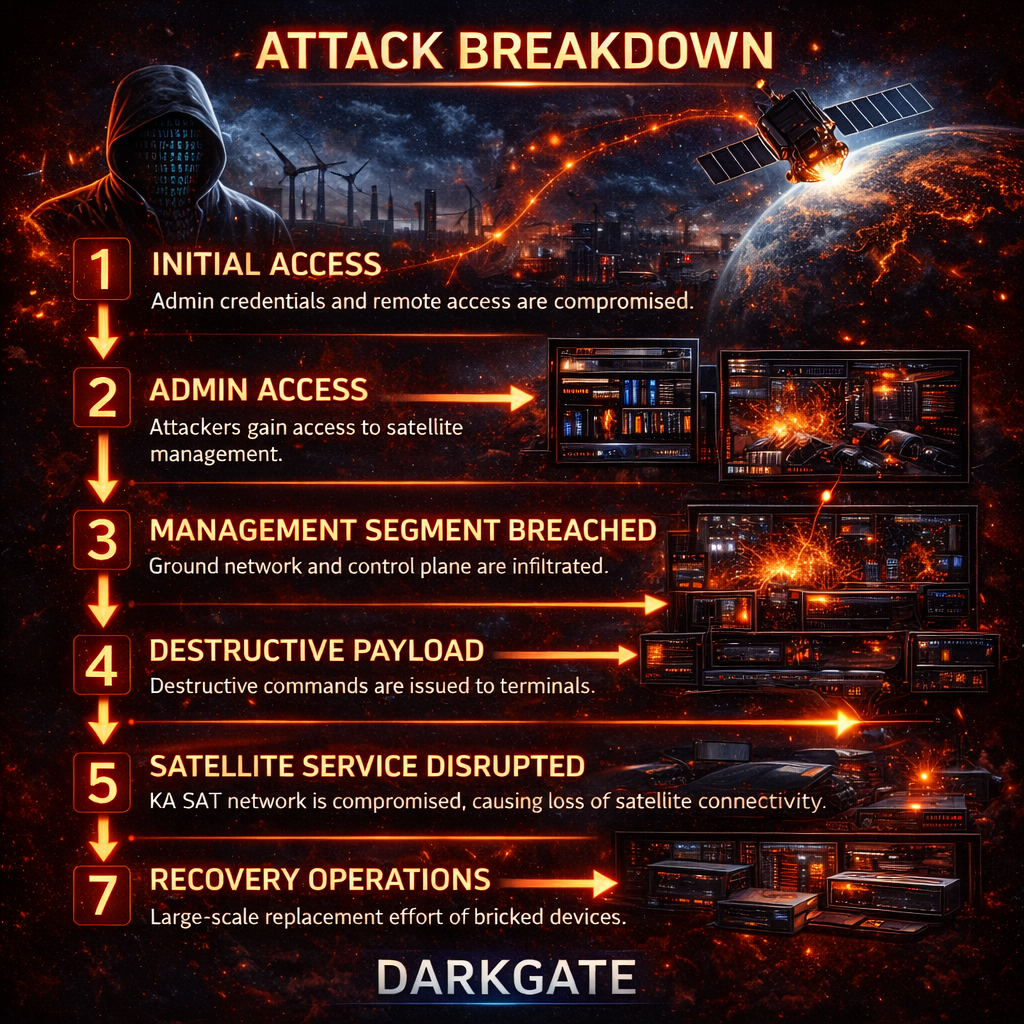
The attack did not target devices. Not terminals. Not antennas. Not modems. It targeted the management layer of the network. The place where identities are managed, configurations are distributed and systems are introduced to each other. The place where control lives. If you touch that layer, you do not attack a thousand machines. You attack the idea that makes those machines a network in the first place.That is the real nature of this attack. It destroyed nothing. It stole nothing. It corrupted nothing that could be photographed or measured. It removed something. It removed connection. And in doing so it showed that modern infrastructure no longer lives in places but in relationships. In dependencies. In control planes. In coordination. In layers no one looks at as long as everything works.We grew up thinking of infrastructure as something physical. Roads. Bridges. Power plants. Pipelines. Things you can see, touch and repair. But more and more of our infrastructure has become invisible. It is made of protocols, identities, configuration files and orchestration logic. It does not run through landscapes. It runs through systems. And it is just as critical. Just as system relevant. Just as fragile.
The KA SAT attack made that visible. It showed that vulnerability no longer lives where something is weak but where something is centralized. Where control is concentrated so that everything becomes manageable, efficient and scalable. Where a single intervention can influence thousands of systems at once.This is not a failure of one operator. It is a pattern of our time. We build systems that are global by design, that connect physical reality with digital coordination, that span continents and industries. And we build them in a way that keeps them controllable. That keeps them administrable. That keeps them simple enough to operate. That is their strength. And that is their weakness.
The attack was quiet. No scandal. No headlines. No visible damage. But it shifted something. Not in the network, but in our understanding. It showed that critical infrastructure now begins in places we never used to consider as such. In orbit. In control systems. In management layers. In invisible spaces we only notice when they disappear.Maybe that is the real story here. Not that something failed, but that something became visible. How deeply our world now depends on being connected. And how little it takes to take that connection away.And maybe that is the uncomfortable truth that remains. Modern systems do not need to be destroyed to be at risk. It is enough to separate them.