This is another article in Darkgate’s series on real cyberattacks that did not live in slide decks or strategy papers but actually happened. Attacks that did not steal data or lock screens but changed something in the real world. Not to make money. Not to spy. But to interfere. To disrupt. To cause damage where damage is not abstract but visible, tangible and in this case irreversible for a time. This story is not about electricity, not about satellites and not about industrial production. It is about water. And about what happens when code reaches into nature.
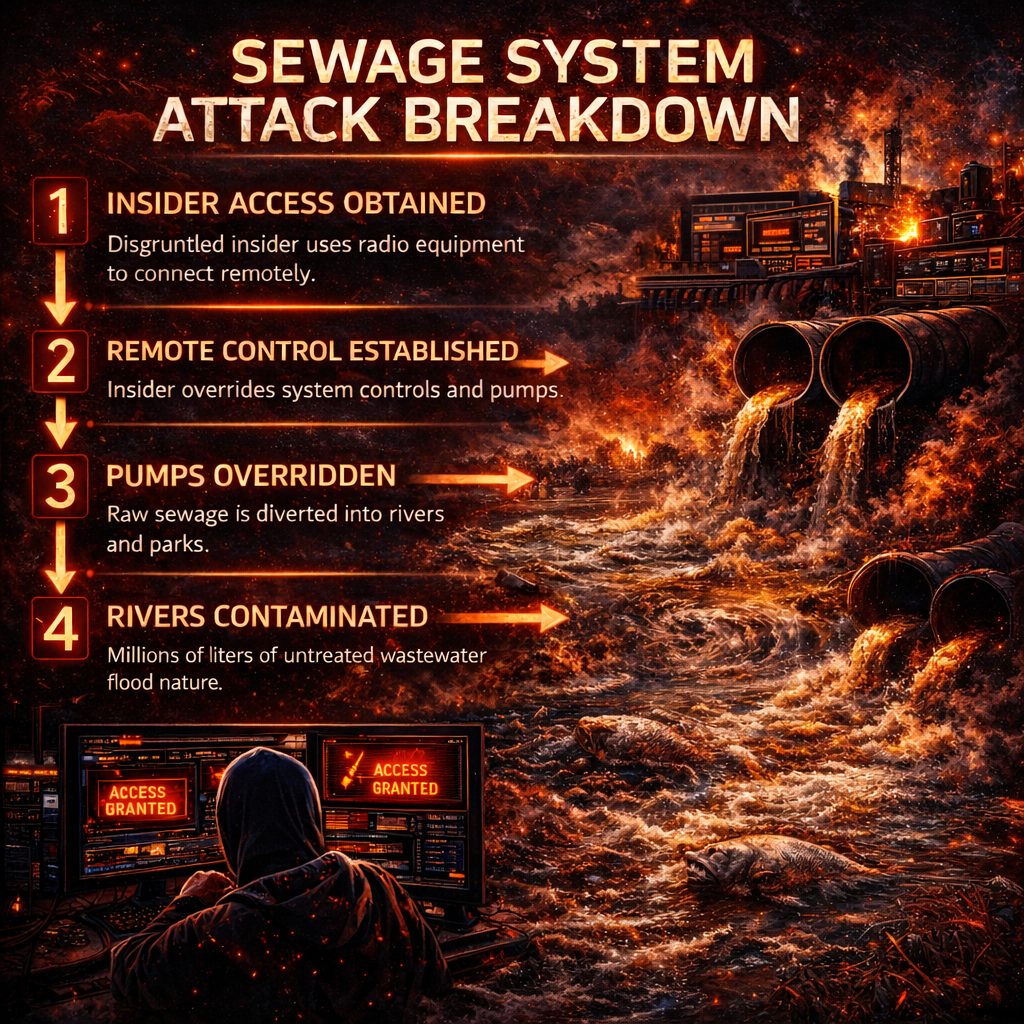
In the year 2000, the sewage control system of Maroochy Shire in Australia was deliberately manipulated. Millions of liters of untreated wastewater were released into rivers, parks and coastal areas. Fish died. Vegetation was contaminated. Residents complained about smell and pollution. At first, authorities assumed technical failure. Faulty pumps. Sensor errors. Software bugs. No one considered a cyberattack. That assumption allowed the attack to continue.The perpetrator was not a foreign actor, not a criminal syndicate and not a hacker in the stereotypical sense. It was an insider. A former contractor who had worked on the system and understood its architecture, its weaknesses and its remote control mechanisms. He had access, he had knowledge and he had a motive. Frustration. Anger. A sense of grievance. There was no financial gain and no political message. The purpose was simply to interfere with a system and to harm what that system controlled.
This is what makes the Maroochy case so significant. It was not fraud. It was not deception. It was not theft. It was influence. Direct, intentional influence over physical processes through digital means. The system was not used incorrectly. It was used exactly as designed, only with hostile intent. Control became a weapon.Using radio communications and control software, the attacker sent commands to pumping stations, activating and deactivating valves, changing flow behavior and overriding safety assumptions. The system had been built for efficiency and remote management. Those same design principles made it vulnerable. What enabled optimization also enabled manipulation.The sewage system became an instrument of environmental harm. Not metaphorically, but literally. Rivers were polluted. Parks were flooded with waste. Wildlife was affected. Residents were exposed to contamination. All of this happened not because of a broken pipe or a mechanical failure but because of code. Because someone changed logic instead of hardware.
This attack marks a turning point. It is one of the first documented cases where a cyberattack caused real environmental damage. It showed that cyber risk is not limited to data loss or financial disruption. It can damage ecosystems. It can affect public health. It can change landscapes.It also exposed how misleading the boundary between digital and physical really is. The infrastructure consisted of pipes, pumps and reservoirs. Concrete and steel. But it was governed by software. By logic. By remote instructions. Whoever controls that logic controls the physical outcome.That insight makes the Maroochy case feel disturbingly modern. Today, far more systems depend on digital control than they did in 2000. Water treatment, energy distribution, traffic systems, agriculture, chemical processing, waste management. All of it is automated, optimized and remotely managed. And all of it is therefore influenceable.Compared to later attacks like Stuxnet or Triton, Maroochy looks simple. No zero day vulnerabilities. No complex malware. No elaborate supply chain compromise. Just one person and a system that trusted him. That simplicity is exactly what makes it unsettling. Not every attack needs to be sophisticated to be effective. Not every threat comes from a powerful actor. Sometimes it comes from proximity and knowledge.The case also forces a broader question. If digital systems can influence rivers, forests and cities, then cybersecurity is no longer just a technical discipline. It becomes an environmental issue. A public safety issue. A societal issue. It is not only about protecting servers. It is about protecting processes that shape daily life.
Maroochy shows that code can be a tool of pollution. That logic can be destructive. That digital access can translate directly into physical harm. It was not a war. It was not terrorism. It was not organized crime. It was something new. A digital act with ecological consequences.That is why this case still matters.Not because it was technically advanced, but because it revealed something fundamental about the world we are building. A world in which control is increasingly abstract. In which influence travels through networks. And in which the distance between a command and its physical effect is shrinking.Maroochy was not the loudest cyberattack in history. It was not the most complex. But it was one of the first to show that cyber does not stay in cyberspace.