Cloud is not a product. Cloud is not a place. And cloud is not a single provider. Cloud is a way of organizing, delivering and consuming computing power, storage and software without owning or physically operating it. That is its real significance. It moved computing from something local and tangible into something abstract, flexible and global.Before cloud existed, IT was concrete. Companies bought servers, installed them in rooms, cooled them, wired them, maintained them and replaced them after a few years. Growth meant new hardware. Peak load meant overprovisioning. Failure meant downtime. IT was ownership, planning and risk at the same time. If you wanted to scale, you had to invest long before you knew whether you would ever really need that capacity. This logic began to break when the internet stopped being just an information platform and became economic infrastructure. Companies like Amazon, Google and later Microsoft faced a new problem in the early 2000s. Their systems had to scale globally, absorb seasonal spikes and remain stable and available at the same time. The classical model of hardware procurement and capacity planning no longer fit a market that moved in weeks and months instead of years.
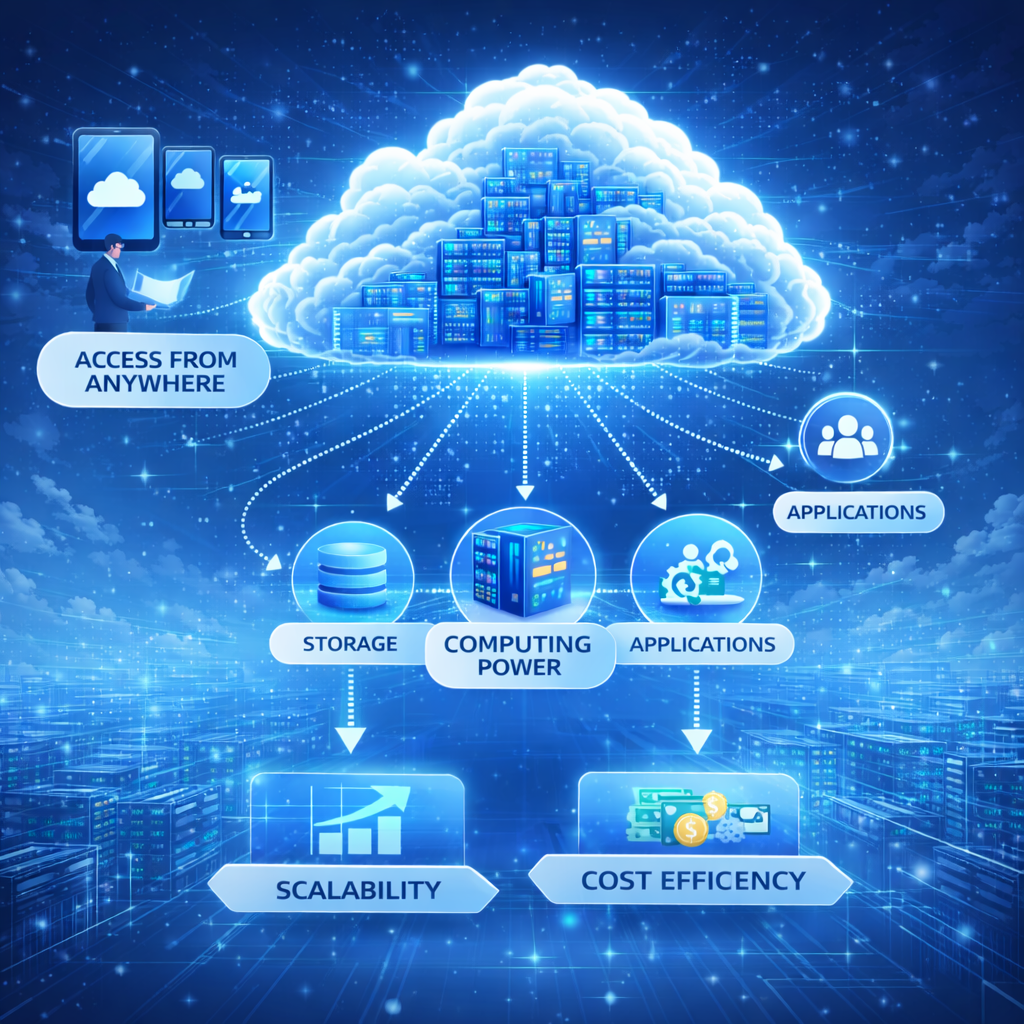
The solution was not to build bigger data centers but to change the idea of infrastructure itself. Compute was virtualized, storage was decoupled, networks became programmable. Servers were no longer treated as machines but as resources that could be allocated dynamically. Infrastructure became software. Ownership became usage. Planning became elasticity. When Amazon opened this internal infrastructure to external customers in 2006, it was not a loud moment. But it was a structural turning point. Suddenly any company, regardless of size or capital, could use the same technical foundation as a global enterprise. Suddenly scaling was no longer an investment project but a configuration step. Suddenly IT shifted from bottleneck to enabler.Today, according to multiple market studies, more than ninety percent of enterprises use cloud services in some form. Not because cloud sounds modern but because it makes economic and organizational sense. It shifts costs from capital investment to operational expense. It shortens development cycles. It lowers entry barriers. It makes global presence technically trivial. But cloud is more than a new hosting model. It changes where control lives. Technically every cloud has two layers. A physical layer of data centers, power, cooling, fiber and hardware, and a logical layer of identities, APIs, automation, orchestration and permissions. Users only see the logical layer. They click, configure, deploy. What happens underneath remains invisible.This invisibility is part of the appeal and part of the risk. It decouples responsibility from perception. You no longer see where data resides, how systems are connected or which dependencies exist. Infrastructure becomes something that is always there while it works and suddenly gone when it does not. As one infrastructure architect at a European industrial company put it, we used to have servers, now we have relationships. Relationships between services, identities, APIs and dependencies. When one of those breaks, it is not a machine that fails but an entire process.
That shift also changes the security model. In the cloud it is less about protecting individual systems and more about protecting access to control. The critical layer is the control plane. Whoever controls that layer does not control one machine but entire environments. This concentration is the price of efficiency. Cloud works because it centralizes, standardizes and automates. It makes systems manageable by abstracting them. But in doing so it also creates new forms of dependency. Organizations are no longer just users of infrastructure. They become part of a larger system whose rules they do not define themselves.Cloud is therefore never neutral. It is economically, politically and strategically relevant. It shifts power to those who operate the platforms. It defines standards, prices, security models and technical possibilities. It creates lock in effects that often only become visible when a change is necessary. This does not mean cloud is bad. On the contrary, it is the foundation of the modern digital economy. Without it there would be no global platforms, no rapid innovation, no distributed work models. But it is not just a technical tool. It is a structural principle.That is why cloud should not only be viewed as an IT decision but as societal infrastructure. Something that shapes economies, labor, security and sovereignty. Cloud did not change the world loudly. It rewired it quietly. Not through destruction but through displacement. From ownership to usage. From planning to dynamics. From control to trust. Whether that trust is justified in the long run is not a technical question. It is political, economic and organizational. And it is far from settled.