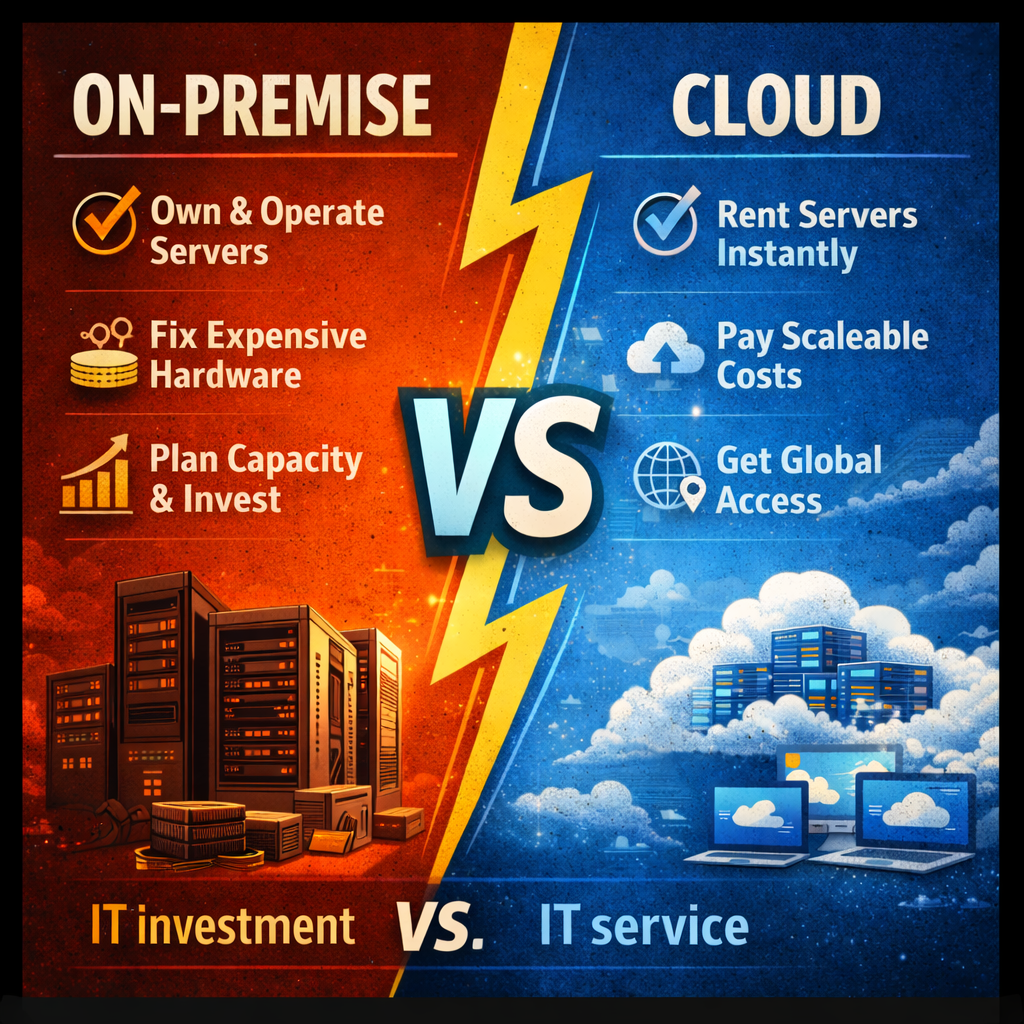
For a long time, IT was not a service, not a platform and not an ecosystem. It was a room. A room with air conditioning, raised floors, loud fans and blinking LEDs. IT meant hardware, racks, cables, power, backup tapes and administrators on night shifts. We did not call it on premise because there was no alternative. It was simply IT. Companies bought servers, installed them in their own data centers and operated them themselves. This was not an architectural choice. It was the only technically and economically viable way to run digital systems.
This model emerged in the 1980s and 1990s when companies began to digitize their core processes. ERP systems, databases, email servers, file servers and later web servers were all hosted internally because bandwidth was expensive, the internet was slow and unreliable, and external hosting was neither standardized nor trusted. Storing critical business data outside physical company control felt risky, almost irresponsible. Security meant being able to touch the server. Control meant it was inside your building.On premise meant full autonomy. Companies decided which hardware to use, which software to install, when to update, how to back up and how to secure systems. That autonomy came at a cost. IT became a capital investment. Servers were planned, purchased and depreciated over years. Capacity had to be estimated long before demand was known. If estimates were too conservative, performance suffered. If they were too generous, expensive machines sat idle. Scaling was not a button. It was a procurement process. Growth meant more servers, more racks, more power, more cooling.
At the same time, complexity increased. Systems became interconnected. Applications depended on each other. Failures spread further and faster. IT departments turned into operational centers keeping the business alive. A problem in the data center could suddenly impact sales, production and finance at the same time. Yet despite its growing importance, IT remained structurally heavy. Innovation meant carefully extending existing systems rather than rethinking them.Virtualization was the first structural shift. Around the early 2000s, companies started running multiple virtual machines on a single physical server. Hardware utilization improved. Migrations and backups became easier. The separation between application and hardware began. But the servers were still in the same building. Virtualization abstracted hardware, but it did not remove ownership.
Meanwhile the internet changed. Bandwidth became cheaper. Connections became stable. Global networks became reliable. Large-scale data centers emerged that were not built for single companies but as shared infrastructure. In the mid 2000s Amazon began offering its internal infrastructure as a service. AWS launched in 2006. Google and Microsoft followed. What initially looked like a technical experiment turned out to be a structural break.Around 2010 cloud computing became economically relevant. Companies realized they did not need to own infrastructure to use it. They could rent compute, storage and services on demand. Costs shifted from capital expenditure to operating expenditure. Scaling became elastic. Global reach became normal. New systems could be deployed in hours instead of months. IT moved from being a bottleneck to being an enabler.
The real transformation was cultural, not technical. Cloud meant giving up control to gain speed. Security was no longer defined by ownership but by processes, certifications and transparency. Responsibility shifted from internal administrators to platform providers. IT became less mechanical and more architectural. Engineers who once installed servers now designed systems.The advantages were obvious. Faster innovation. Lower entry barriers. Global availability. Startups gained access to resources once reserved for enterprises. Companies could expand without building infrastructure. IT became more accessible, more flexible and more dynamic.
But cloud also introduced new limits. Dependencies emerged. Platforms became gatekeepers. Complexity did not disappear, it moved. Instead of managing hardware, companies now manage contracts, APIs, billing models and shared responsibility frameworks. The simplicity is often an abstraction hiding a complex reality.This article is not an argument for or against the cloud. It is a reminder that today’s architecture grew out of a very physical past. Out of server rooms. Serial numbers. Backup tapes. Maintenance windows. The cloud is not the elimination of that world. It is its abstraction.In the next articles we will dive deeper into the cloud itself, its models, risks, power structures and its impact on security, economics and society. But before we can understand where IT is going, we need to understand where it came from. And it came from basements, not from the sky.