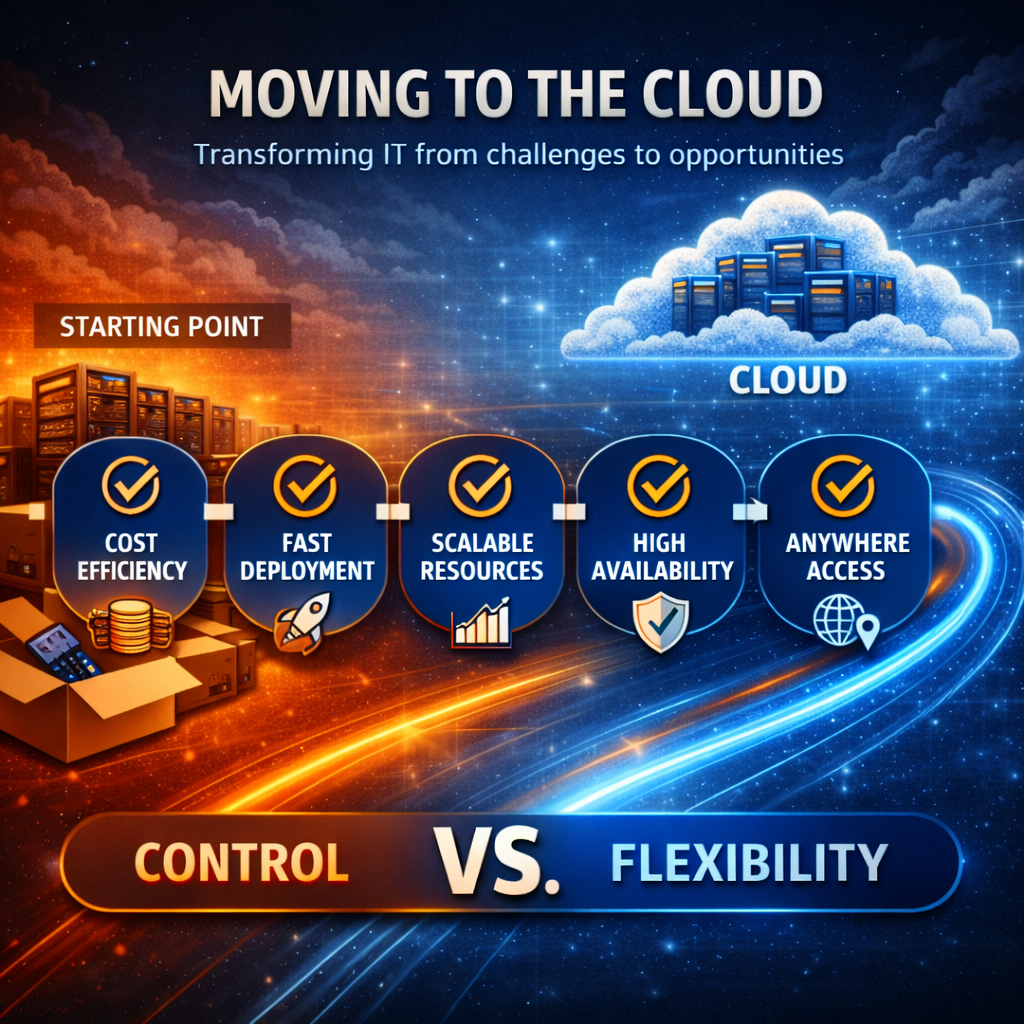

Companies did not move to the cloud because they wanted to be modern. They moved because the old model stopped working. Not suddenly, not dramatically, but slowly, quietly and very consistently. The cloud was not a trend. It was a logical response to a reality in which IT became more important and at the same time harder to manage. Looking back today, this was not a technological leap but a shift of responsibility, risk and complexity.It started with a very simple problem. IT became expensive. Not only to buy, but to operate. Servers had to be purchased long before anyone knew how much capacity would actually be needed. Companies planned for peak demand that might never come. And when it did come, it often came too late. Growth meant new hardware, new contracts, new delivery times, new projects. Months passed before systems became productive. In a world where business models changed within weeks, this became a structural disadvantage.
The cloud did not solve this problem. It removed it. No upfront investment. No planning based on assumptions. Compute power became something you could turn on when you needed it and turn off when you did not. IT shifted from being a bet to being a tool. That changed not only budgets but also mindsets. Projects could start without being approved, financed and built first. They could fail without leaving behind a data center no one needed anymore.Speed followed. In the past, IT was a limiting factor. Today, it is an accelerator. Systems can be deployed in minutes instead of quarters. Infrastructure follows the idea, not the other way around. Innovation became independent of ownership. Small teams suddenly had access to the same technical foundation as global enterprises. Not because they became richer, but because access became more important than possession.
Scalability was redefined as well. Before the cloud, growth meant stress. More users meant more load, more risk, more bottlenecks. Today, growth usually just means more consumption. Systems scale with demand without human intervention. And they shrink again when demand falls. This elasticity removed the fear of success. Companies no longer had to worry that growth would break their own systems.Availability was another factor. The famous story of the server in the basement is not a cliché. It was reality. And it was risky. Power outages, water damage, hardware failures, human mistakes. All of it could shut down operations. Cloud providers distributed systems across regions, countries and continents. Resilience became part of the architecture instead of something improvised afterwards. For many companies this was not a luxury. It was a necessity.
At the same time, software itself changed. It was no longer installed, it was used. SaaS meant applications no longer had to be maintained. They simply worked. Updates happened in the background. Security improvements were rolled out centrally. New features appeared without projects being launched. Collaboration became location independent. Teams worked globally without moving infrastructure. IT adapted to people, not the other way around.All of this shifted responsibility. Companies gave up a degree of control and gained stability, speed and focus. They no longer had to manage cooling, power, hardware, spare parts or patch cycles. They could focus on their actual business. The cloud was not a technical decision. It was an economic relief.
Of course this created new dependencies. New risks. New questions about control, security and sovereignty. But these questions did not arise because the cloud exists. They arose because the world became digital. The cloud made these dependencies visible. And therefore discussable.Companies did not move to the cloud because they wanted to. They moved because they had to. Because standing still became more expensive than changing. Because ownership became heavier than usage. Because control became slower than trust. The cloud was not a hype. It was a consequence.And that may be the most important point. The cloud is not a destination. It is a state. A reflection of a world in which speed matters more than ownership, access more than possession and adaptation more than perfection. Understanding that means understanding not only the cloud, but the direction in which companies are moving.