From the outside, an IT system house often looks like a place full of projects, tickets, firewalls, servers, cloud migrations and framed certificates on the walls. You see engineers, consultants, project managers and account managers moving between customer workshops, internal meetings and technical escalations. What you rarely see at first glance is the real heart of the company. The business model that quietly determines whether a system house grows, stagnates or disappears from the market. At Darkgate, we speak every day with managing directors, CEOs, department heads, team leads and architects from these companies. Not in theory, not from brochures, but from real conversations shaped by real customer projects. And in those conversations, one thing becomes very clear. A modern system house is far less of a pure technology company than many believe. It is a business model built on trust, margin, responsibility and long term relationships.
A modern IT system house does not primarily sell technology. It sells translation. It translates the complexity of IT vendors into a functioning reality at the end customer. On one side, you have the IT vendors. They build products such as firewalls, switches, cloud platforms, security solutions, storage systems and collaboration tools. They have sales organizations, marketing departments, partner programs and roadmaps, but in most cases they do not have deep access to the operational reality at the customer. They understand their product, but not the environment in which it must live. On the other side, you have the end customers. Mid sized enterprises, industrial companies, banks, energy providers, hospitals and logistics organizations. They have business processes, legacy systems, budgets, regulatory constraints, internal politics and often an IT department that is permanently overloaded. They know they must modernize, but they are not always sure how. And between these two worlds stands the system house.
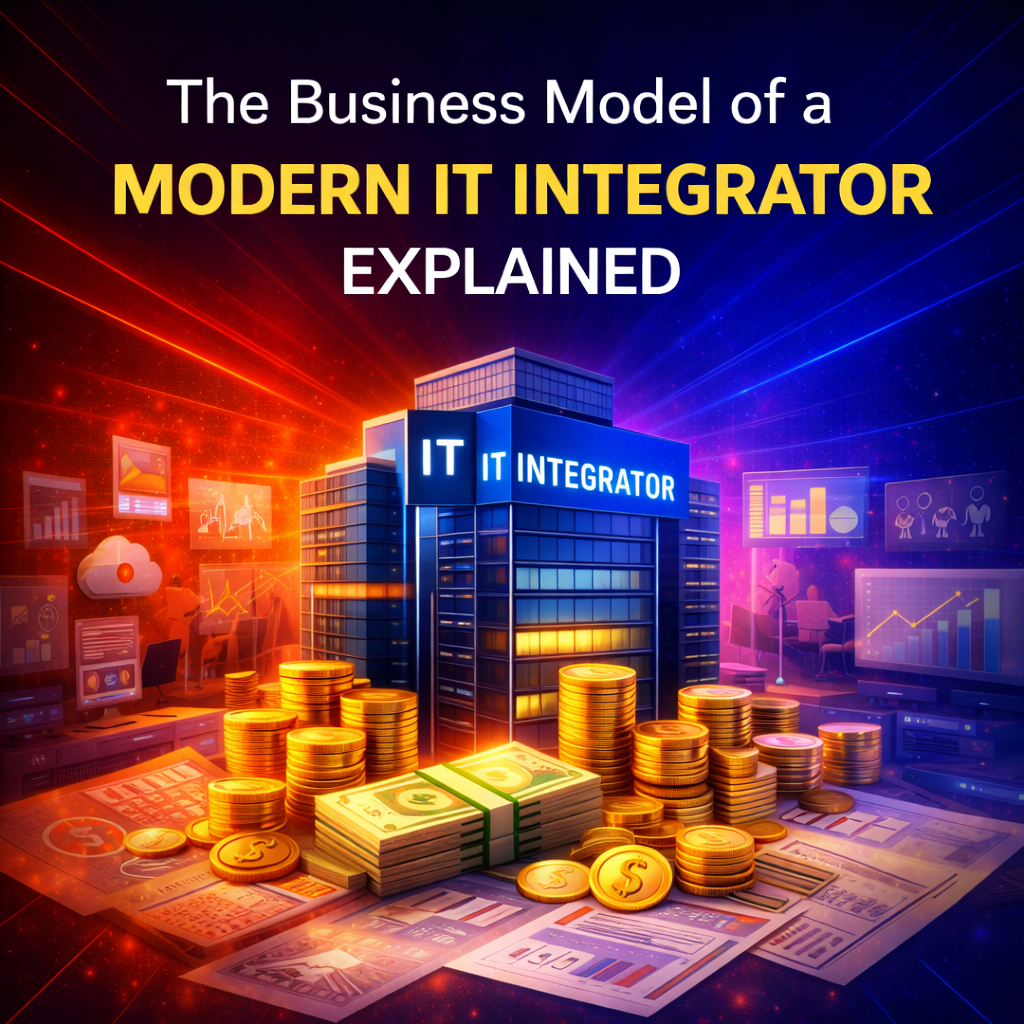
A system house makes money because it connects these worlds. It knows the vendor landscape and it knows the customer reality. It knows which product not only looks good on paper but actually runs stable in day to day operations. It knows which vendors provide real support and which ones mainly provide polished presentations. This knowledge is rarely written down. It is experience. And that experience is extremely valuable. Revenue is generated on several levels at the same time. There is the margin on hardware and software where vendors provide purchasing conditions and the system house resells these products to the end customer. The margin is often not spectacular, but it is consistent and in larger projects this quickly adds up.
Where it becomes truly interesting is in the services. Design, architecture, implementation, migration, operations and managed services are the real financial backbone. This is where margins are higher and where scalability becomes visible. A well structured managed service contract creates predictable monthly revenue over many years. For the system house, this is stability and planning security. For the customer, it means peace of mind. That is why managed services have become a strategic core for many system houses. On top of that comes the project business. Large migrations, new sites, security programs, cloud transformations and network modernizations bring significant short term revenue while at the same time creating the foundation for new managed service contracts. Projects and operations work together like interlocking gears.
One managing director of a larger system house once told us, half joking and half serious, that they do not sell firewalls but the ability for someone to sleep well at night. That sentence describes the business model perfectly. A modern system house sells reliability, security and orientation in an increasingly complex IT world. What is often underestimated is the role of people in this model. A system house lives and dies with its architects, consultants, account managers and service owners. These are not simply employees. They are the bridge between vendor and customer. They are trusted advisors. They sit in workshops, fill whiteboards and help to shape decisions that represent investments of millions.
This is where the bridge to career becomes visible. As an architect, consultant or account manager in a system house, you are closer to the real market than in almost any other IT environment. You see different vendors, different customers, different industries and different problems. You gain a breadth of experience that is difficult to achieve in a purely internal IT department. A team lead in one system house summarized it very clearly by saying that a good engineer learns more about real IT in three years in a system house than in ten years in an internal IT department. This diversity makes system houses extremely powerful career platforms. You do not only learn technology. You learn communication, advisory skills, economic thinking, prioritization and how to deal with decision makers on the customer side.
At the same time, very clear career paths emerge. From engineer to consultant, from consultant to architect, from architect to team lead or into sales as a technical account manager. Technology and business are not opposites in a system house. They naturally grow together. For the business model of the system house, this is critical. People who understand technology and can think economically. People who do not just solve problems at the customer, but build trust. That is why successful system houses invest heavily in training, certifications and internal development. Not out of idealism, but because their entire business model depends on it.
A modern system house is less a technical service provider and much more an orchestrator. It orchestrates vendors, technologies, customer requirements, projects and operational models. And it makes money because it can orchestrate this complexity better than any of the individual players involved. Once you understand this, you understand why these companies play such a central role in the market and why they are one of the most exciting environments for IT professionals who want more than tickets and routine operations. The business model of a system house is not a secret, but it is layered, experience driven and deeply people centric. And that is exactly what makes it so fascinating.