
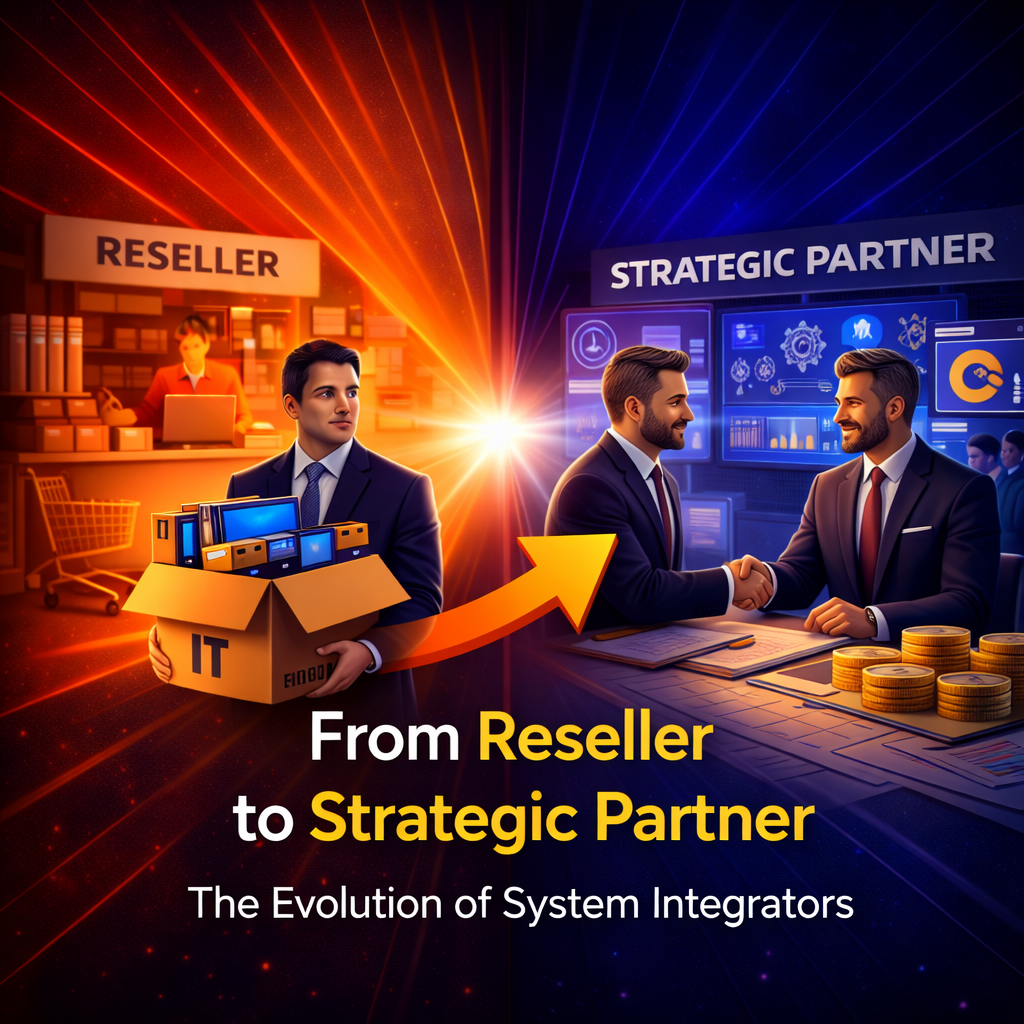
When you look at a modern IT integrator today, you see a company that moderates workshops, designs architectures, operates managed services, develops security concepts and acts as a trusted advisor at eye level with the executive management of its customers. This picture, however, did not always exist. The path from classic reseller to strategic partner has been a development over decades, shaped by technological shifts, changing vendor strategies, increasing IT complexity and growing expectations on the customer side. At Darkgate, we have already touched parts of this topic in our categories IT Vendors and IT Integrators. Now we want to take a closer look again, with a stronger focus on the business perspective and the historical evolution of this model.
In the early days of IT, the roles were relatively clear. Vendors developed hardware and software, customers bought these products and operated them internally. In between stood resellers whose primary role was simple: sell. Their value was availability, pricing and logistics. Consulting played only a minor role. The reseller was essentially an extended sales arm of the vendor.As networks, server landscapes and later virtualization became more common, this picture began to change. Customers were suddenly faced with the challenge of connecting more and more systems. Different vendors had to work together, new technologies had to be integrated into existing environments. It was no longer enough to simply deliver products. There was a growing need for planning, design and technical implementation. This was the birth phase of the system integrator.
The integrator was no longer just a seller, but a technical implementer. They combined components from various vendors into a working overall solution. This phase was crucial because it laid the foundation for today’s business model. Knowledge about how technologies work together became the key value. Experience became more important than pure product knowledge.With the rise of virtualization, storage networks, advanced security solutions and later cloud platforms, complexity increased exponentially. Customers could no longer keep track of this variety on their own. At the same time, vendors changed their strategies. They expanded partner programs, trained integrators, certified them and shifted more and more responsibility into the channel. The integrator became the extended technical arm of the vendor at the customer site.
During this phase, a new self understanding emerged. The system integrator was no longer only a project implementer, but an advisor. They spoke with IT managers, security officers and later also with business departments and executive leadership. They did not only help with implementation, but with decision making. Technology became a tool to achieve business goals. This was the point where the transition from technical service provider to strategic partner truly began.
A managing director of a well established integrator once described this change very precisely. In the past, we asked what hardware was needed. Today, we ask what problem the company wants to solve. This shift in perspective describes the evolution perfectly.At the same time, a second important pillar developed. Operations. With managed services, the focus moved from one time projects to long term partnerships. Integrators took responsibility for the ongoing operation of networks, security environments, cloud infrastructures and collaboration platforms. Individual projects turned into lasting relationships. One time revenue turned into predictable recurring income.
For the business model, this was a turning point. The integrator was now permanently present at the customer. They knew the environment better than anyone else. They were automatically included in strategic discussions when new sites were planned, new security requirements emerged or cloud strategies were discussed. Trust became a central economic factor.
With increasing regulation through data protection, compliance requirements, industry specific regulations and cybersecurity, the role of the integrator grew even further. Customers needed orientation in a jungle of regulations, technologies and risks. The integrator became a navigator. They explained, prioritized and translated regulatory requirements into technical measures.Today, in our conversations at Darkgate with managing directors and architects, we see that modern IT integrators in many cases are closer to the business strategy of their customers than the vendors themselves. They sit at the table when investments are discussed. They evaluate risks, feasibility and economic impact. They connect technology, business and governance.
This development has also changed the internal structure of integrators significantly. Where sales and technical departments used to be clearly separated, hybrid roles have emerged. Technical account managers, architects with commercial responsibility, consultants with business understanding. Career paths no longer run only along technical expertise, but towards advisory roles, strategy and customer responsibility.
For professionals, this offers enormous opportunities. Working in an integrator means learning not only products and technologies, but also markets, business models and decision making processes on the customer side. You experience how investments are evaluated, how budgets are planned and how IT decisions are directly linked to business objectives. This type of exposure is rarely available in such concentrated form in other environments.
The modern picture of the integrator is therefore that of an orchestrator. It orchestrates vendors, technologies, customer requirements, projects, operations and strategic development. It makes money not only by selling products, but by leveraging knowledge, experience, trust and long term relationships.Looking at this historical development, it becomes clear that the term reseller no longer does justice to what an integrator represents today. The reseller was replaceable. The modern IT integrator is not. It is deeply embedded in the customer environment, understands the history of the infrastructure, the specifics of the organization and the strategic goals. It is a partner in the truest sense of the word.This evolution from trader to strategic partner is not accidental. It is the logical response to an increasingly complex IT world. And it explains why IT integrators today are one of the most important pillars in the entire IT ecosystem, positioned between vendors and end customers in a role that goes far beyond technology.





