
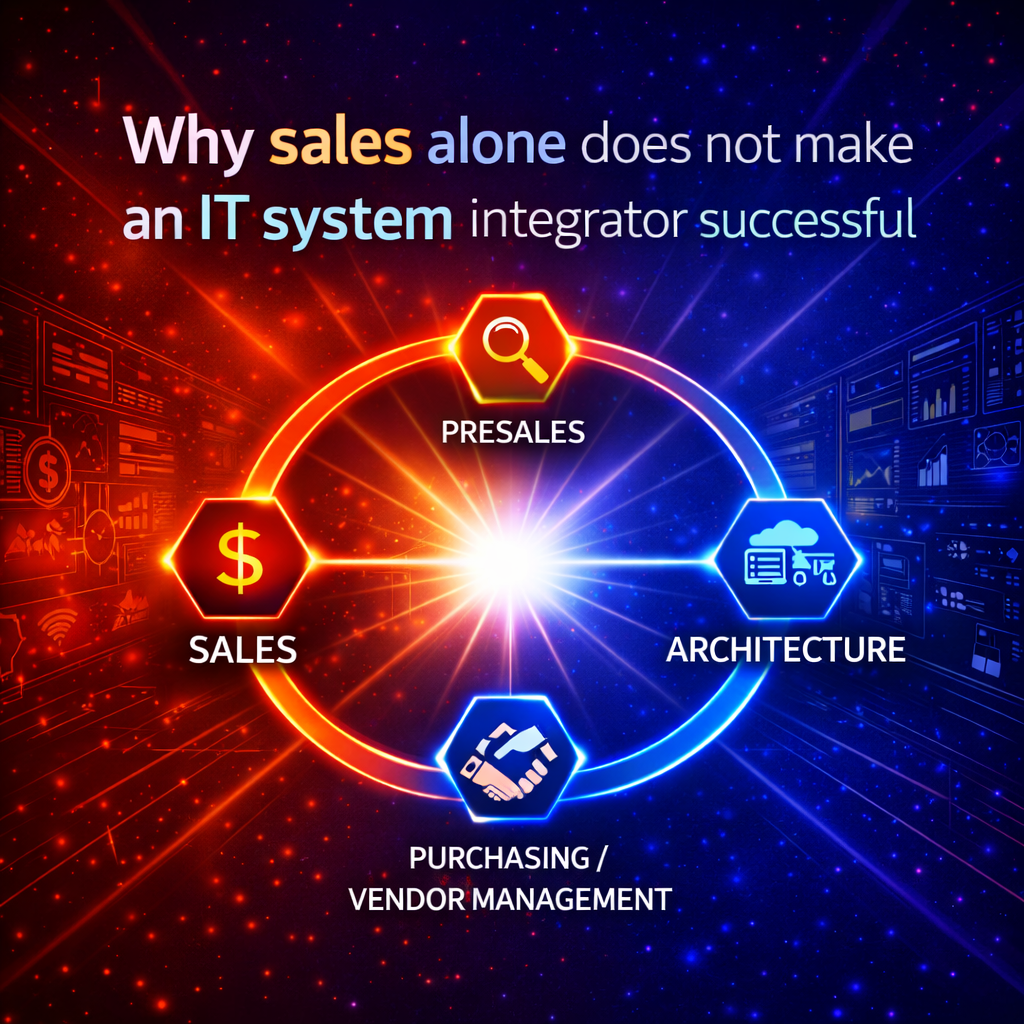
From the outside, the success formula of an IT system integrator appears simple. You need a strong sales team, capable account managers, people who sit with customers, identify demand, win projects and generate revenue. If revenue grows, everything seems to be working. But when you look at the internal economic reality of a system integrator, it becomes clear that revenue alone says surprisingly little about whether the company is truly successful. Because between winning a project and running a profitable project lies a significant gap, and inside this gap one of the most common misunderstandings in many system houses appears: the overestimation of sales when it does not work in close alignment with presales, architecture and purchasing.
In many organizations, sales is the most visible function. Sales brings in projects, builds pipeline and is measured, managed and incentivized accordingly. That makes sense, because without sales there are no contracts. But this is also where the misconception begins. Sales can win projects that later become economically painful for the company. Sales can make promises that are technically possible but operationally expensive. Sales can close deals that look impressive in terms of revenue but leave little or no margin once delivery begins. And often, sales is not even aware of it, because sales is focused on revenue while profitability is shaped somewhere else entirely. The key point is this: sales decides that something is sold, presales and architecture decide what is sold, and purchasing decides under which conditions it can be delivered profitably.
When these functions do not work together closely, you get a system integrator that wins many projects but constantly struggles internally. Projects run over budget, margins shrink, delivery teams are overloaded, customers become dissatisfied, and management starts wondering why, despite full order books, economic success feels fragile. A strong sales team without strong presales is like an engine without a transmission. It produces power, but the power is not transferred efficiently. Presales sees projects from a completely different perspective. While sales sees opportunity, presales sees complexity. While sales sees potential revenue, presales sees potential risks. While sales wants to close, presales is already thinking about how the project will be executed months later. During the offer phase, critical decisions are made: which architecture is proposed, which vendors are positioned, how the scope is defined and how realistic the delivery will be. This is where margin is either built or destroyed.
Many system integrators are organized in a way where presales is treated as a technical support function for sales. In reality, presales should be seen as a strategic economic function because it protects the company from economically problematic projects long before contracts are signed. This dynamic becomes even more visible when you consider the role of architecture. Architects do not only think technically, they think structurally. They understand how solutions fit into existing environments, where long-term complexity arises and where future problems are already predictable. When architecture is involved too late, a gap appears between what was sold and what can realistically and efficiently be delivered, and this gap becomes expensive. Very expensive.
Then there is a function that is often almost invisible but has enormous economic impact: purchasing and vendor management. This is where buying conditions are negotiated, deal registrations are handled and vendor relationships are maintained. Two or three percent better purchasing conditions can mean hundreds of thousands of euros in additional profit over the course of a year, but this only works when sales and presales position the right vendors and solutions from the beginning. When sales operates without this alignment, economic potential is simply wasted. The result of this missing coordination is visible in many system houses that grow quickly but still struggle with margin. They have many projects but little time to execute them properly. They are constantly hiring because delivery is under pressure. They wonder why projects take longer than planned and why profitability does not match revenue growth. The root cause is rarely found in delivery. It is almost always found in the offer phase.
Many sales teams do not realize this because they operate in a logic that is focused on revenue. They are measured by closed deals, not by the profitability of those deals months later. Their success is defined by the contract signature, not by the smooth execution of the project. Presales, architecture and purchasing operate in a different logic. They think in terms of feasibility, structure, efficiency and margin. Successful IT system integrators have understood that these functions must not be hierarchical but equal. Sales must not operate without presales, architecture must be involved early and purchasing must be strategically integrated into the offer process. Where this alignment exists, profitable projects are created. Where it does not, problems arise that only become visible long after the deal is signed.
An IT system integrator is not a pure sales machine. It is an economic system in which several roles must interact perfectly for revenue to become profit. Sales opens the door, presales defines what enters, architecture ensures it can be built properly, and purchasing ensures it can be built profitably. Only the combination of these roles makes a system integrator truly successful, not revenue alone.