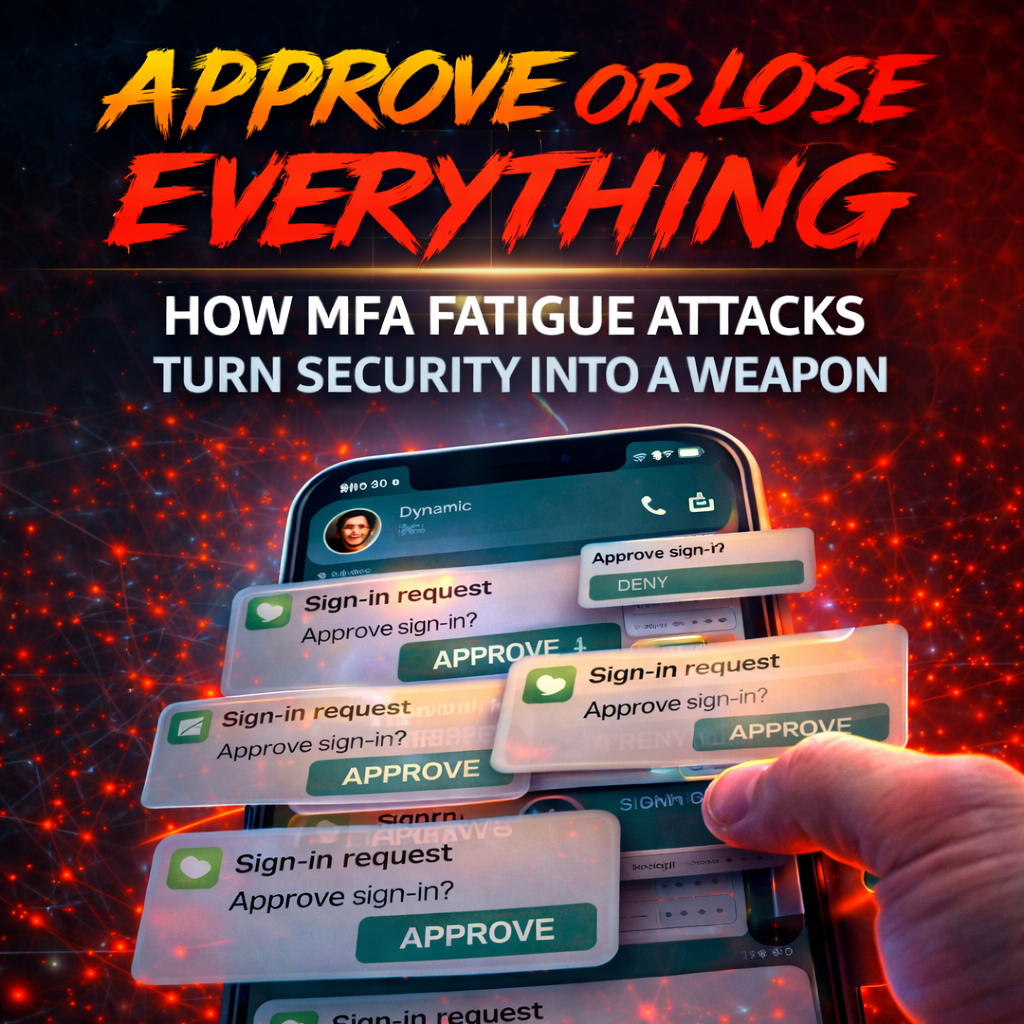
It often starts quietly. No visible breach, no sophisticated malware, no dramatic system failure. Just a simple push notification on a smartphone: “Sign-in request – Approve?” Then another. And another. Within minutes, a security feature designed to protect accounts—Multi-Factor Authentication (MFA)—begins to work against the user.
This is the essence of MFA Fatigue Attacks, also known as Push Bombing. Instead of bypassing security systems directly, attackers exploit something far more vulnerable: human behavior.
The mechanics are deceptively simple. Attackers already possess valid credentials—typically obtained through phishing, data breaches, or credential stuffing. MFA remains the final barrier. Rather than attempting to break it, they repeatedly trigger login attempts, each one generating a push notification on the victim’s device.
The result is a flood.
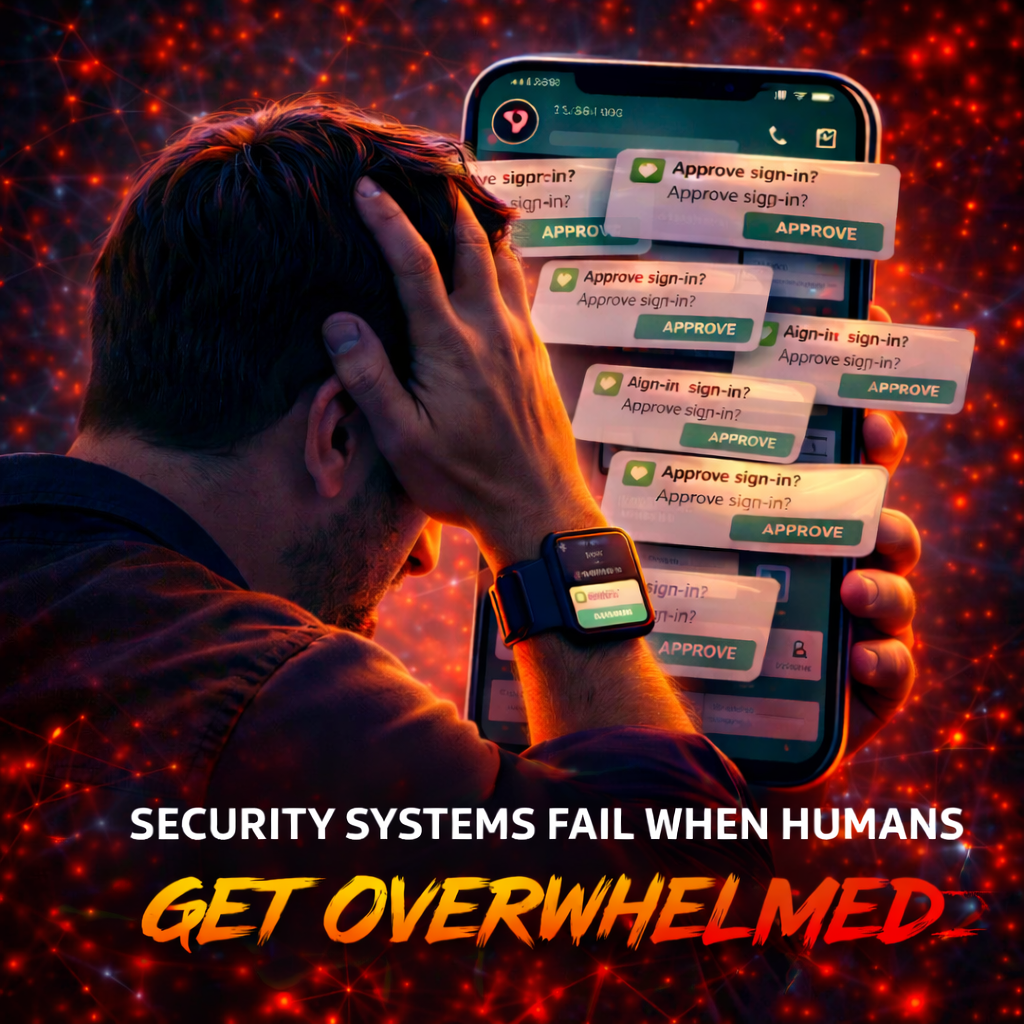
Notifications stack up. The phone vibrates constantly. The user is pulled out of their workflow and into a state of confusion. What initially appears suspicious quickly becomes disruptive. And disruption, when sustained, turns into pressure.
That pressure is the attack.
Within minutes, perception shifts. The user is no longer analyzing the situation—they are reacting to it. The goal becomes simple: make it stop. And in that moment, a single tap on “Approve” feels like relief. The noise ends. The interruptions disappear.
At the same time, the attacker gains access.
The critical detail: the user often believes they are resolving a technical issue. In reality, they are actively authorizing the breach.
The attack becomes significantly more effective when combined with social engineering. While the push requests are ongoing, the victim receives a phone call. Calm, professional, credible.
“Hello, this is IT support. We’ve detected unusual activity on your account. You may receive multiple login requests—please approve one so we can secure your access.”
Now the attack operates on two levels. Technical pressure from the repeated MFA prompts, and psychological pressure from perceived authority. The user is no longer questioning the request—they are cooperating.
What makes MFA Fatigue Attacks particularly dangerous is that they exploit a core assumption of modern security architecture: that the user will make a conscious, informed decision.
This assumption does not hold under stress.
In a world saturated with notifications—emails, apps, messages—users are conditioned to respond quickly, not critically. MFA prompts become just another interaction to process. And when those interactions are weaponized, speed becomes a liability.
The irony is clear. A system designed to increase security becomes a vulnerability when it is overused, misunderstood, or manipulated.
From a technical standpoint, the attack is trivial. No zero-day exploit, no advanced malware, no complex infrastructure. Often, a simple script is enough to trigger repeated authentication attempts. The sophistication lies not in the code, but in the understanding of human behavior.
And that is what makes it scalable.
These attacks are not hypothetical. They have been used against major organizations, including technology companies and financial institutions. Even environments with strong security postures are not immune.
Because MFA is not purely technical—it is interactive.
Once that interaction is compromised, the system itself becomes unreliable.
The risk is further amplified in high-pressure environments. Support teams, operations staff, and employees with elevated access often operate under time constraints. In such conditions, an unexpected MFA request can easily be misinterpreted as part of a legitimate process.
A single approval is enough.
From there, attackers can:
- Access sensitive systems
- Extract data
- Move laterally across networks
- Establish persistence
- Or prepare further attacks
Perhaps the most concerning aspect is visibility. From a system perspective, everything appears legitimate. The login was successful. MFA was completed. No obvious anomaly is detected.
This makes traditional detection methods far less effective.
Defending against MFA Fatigue Attacks requires more than enabling MFA—it requires rethinking how it is implemented.
Modern approaches include:
- Number Matching, requiring users to confirm a code instead of simply approving
- Context-aware authentication, factoring in location, device, and behavior
- Rate limiting, preventing excessive authentication attempts
- And most importantly: user awareness
Because at its core, this is a behavioral attack.
Users must understand that an unexpected MFA prompt is not routine—it is a signal. A warning. A potential breach attempt.
The most important rule is simple:
If you did not initiate the request, do not approve it. Ever.
MFA Fatigue Attacks highlight a broader shift in cybersecurity. The focus is no longer solely on systems and software, but on perception, timing, and human decision-making.
Attackers are not just hacking technology.
They are manipulating interaction.
And in that environment, security is no longer defined by what a system can do-but by what a user decides in a single moment.
Because sometimes, the difference between safety and compromise is just one tap.
Approve. Or lose everything.